
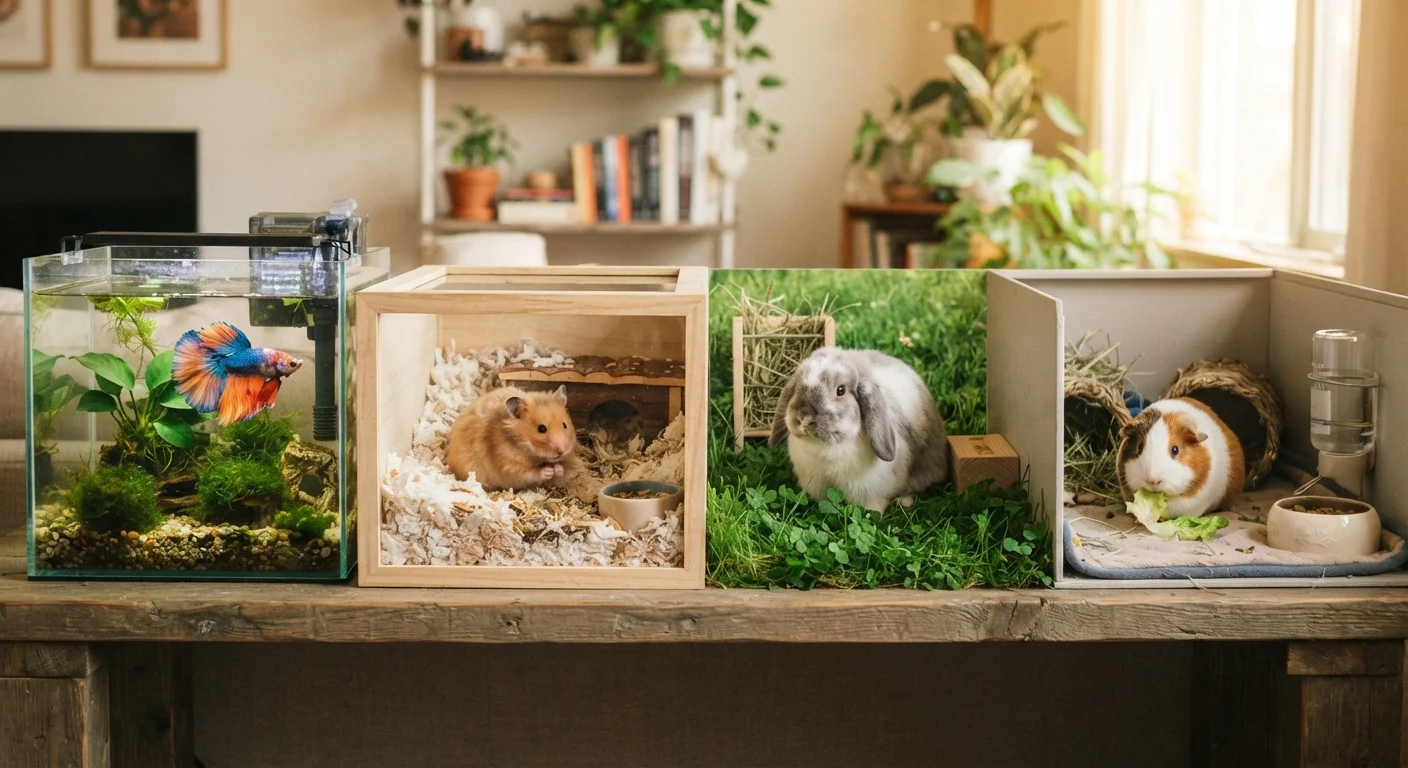
Why the Right Match Matters More Than Popularity
Small pets are often marketed as easy starter animals, but that framing can set both owners and animals up for disappointment. Each species has behavioral needs, diet requirements, and social structures that don't disappear just because the animal fits in a small enclosure. Before choosing based on appearance or cost, it's worth comparing what each animal actually requires against what your lifestyle actually looks like.
This isn't about finding the "easiest" pet — it's about finding the best fit. Underestimating a pet's needs is one of the leading reasons small animals are rehomed or experience chronic stress. Understanding how small pets experience stress can help you recognize problems early, but preventing mismatch from the start is far better.
| Fish | Hamster | Rabbit | Guinea Pig | |
|---|---|---|---|---|
| Typical lifespan | 2–5 years (species-dependent) | 2–3 years | 8–12 years | 4–7 years |
| Daily time commitment | Low (tank checks, feeding) | Moderate (evening handling) | High (free-roaming, bonding) | Moderate-high (interaction, fresh food) |
| Social needs | None (observational only) | Solitary; minimal companionship | High; bonds with owners | High; needs a companion |
| Space requirement | Tank footprint only | Large enclosure with deep bedding | Large pen plus roam space | Spacious enclosure for pairs |
| Handling suitability | Not handleable | Moderate; patience needed | Varies; trust-building required | Generally tolerates gentle handling |
| Diet complexity | Species-specific pellets/flakes | Seed mix, fresh veg, protein | Unlimited hay, pellets, greens | Vitamin C-rich fresh veg daily |
| Vet care availability | Limited exotics vets needed | Exotic-animal vet required | Exotic-animal vet required | Exotic-animal vet required |
| Noise level | Silent | Wheel noise at night | Quiet (occasional thumping) | Vocal; wheeking and purring |
Fish: Low-Touch, High-Consistency
Fish are often chosen for their calm visual presence and perceived simplicity, but a healthy aquarium demands reliable routine. Water temperature, pH, filtration, and feeding schedules must be maintained consistently — skipping tank maintenance leads to rapid water quality decline, which is harmful to fish health.
Fish don't form bonds with owners the way mammals do, and they cannot be handled. They're well-suited to individuals who appreciate observational engagement and are willing to invest in proper equipment upfront. A basic freshwater setup is less demanding than a marine tank, but both require regular attention. If your schedule is irregular or you travel frequently, a reliable care plan (and sometimes an automatic feeder) is essential.
Start With a Freshwater Setup
If you're new to fishkeeping, a cycled freshwater aquarium is more forgiving than a saltwater or planted tank. Research the nitrogen cycle before adding fish — a properly cycled tank maintains stable water chemistry and is one of the most important factors in fish health. Many local aquarium clubs offer free advice and even tank-cycling assistance.
Hamsters: Independent, Nocturnal, and Often Misunderstood
Hamsters are frequently marketed toward children, but their nocturnal nature means peak activity happens in the evening and overnight — often not when young children are awake and patient. For adults with evening availability, however, hamsters can be genuinely rewarding. They are typically solitary animals (especially Syrian hamsters) and should not be housed in pairs, which makes their social needs simpler than other small mammals.
What many owners underestimate is the space requirement. Hamsters need large enclosures with deep bedding for burrowing and wheels with a minimum diameter appropriate for their species. Cramped setups lead to stereotypic behavior (repetitive, stress-driven movements) and poor welfare. For a full picture of what a well-set-up hamster life looks like, see what hamsters actually need to thrive.
Rabbits: Social, Smart, and a Long Commitment
Rabbits live 8–12 years on average, making them a longer commitment than many people expect. They are highly social, curious animals that need daily out-of-cage time — a minimum of several hours to roam safely in a bunny-proofed area. Keeping a rabbit permanently confined to a hutch is widely considered insufficient for their welfare by rabbit welfare organizations.
Rabbits also require a hay-based diet (unlimited timothy hay is the foundation), regular veterinary care from an exotic-animal specialist, and mental enrichment to prevent boredom-related behaviors like destructive chewing. For a grounded look at what ownership involves day-to-day, rabbits as pets: the honest trade-offs offers a balanced perspective. Rabbits can be litter-trained and, when properly socialized, are affectionate companions — but they reward owners who invest real time.
Guinea Pigs: Social by Nature, Best in Pairs
Guinea pigs are among the most communicative small pets — they vocalize, express body language clearly, and form genuine bonds with both their cage mates and their owners. Unlike hamsters, guinea pigs are highly social and typically do best when housed with at least one companion of the same species. A solitary guinea pig requires significantly more human interaction to compensate.
Their diet must include fresh vegetables and a reliable source of vitamin C, since guinea pigs (like humans) cannot synthesize it internally. Leafy greens, bell peppers, and appropriate pellets form the core of a healthy diet. Understanding their communication — popcorning when happy, teeth chattering when annoyed — makes the relationship much richer. Guinea pig body language is worth learning before bringing one home.
All four animals benefit from enrichment that goes beyond their enclosure basics. Practical ideas for each species are covered in our guide to enrichment ideas for small pets. And regardless of which animal you choose, sourcing qualified veterinary care matters — what to look for in a small-animal veterinarian explains how to find a provider with genuine exotic-animal experience.
This article is for general informational purposes only and is not a substitute for professional veterinary advice. Always consult a qualified exotic-animal veterinarian for guidance specific to your pet's health and care needs.