
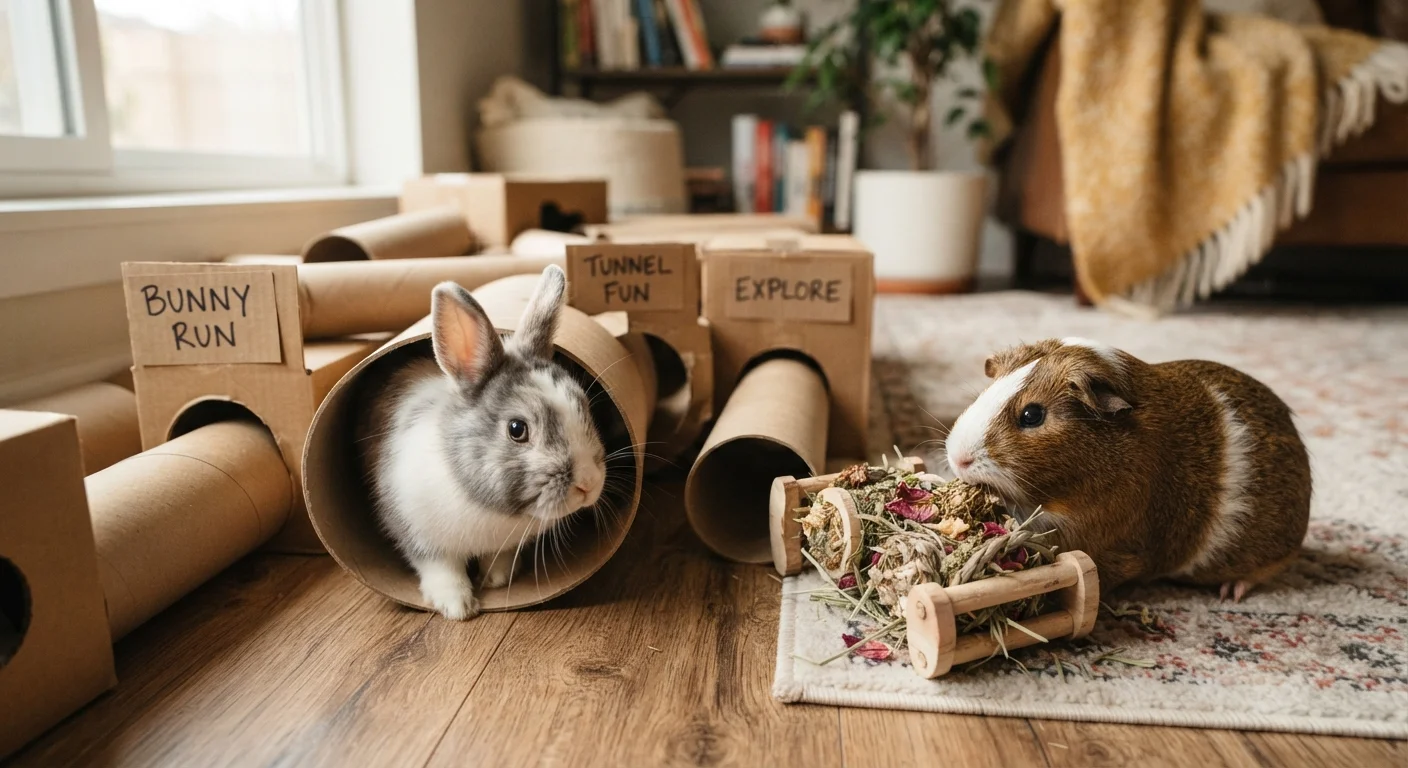
Why Enrichment Matters for Small Pets
Most small pets spend the majority of their lives in a relatively confined space. Without intentional enrichment, that confinement can lead to stress, boredom-driven behaviors like bar-chewing or over-grooming, and even physical health problems. The good news: you don't need elaborate setups or expensive equipment to make a meaningful difference.
Mental stimulation is something we naturally discuss for dogs and cats — see our guides on keeping dogs mentally stimulated indoors and enriching a solo cat's day — but rabbits, guinea pigs, hamsters, and even fish benefit from the same principle. Their brains are wired to explore, forage, hide, and problem-solve. When that wiring goes unused, behavioral problems follow.
If you're still deciding which small pet fits your lifestyle, our comparison guide on matching small pets to your lifestyle can help you choose wisely before setting up an enrichment plan.
Start simple, then build complexity
If your pet is new to enrichment, introduce one change at a time. Overwhelming an anxious animal with too many new objects at once can backfire. Watch how they respond to each addition over a day or two before layering in more options.
Eight Enrichment Ideas Worth Trying
Foraging setups for rabbits and guinea pigs
In the wild, rabbits and guinea pigs spend a significant portion of their day searching for food. Replicating that search behavior indoors reduces boredom and satisfies instinctual drives. Scatter leafy greens, herbs, or small pieces of hay-based treats around their enclosure or inside paper bags, cardboard rolls, or loosely woven hay balls. This turns mealtime into an activity rather than a passive event.
For rabbits specifically, a well-designed living space sets the foundation — our guide on setting up a rabbit-safe indoor space covers how to create a room where foraging and exploration can happen safely.
Scattering food rather than bowl-feeding turns mealtime into genuine mental exercise.
Cardboard tunnels and digging boxes
Both rabbits and guinea pigs have strong instincts to explore tight spaces and, in some cases, dig. A simple cardboard box filled with shredded paper, compressed hay, or chemical-free soil gives them a sanctioned outlet for these behaviors. Cardboard tubes from paper towels work as impromptu tunnels. Rotate between different configurations — a straight tunnel one week, a branching maze the next — to maintain novelty.
Make sure all cardboard is free of tape, staples, ink, or plastic coatings. Plain, unprinted cardboard is the safest option.
A simple cardboard maze costs almost nothing and can occupy a rabbit for extended periods.
Exercise wheels and running options for hamsters
Hamsters are built for distance. In their natural habitat, they may cover several miles in a single night. A solid-surface (not wire-rung) exercise wheel sized appropriately for your hamster's species is widely considered one of the most important welfare items in their habitat. Syrian hamsters generally need a larger diameter wheel than dwarf species to maintain a healthy back posture while running.
Supplement wheel time with occasional supervised free-roaming in a secured, hamster-proofed space or an appropriately sized exercise ball used for short, supervised sessions only.
A properly sized solid-surface wheel addresses one of the hamster's most fundamental biological needs.
Puzzle feeders and treat-dispensing toys
Puzzle feeders require animals to manipulate an object to release food, which engages problem-solving circuits and slows down eating. For guinea pigs and rabbits, this can be as simple as a wooden skewer threaded with leafy greens, requiring them to strip pieces off. For hamsters, small wooden puzzle boxes designed for rodents provide similar challenge. Introduce puzzle feeders gradually — if your pet becomes frustrated and disengages, simplify the design before increasing difficulty.
Puzzle feeders slow eating and activate problem-solving instincts simultaneously.
Environmental variation for fish
Fish enrichment is less intuitive but genuinely impactful. Research in aquatic animal welfare suggests that environmental complexity — including varied hiding spots, plants (live or silk), and substrate textures — supports more natural behavioral repertoires in captive fish. For bettas and other curious species, rearranging tank decor periodically or adding a mirror for brief, supervised periods (no more than a minute or two) can prompt exploratory behavior. Avoid overusing the mirror, as prolonged exposure to their own reflection can cause stress.
Feeding variety also counts: alternating between flakes, frozen, or freeze-dried foods (species-appropriate) introduces sensory novelty at mealtimes.
Rearranging tank decor periodically gives fish new territory to investigate and map.
Social pairing and species-appropriate companionship
Guinea pigs are highly social animals; many animal welfare organizations recommend housing them in same-sex pairs or small groups rather than alone. A companion animal provides ongoing social stimulation that no toy or tunnel can fully replicate. Rabbits can also benefit from bonded companionship, though introductions require patience and a careful bonding process.
Hamsters, by contrast, are generally solitary and may fight if housed together — know your species before assuming companionship is enriching rather than stressful.
For guinea pigs, a bonded companion provides enrichment that no object or activity can replace.
Chewing materials and dental enrichment
Rabbits, guinea pigs, and hamsters all have continuously growing teeth that require regular wear. Providing safe, appropriate chewing materials isn't optional — it's a health necessity that doubles as enrichment. Untreated wooden chews, dried herbs tied into small bundles, woven grass mats, and plain hay-based items all work well. Avoid anything treated with paint, varnish, glue, or synthetic dyes.
Hay itself — particularly for rabbits and guinea pigs — should make up the bulk of the diet and provides constant low-level chewing activity throughout the day.
Chewing materials serve both dental health and behavioral enrichment — making them doubly essential.
Scheduled interaction and handling
Enrichment isn't only environmental — it's relational. Gentle, consistent handling builds trust, reduces fear responses, and provides social stimulation for pets who have been acclimated to human contact. Keep handling sessions short and calm, especially early on. Let the animal set the pace; forcing interaction typically undermines trust rather than building it.
Even quiet time near the enclosure — talking softly, moving predictably, or reading nearby — can help prey-animal species learn that your presence is safe rather than threatening.
Calm, regular interaction builds the kind of trust that makes all other enrichment more effective.
Species differences matter significantly
What works well for a rabbit may be completely irrelevant — or even stressful — for a hamster. Always research the specific behavioral and physiological needs of your pet's species before introducing new enrichment. When in doubt, consult an exotic-animal veterinarian who works regularly with your type of pet.
Making Enrichment a Consistent Habit
The most effective enrichment isn't a one-time project — it's an ongoing practice. Rotate toys and foraging setups every few days so your pet encounters something new regularly. Observe how your pet responds: a guinea pig who suddenly ignores a toy they once loved may simply be bored of it, or may be signaling something else. Learning to read those cues matters — our article on guinea pig body language is a useful companion resource.
If you notice persistent lethargy, repetitive behaviors, or changes in appetite despite enrichment efforts, consult a qualified exotic-animal veterinarian. Not every clinic is equipped to assess small-animal needs — our guide on choosing a small-animal vet explains what to look for. Enrichment supports wellbeing, but it doesn't replace professional veterinary care when something seems off.
This article is for general informational and educational purposes only. It is not a substitute for professional veterinary advice. If you have concerns about your pet's health or behavior, consult a licensed exotic-animal veterinarian.