
Why Mental Stimulation Matters for Solo Cats
Cats living alone don't have a feline companion to chase, wrestle with, or groom. That social and physical gap adds up quietly. Without enough mental engagement, a single cat may start displaying signs of stress — excessive vocalizing, destructive scratching, over-grooming, or withdrawal. These aren't personality quirks; they're often behavioral responses to an understimulating environment.
The good news is that enriching a solo cat's day doesn't require major expense or constant attention from you. It requires intentional setup and a few consistent habits. The strategies below are grounded in what veterinary behaviorists and animal welfare organizations generally recommend for indoor cats.
If your cat already shows signs of stress-related hiding or withdrawal, our guide on why cats hide when stressed offers helpful context alongside these enrichment ideas.
Start with one or two changes at a time
Introducing too many enrichment changes at once can actually overwhelm some cats, especially anxious ones. Pick one or two strategies from this list and give your cat a week to adjust before adding more. Gradual changes tend to stick better — for your cat and for your own routine.
8 Practical Ways to Keep Your Solo Cat Engaged
Use a puzzle feeder instead of a bowl
Cats are natural hunters, and eating from a flat bowl gives them zero cognitive challenge. Puzzle feeders — containers that require pawing, rolling, or nudging to release kibble — tap into that foraging instinct and slow down eating at the same time. Start with a simple level-one puzzle and increase difficulty as your cat gets comfortable. Even a muffin tin covered loosely with a cloth works as a low-cost alternative.
Puzzle feeders turn mealtime into a mentally engaging hunting exercise.
Create reliable window access with a view
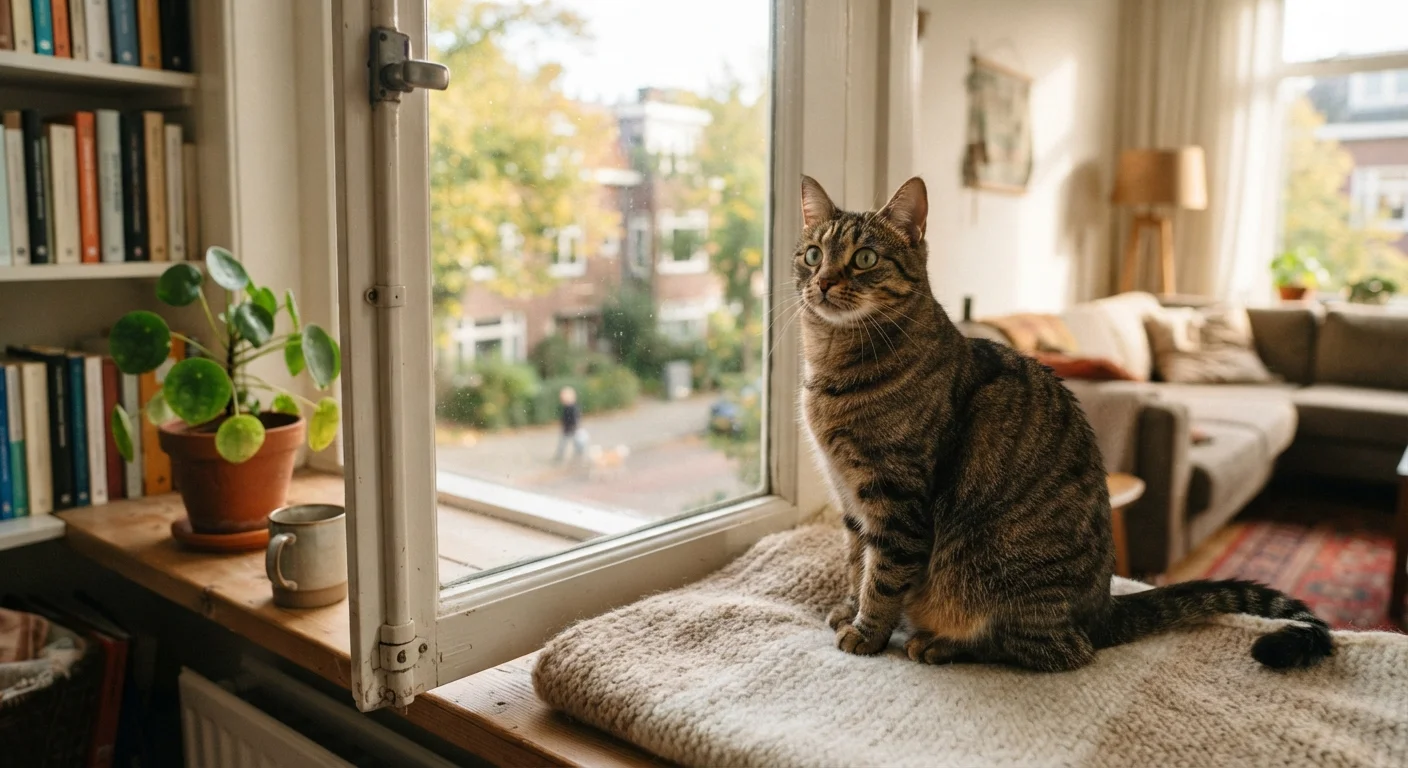
A window perch is one of the most effective and passive enrichment tools available. Cats are highly visual and will spend significant time watching birds, squirrels, and passing activity outside. Position a stable perch or cleared shelf at window height where your cat can safely sit. Adding a bird feeder just outside the glass essentially gives your cat a live-action nature channel for free.
A window perch with an outdoor view provides hours of passive mental engagement.
Rotate toys on a regular schedule
Cats habituate to the same toys quickly — what was exciting on Monday may be completely ignored by Friday. Rotating a small collection of toys every two to three days keeps novelty alive. Store some out of sight and reintroduce them after a week or two. You don't need more toys; you need better management of the ones you already have.
Rotating toys every few days restores novelty and reignites your cat's curiosity.
Schedule short interactive play sessions daily
Wand toys, laser pointers (always followed by a physical toy to 'catch'), and feather teasers engage a cat's predatory sequence — stalk, chase, pounce, catch. Aim for two sessions of five to ten minutes each, ideally once in the morning and once in the evening when cats are naturally more active. Consistency matters more than duration; daily short sessions outperform occasional long ones.
Two short daily play sessions are more beneficial than one infrequent long one.
Introduce vertical space and climbing options
Cats feel more secure — and more stimulated — when they can survey their environment from above. Cat trees, wall-mounted shelves, or cleared bookcase tops all serve this purpose. Vertical space also gives a solo cat more territory to patrol mentally, which can meaningfully reduce restlessness. If space is limited, even a single stable cat tree near a window provides both climbing enrichment and a lookout post.
Vertical climbing space gives cats more territory to explore and survey safely.
Offer ambient sound or cat-specific video content
Leaving a radio or TV on low volume can reduce the stark silence of an empty apartment, which some cats find unsettling. There is also a growing range of video content specifically designed for cats — bird feeders, fish tanks, and small animals filmed in high resolution. While research on whether cats truly 'watch' video is still limited, anecdotal evidence from veterinary behaviorists suggests some cats do respond to movement on screen and show reduced restlessness.
Ambient sound or cat-specific video can reduce the stress of daytime silence.
Try scent enrichment inside the home
Scent is one of a cat's primary senses, and introducing new smells is a low-effort way to stimulate curiosity. Safe options include dried catnip, silver vine, or valerian (note that not all cats respond to catnip — it's genetically determined). You can also rub a cloth on outdoor surfaces and bring it inside for your cat to investigate. Always introduce new scents gradually and monitor for any signs of overstimulation or discomfort.
Safe scent introductions engage a cat's most powerful sense with minimal effort.
Use cardboard boxes and paper bags as exploration tools
It may sound too simple, but cats are naturally drawn to enclosed spaces — they provide a sense of security and trigger investigative behavior. A plain cardboard box left on the floor, or a paper bag with handles removed (for safety), becomes an instant enrichment tool. Rotate these in and out, cut different-sized holes, or stack them loosely to add variety. This costs nothing and works reliably for most cats.
Cardboard boxes trigger natural investigation instincts at zero cost.
Every cat has a different enrichment threshold
Some cats are naturally more active and curious, while others are content with modest stimulation. Age, health, and personality all play a role. Senior cats or cats with health conditions may have lower energy and different enrichment needs — your veterinarian is the best resource for tailoring advice to your specific cat's situation.
Building a Routine That Actually Sticks
Enrichment works best when it's woven into daily life rather than treated as an occasional project. A realistic routine might look like: puzzle feeder at breakfast, a window perch available all day, a five-minute wand toy session in the evening, and a rotating toy set refreshed every few days. That's it — consistent and low-effort.
Remember that mental stimulation and physical care reinforce each other. A well-groomed, stress-free cat is a more engaged one. If you haven't yet built a grooming routine, grooming your cat at home without a struggle is a practical next step. Cats who feel physically comfortable are generally more receptive to play and exploration.
This article is for general informational purposes only. If your cat is showing significant behavioral changes, consult a licensed veterinarian or certified animal behaviorist for personalized guidance.