Two Environments, Two Very Different Skill Sets
Many drivers assume that clocking enough hours behind the wheel makes them equally prepared for any road. In reality, highway driving and city driving each demand a distinct set of cognitive and physical skills - and being good at one doesn't guarantee competence in the other.
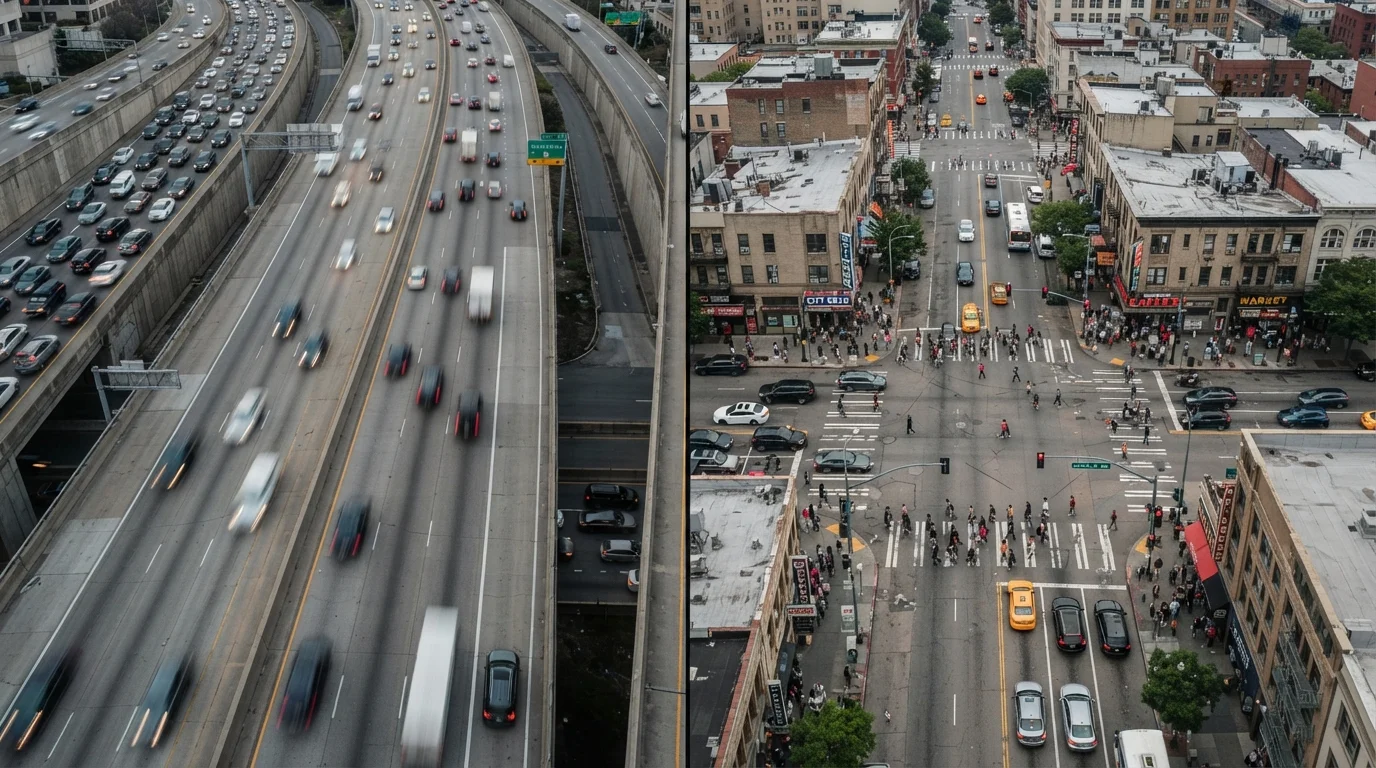
Highway driving is characterized by sustained high-speed travel with fewer decision points per minute. City driving is defined by constant interruptions: signals, crosswalks, double-parked vehicles, cyclists appearing from bike lanes, and drivers making unpredictable moves. Both environments are demanding, just in different ways. Understanding those differences is the foundation of deliberate driving practice.
| Criterion | Highway Driving | City Driving |
|---|---|---|
| Decision frequency | Low - fewer inputs per mile | High - constant adjustments |
| Primary hazard type | High-speed collisions, fatigue | Pedestrians, cyclists, intersections |
| Following distance | 3+ seconds at speed | Shorter, situational awareness |
| Key visual skill | Long-range scanning, blind spots | Wide-angle hazard scanning |
| Speed range | 55-80 mph sustained | 0-45 mph with frequent stops |
| Main mental challenge | Sustained focus, fatigue resistance | Rapid multi-variable processing |
| Lane change complexity | High - speed-critical timing | Moderate - shorter windows |
What Highway Driving Actually Requires
On the highway, the primary challenge isn't complexity - it's sustained vigilance. At 70 mph, your car covers roughly 103 feet per second. That means a lapse in attention of just two seconds puts you well over 200 feet down the road without processing new information.
Following distance becomes more consequential at speed. The standard guidance is the 3-second rule at highway speeds - choosing a fixed object ahead, and counting at least three seconds between when the car in front passes it and when you do. In wet conditions or heavy traffic, extend that gap further.
Lane changes and merging are the highest-risk maneuvers on highways. A proper lane change involves checking mirrors, signaling, performing a physical blind spot check over your shoulder, and smoothly adjusting speed - not just glancing and swerving. See our guide to merging onto busy highways for a detailed breakdown of timing and gap selection.
Fatigue management is a highway-specific concern. The monotony of long-distance driving can cause attention to drift even when you feel alert. Experienced highway drivers recognize early signs of fatigue and plan rest stops proactively rather than pushing through.
~40%
Of US traffic fatalities on rural/highway roads
According to the NHTSA, rural roads (including highways) consistently account for a disproportionate share of fatal crashes relative to their traffic volume.
3 sec
Minimum recommended following distance at highway speed
The 3-second rule is a standard guidance endorsed by driver safety programs across the US - increase it in adverse conditions.
5-8 sec
Mirror check interval recommended for city driving
Driver training programs commonly recommend checking mirrors every 5-8 seconds in urban environments to maintain situational awareness.
What City Driving Actually Requires
Urban driving compresses decision-making into a near-constant stream. In a single city block, a driver might navigate a signal change, a pedestrian stepping off a curb, a delivery truck partially blocking a lane, and a cyclist moving to the left to avoid a pothole - all within 30 seconds.
Hazard scanning is the core city skill. Rather than focusing straight ahead, experienced urban drivers use wide, active eye movement - checking mirrors every 5-8 seconds, reading sidewalks for pedestrians about to cross, and watching gaps between parked cars where a person or cyclist might emerge. The ability to read traffic patterns is especially valuable here.
Speed management at low speeds is more nuanced than it sounds. Covering ground slowly while staying attentive - rather than stopping and starting unnecessarily - reduces fuel consumption and rear-end risk. Smooth, anticipatory braking (reading the light cycle and coasting toward a red) is a hallmark of skilled urban drivers.
Right-of-way judgment in city intersections, especially uncontrolled ones, requires both knowledge of traffic law and an ability to read other drivers' intentions. Overconfidence about having the right of way is a common cause of urban collisions.
Where the Skills Overlap - and Where They Diverge
Both environments reward the same foundational habits: smooth inputs on the wheel and pedals, consistent mirror use, and an awareness of the space around your vehicle. But where they diverge matters:
- Gaze distance: Highway drivers should scan 10-15 seconds ahead; city drivers need to split attention between near (3-5 seconds) and far (10 seconds) zones simultaneously.
- Mental load: Highways generate low-frequency, high-stakes decisions (a tire blowout, sudden traffic stop). Cities generate high-frequency, lower-stakes decisions that accumulate into stress and error.
- Speed transitions: Entering and exiting highways requires rapid speed adjustment - something city-only drivers often find jarring initially.
If you drive across both environments regularly, it's worth reading about how travel context shapes your expectations and habits - the same mental switching applies behind the wheel. And for any conditions that add complexity to either environment, see our breakdown of driving in rain, snow, and fog.
New Drivers: Start Highway, Then City
Counterintuitively, many driver educators recommend that newer drivers gain initial highway experience before tackling dense urban traffic. Highways offer predictable flow and fewer simultaneous variables, which helps new drivers build speed management and lane discipline before adding pedestrians, cyclists, and complex intersections to the mix. That said, supervised city practice should follow promptly - both skill sets are essential.