Why Merging Feels So Stressful
Highway merging puts several driving skills in motion at the same time - speed management, spatial judgment, mirror work, and timing - all within a few hundred feet. That compression is exactly why it rattles newer drivers and still trips up experienced ones who've picked up bad habits.
The underlying physics are straightforward: you're joining a stream of vehicles traveling at 60-75 mph, and you need to enter that stream without forcing anyone to brake sharply. Disrupting traffic flow at highway speed carries real consequences - sudden braking can cascade into a chain reaction. Understanding what highway drivers expect of you is the first step toward doing this confidently.
If you're still building general road awareness, our guide to reading traffic patterns covers how to interpret what moving vehicles around you are communicating before you ever need to react.
What you will need
What You Need Before You Start
Merging well isn't just about technique in the moment - it starts with preparation. Make sure the following are in order every time you approach a highway entrance.
Properly adjusted mirrors
Eliminate as much blind-spot area as possible so you can track vehicles in adjacent lanes while keeping eyes forward.
Functional turn signal
Communicates your merge intent to highway drivers early enough for them to respond.
Clear rear and side windows
Dirty or fogged glass reduces your ability to judge distances of approaching vehicles accurately.
Familiarity with your car's throttle response
Knowing how hard to press the accelerator to hit 65-70 mph on a short ramp removes hesitation at a critical moment.
Also take a moment to check your assumptions about driving rules - several common beliefs about right-of-way and speed limits on ramps are simply wrong and can get you into trouble.
How to Merge Safely, Step by Step
Follow these steps every time you approach a highway on-ramp. With practice, they'll become automatic.
Begin scanning before you commit to the ramp
As soon as you see the highway entrance sign, start observing traffic in the lane you'll be joining. Note the density of vehicles, approximate speed, and whether any large trucks or slow-moving vehicles are in the right lane near the merge point. This early read gives you several seconds to form a plan rather than improvise at the ramp's end.
Signal before you begin accelerating
Activate your turn signal as you enter the on-ramp - not at the last 50 feet before merging. Early signaling tells highway drivers that a vehicle will be entering from the right, giving them time to move left or adjust speed rather than react in surprise.
Accelerate firmly through the on-ramp
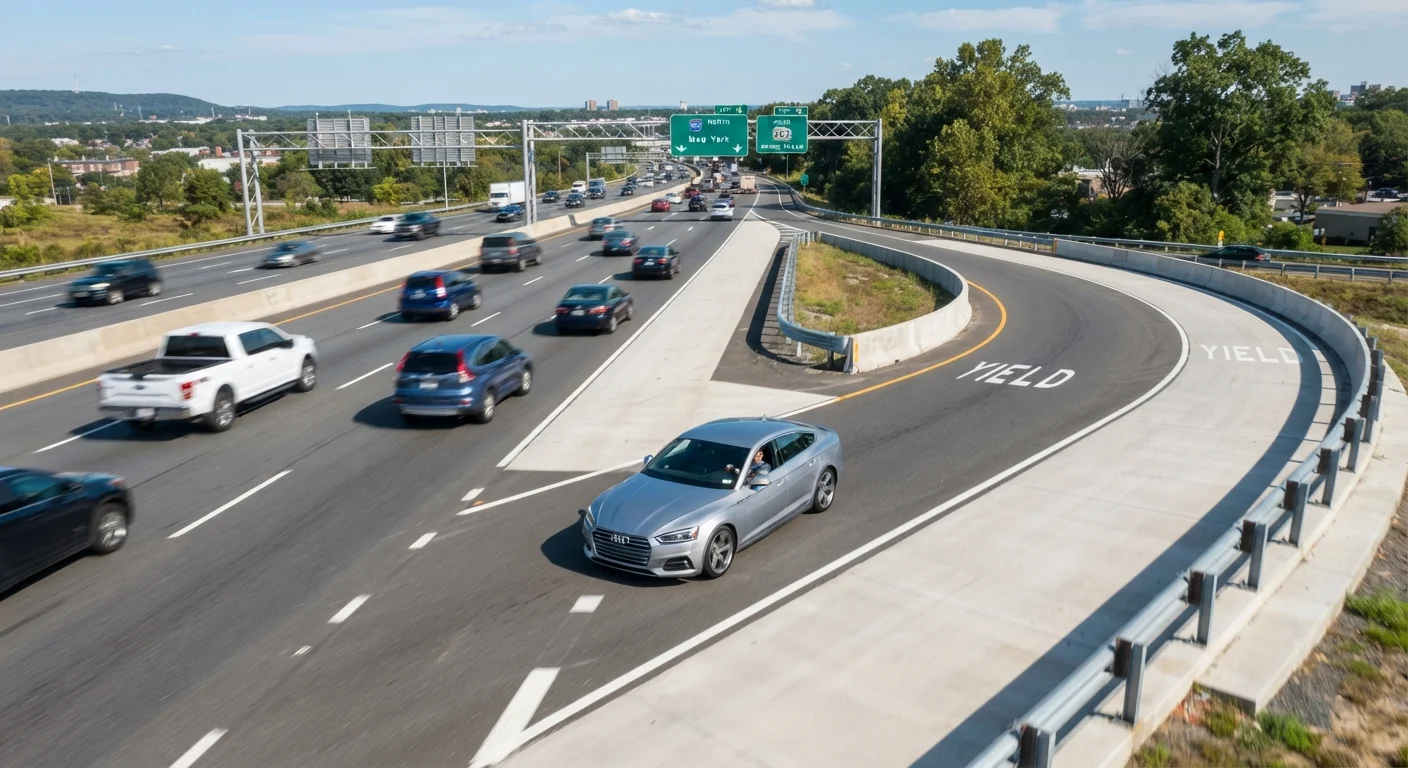
The on-ramp acceleration lane exists for one purpose: reaching highway speed before you arrive at the merge point. Accelerate steadily and purposefully. Many new drivers instinctively slow down to 'be careful,' but entering a 70 mph stream at 40 mph creates a dangerous speed differential that forces highway drivers to brake hard.
Target a speed within 5-10 mph of the prevailing traffic speed before you reach the dashed merge line.
Identify your gap while still accelerating
Simultaneously check your left mirror, then do a quick head-check over your left shoulder to confirm the blind spot is clear. You're looking for a gap roughly 4-5 seconds of following distance in front and behind the space where you plan to slot in. At highway speeds, this translates to approximately 350-450 feet of open space.
If no suitable gap exists, adjust your ramp speed slightly - ease off or accelerate a little - to time your arrival at the merge point with a gap.
Merge smoothly into your chosen gap
When your speed matches traffic and your gap is clear, steer steadily into the right lane without jerking the wheel. Move with intention - a hesitant, drifting merge is harder for other drivers to predict than a clean, decisive one. Once you're in the lane, turn off your signal and match the flow of surrounding traffic.
Establish your position and check your surroundings
Once merged, take a quick scan: check your mirrors, confirm following distance to the vehicle ahead, and note any vehicles that may have sped up or shifted lanes during your merge. Give yourself 3-4 seconds of space from the car in front before considering any additional lane changes.
Never Stop at the End of the On-Ramp
Stopping at the merge point - even when traffic looks tight - is one of the most dangerous things you can do on a highway entrance. It forces vehicles behind you on the ramp to stop unexpectedly and makes merging into fast-moving traffic nearly impossible without causing a disruption. If the gap is too small to enter safely, slow down on the ramp to create time, but keep moving.
Highway merging is one of the core skills covered in our first solo drive guide, which walks through the full picture of what new drivers should have in place before taking on higher-speed roads alone.
How Merging Differs by Traffic Condition
The same technique doesn't apply in every situation. Adjusting your approach based on traffic density is what separates reactive drivers from deliberate ones.
- Light traffic: You have more gap options. Keep your speed up and choose a comfortable gap rather than forcing yourself into the first one you see.
- Moderate traffic: Standard technique applies - match speed, signal, pick your gap, and move smoothly. Highway drivers typically provide space if you signal clearly.
- Heavy or stop-and-go traffic: The ramp itself may slow or stop. Creep forward, identify a gap in the flow, and ease in when the gap opens. Do not stop at the end of the ramp if traffic is still moving - even slowly.
- Multi-lane highways: Aim for the rightmost lane. The far-left lane is not your destination; get established first, then change lanes if needed.
Understanding these environmental differences is core to the contrast between highway and city driving - two contexts that demand fundamentally different mental models.
Give Other Drivers Room to Help You
In moderate to heavy traffic, some drivers in the right lane will move left to give you space - but only if you signal early and maintain consistent speed. Erratic speed changes or late signals eliminate their ability to assist. Predictability is your best tool on any highway.