Why Most Drivers Only React
New drivers are taught to obey signals and follow speed limits - both essential foundations. But formal driver education rarely covers what separates a competent driver from an exceptional one: the ability to anticipate, not just react. Most drivers spend their time responding to what's immediately in front of them. Experienced drivers are processing what's happening three, four, five cars ahead.
This distinction matters because stopping distances are unforgiving. At 60 mph, a vehicle travels roughly 88 feet per second. A one-second delay in recognizing a hazard adds nearly 90 feet before you've even touched the brake pedal. Reading traffic patterns is essentially buying yourself more time - and time is the most valuable resource behind the wheel.
The encouraging news: this skill is learnable. It isn't about reaction speed or reflexes. It's about knowing what to look for and where to look. See our overview of defensive driving principles for the broader framework this skill fits into.
The Signals Drivers Broadcast Without Knowing It
Every vehicle on the road is transmitting information. The challenge is learning to decode it quickly.
Brake Light Patterns
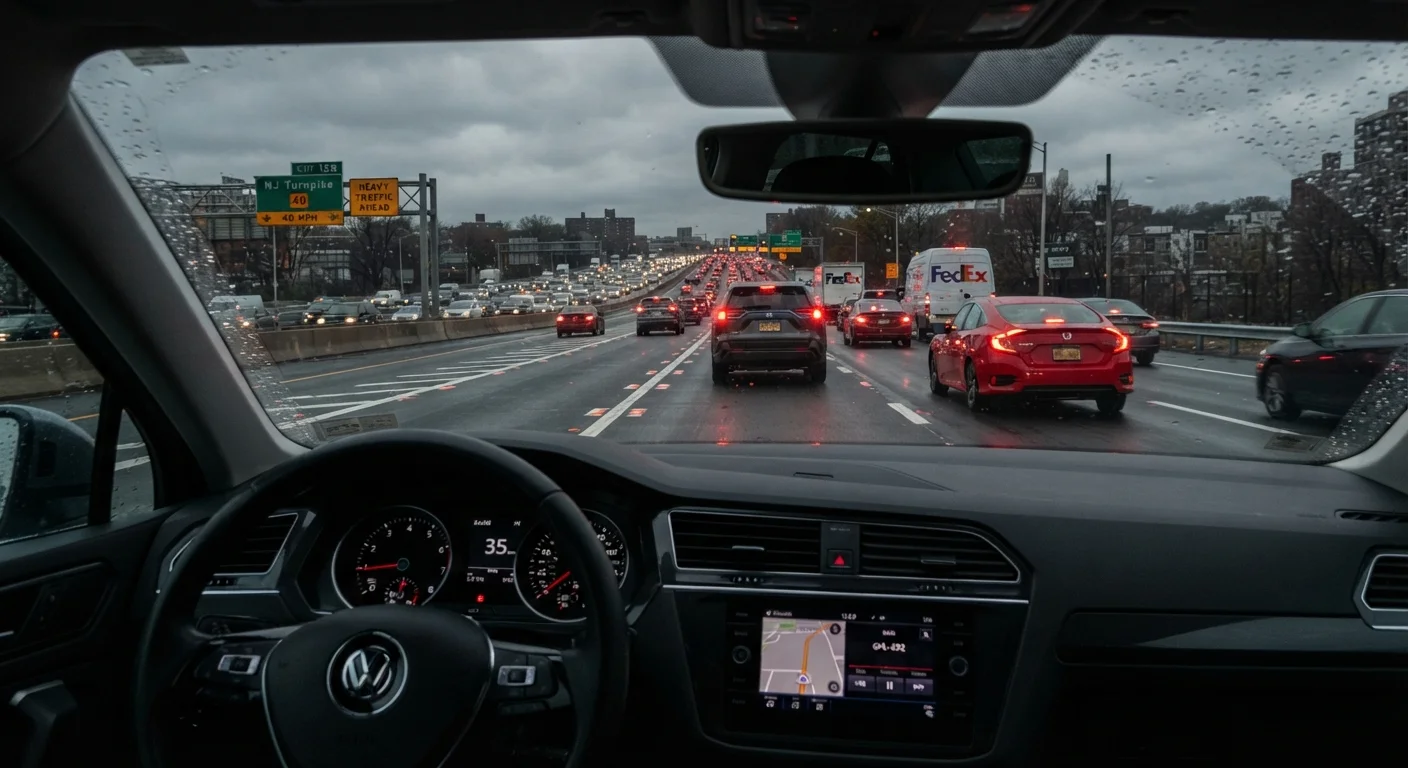
A single car braking gently is routine. A ripple of brake lights moving backward through several lanes signals something more significant - often a bottleneck, stalled vehicle, or accident that you can't yet see. When you notice that wave, easing off the accelerator immediately (rather than waiting until you must brake hard) creates safer stopping distance and smoother traffic flow.
Lane Drift and Sudden Lane Changes
A vehicle that repeatedly drifts toward a lane boundary before correcting is a warning sign - the driver may be distracted, fatigued, or impaired. Give that vehicle extra space and avoid positioning yourself in its blind spot. Sudden, unsignaled lane changes often indicate a driver reacting to something you haven't seen yet: a pothole, a pedestrian stepping out, a parked car ahead.
Speed Inconsistency
A driver who accelerates aggressively then brakes sharply, repeatedly, is harder to predict than one maintaining steady speed. These patterns make following distance even more important - new drivers frequently underestimate how much space they actually need in situations exactly like this.
Use the Two-Second (or More) Rule as a Baseline
The two-second following distance rule gives you a minimum buffer - but in heavy traffic, poor weather, or at highway speeds, three to four seconds is more appropriate. Pick a fixed point on the road, wait for the car ahead to pass it, then count. If you reach that point before you finish counting, you're too close. More space means more time to interpret what traffic ahead is doing.
Scanning Strategy: Where to Actually Look
Most drivers fix their gaze too close - staring at the bumper ahead rather than the broader field. Effective scanning involves three zones working together:
- Far ahead (12-15 seconds of travel time): Where hazards are still developing. This is where you spot congestion building, emergency vehicles approaching, or highway on-ramps about to merge.
- Mid-range (4-6 seconds out): Where you confirm what you spotted in the distance and adjust speed or lane position.
- Immediate surroundings: Mirrors, blind spots, and your current lane - checked on a regular rhythm, not just when something feels wrong.
Mirrors deserve specific attention. A good habit is checking your rearview mirror every five to eight seconds, and checking side mirrors before any position change. This matters because knowing what's behind you shapes how safely you can react forward - if a vehicle is tailgating you, you need to know that before you start braking.
The scanning demands shift depending on your environment. Highway and city driving each require a different perceptual approach - urban environments compress the time horizon and introduce more unpredictable actors like cyclists and pedestrians.
~1 second
Typical perception-reaction time before braking
NHTSA and traffic safety researchers commonly cite perception-reaction time of 1-1.5 seconds for an alert driver, meaning a vehicle at 60 mph travels roughly 88-132 feet before braking even begins.
12-15 sec
Recommended forward scanning range
Driver education standards widely recommend scanning 12 to 15 seconds ahead - translating to roughly a quarter mile at highway speeds - to give drivers adequate time to respond to developing hazards.
Applying This on Real Roads
Reading traffic isn't passive observation - it's an active mental narration. Many driving instructors recommend verbalizing what you see, especially when learning: "That car is slowing without signaling," "Those brake lights are stacking up ahead," "That truck's been drifting." Putting language to observations forces the brain to process them rather than let them wash past.
On the highway, pay particular attention to on-ramps. A vehicle entering from a ramp will need to match speed and find a gap - if you're in the right lane, either speed up, slow down, or move left to give that driver room. Anticipating merges before they're forced prevents the swerving and hard braking that cause accidents. Understanding how merging works from the other driver's perspective makes this easier to anticipate.
In city driving, watch the behavior of pedestrians waiting at crosswalks - a group stepping off the curb before the signal changes tells you a driver somewhere ahead may be stopping unexpectedly. Watch parked cars for occupants who might open a door into traffic. These micro-signals are easy to miss when your eyes stay locked to the bumper ahead of you.
Conditions That Compress Your Reading Window
Rain, fog, and darkness all reduce how far ahead you can see - which shrinks the time you have to interpret traffic signals. In these conditions, increasing following distance and reducing speed isn't just about stopping safely; it's about restoring the perceptual buffer you lose when visibility drops. Different weather conditions demand specific adjustments to how you scan and respond.
Developing this skill isn't about driving more hours - it's about driving more intentionally. Deliberate practice converts seat time into actual competence in a way that passive repetition never does.