Why New Drivers Get Following Distance Wrong
Following distance sounds simple: leave enough room to stop if the car ahead brakes suddenly. Yet tailgating is one of the most persistent habits among new drivers - and one of the most dangerous. Understanding why it develops is the first step toward fixing it.
The core problem is perception. At 60 mph, your car is covering 88 feet every second. A gap that looks substantial in a parking lot disappears in under a second on the highway. New drivers haven't built the experience to translate visual space into real stopping time, so their instincts routinely mislead them.
There's also a psychological dimension. Driving alongside other vehicles creates social pressure - matching the flow of traffic feels like the natural, cooperative thing to do, even when that flow is dangerously compressed. For first-time solo drivers especially, standing out by holding a larger gap can feel uncomfortable. Our guide for your first solo drive covers this kind of confidence-building in more depth.
Tailgating Is a Leading Crash Cause
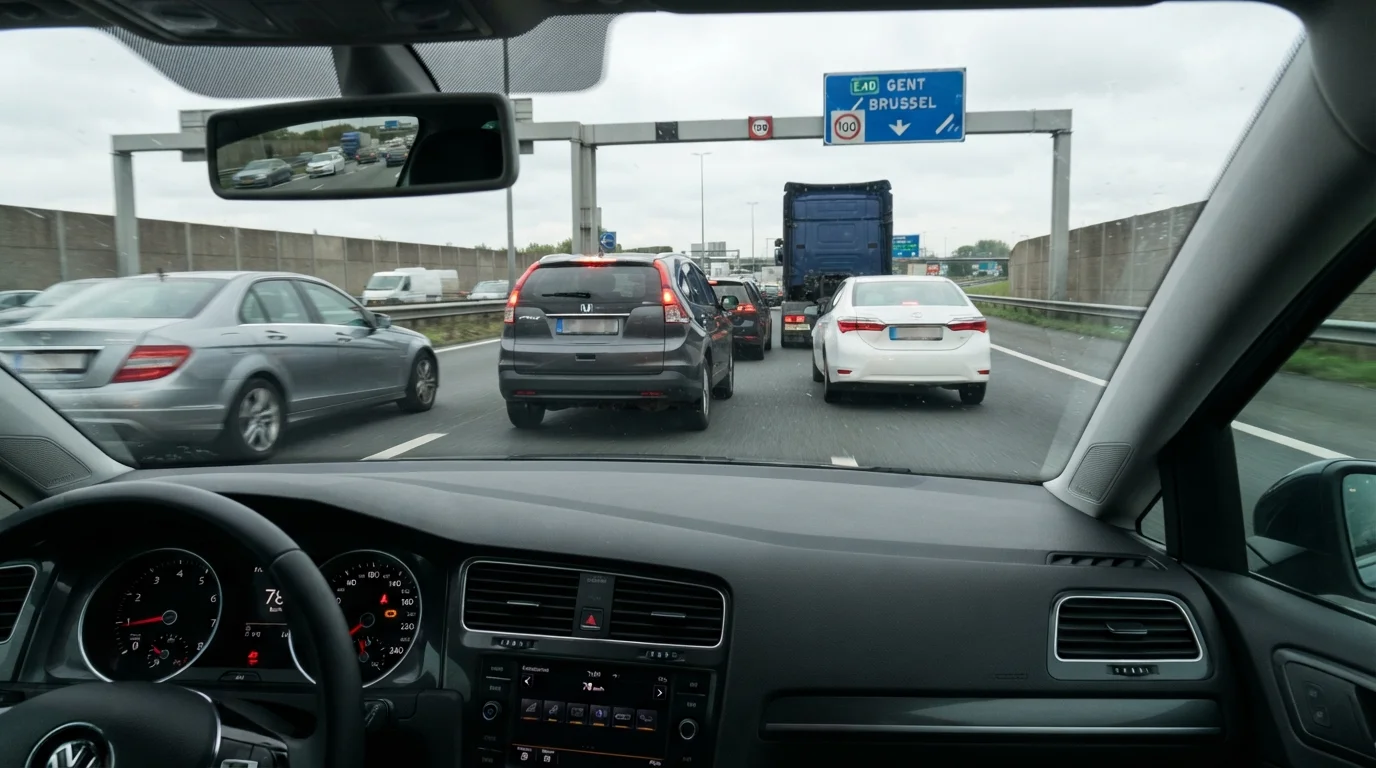
Rear-end collisions are among the most common crash types in the U.S., and insufficient following distance is a primary contributing factor. At highway speeds, even a brief distraction combined with short spacing can make a collision unavoidable. No matter how confident you feel behind the wheel, physics sets the minimum - not instinct.
The Mistakes That Lead to Tailgating - and How to Correct Them
Most following-distance errors fall into a handful of predictable patterns. Each one has a root cause and a practical fix.
Relying on gut feel instead of a measurable gap rule.
Why it happens: New drivers focus intensely on the vehicle directly ahead and judge spacing by eye - which consistently underestimates true distance at speed.
Forgetting that stopping distance grows with speed exponentially, not linearly.
Why it happens: It's intuitive to think that going twice as fast means you need twice the distance to stop. In reality, the physics of kinetic energy means stopping distance increases by the square of speed - 60 mph requires roughly four times the stopping distance of 30 mph.
Closing the gap to prevent other drivers from merging in.
Why it happens: Drivers often interpret a maintained safe gap as wasted space or an open invitation for lane-changers. Closing that gap feels like protecting their position.
Not adjusting following distance for adverse conditions.
Why it happens: Habits formed in ideal conditions become the default setting. New drivers tend to apply the same gap in rain or at night as they use on a dry afternoon, underestimating how dramatically friction and visibility change stopping ability.
Matching the following distance of surrounding traffic rather than setting your own.
Why it happens: Social conformity is a powerful instinct. If everyone around you appears to be driving bumper-to-bumper, maintaining a larger gap can feel conspicuous or even wrong.
~40%
Of all crashes involve rear-end impacts
The National Highway Traffic Safety Administration (NHTSA) has consistently identified rear-end crashes as one of the most frequent crash types on U.S. roads.
4x
Stopping distance increase from 30 to 60 mph
Due to the physics of kinetic energy, doubling your speed roughly quadruples the distance needed to bring a vehicle to a full stop under identical road conditions.
Beyond the individual mistakes listed above, it helps to understand how to read developing traffic situations earlier - not just the car directly in front of you. Reading traffic patterns earlier gives you more time to react, which means your following distance doesn't have to be perfect to keep you safe.
It's also worth checking how following distance interacts with other risk factors. Distracted driving compounds short following distance dramatically - even one glance away from the road can turn a manageable gap into an unavoidable collision.
Building the Habit Until It's Automatic
Knowledge of the 3-second rule isn't enough on its own. Like any driving skill, safe following distance has to become automatic - something you maintain without conscious effort, especially when other demands on your attention spike.
Practice deliberately in low-stakes environments first. On uncongested roads, use roadside markers, overpasses, or signs to check your gap repeatedly until counting the seconds becomes instinctive. Over time, your eye for safe spacing will calibrate to match the math.
Also review what you believe about driving more broadly. Some widely accepted driving habits don't hold up under scrutiny - our piece on common driving myths is worth reading alongside this one, since several of those myths relate directly to speed and spacing assumptions.
The goal is to reach a point where maintaining proper following distance feels as natural as buckling a seatbelt - not a deliberate act, but a baseline expectation you hold for yourself every time you drive.