
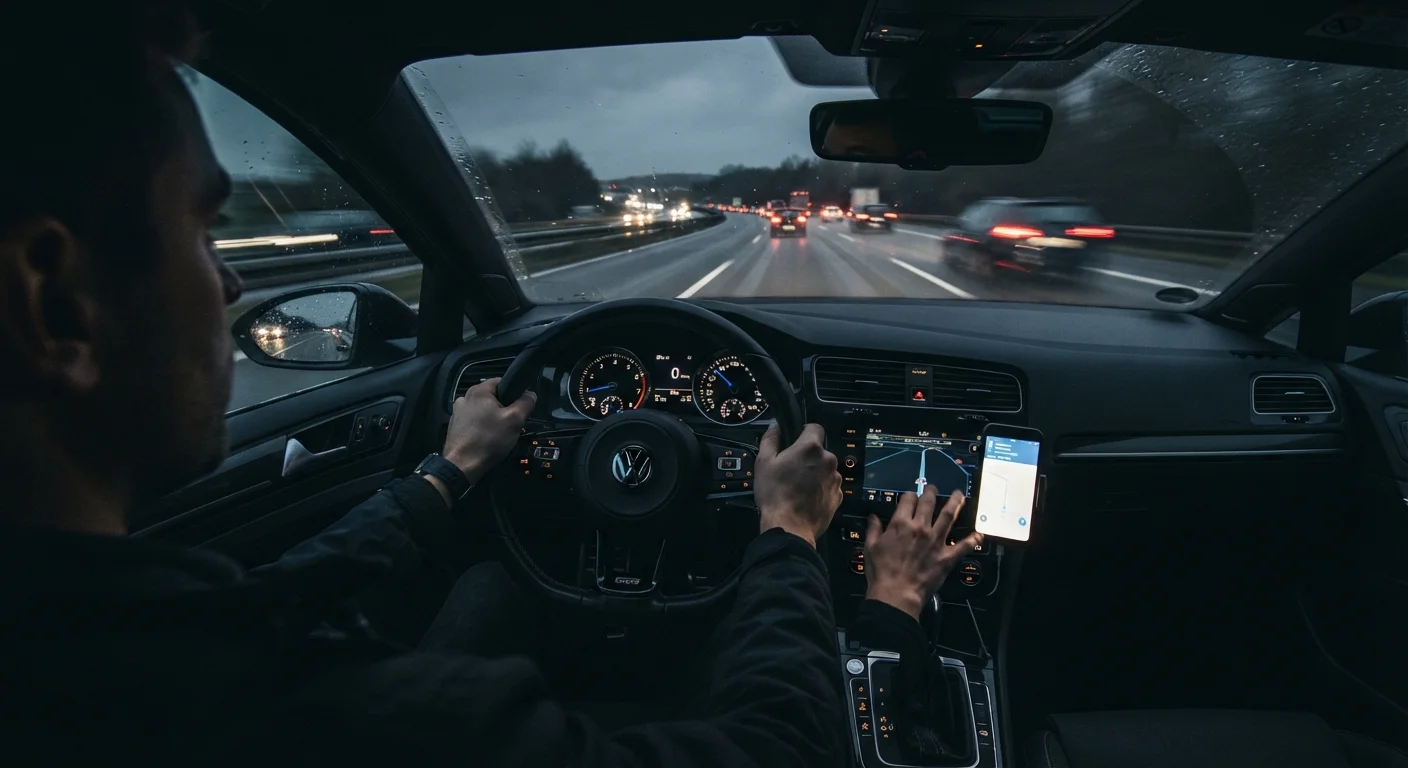
What Counts as Distracted Driving
The National Highway Traffic Safety Administration (NHTSA) defines distracted driving as any activity that diverts attention from the primary task of driving. That definition covers a wider range of behaviors than most drivers expect.
Researchers group distractions into three categories:
- Visual distractions - taking your eyes off the road (reading a text, checking a navigation app, glancing at a billboard).
- Manual distractions - removing one or both hands from the wheel (eating, adjusting the radio, reaching for something in the back seat).
- Cognitive distractions - shifting mental focus away from driving (deep conversation, daydreaming, stress from an argument).
Texting while driving is classified as the most dangerous single behavior because it engages all three categories at once. But eating a burger at a red light, programming a GPS at highway speed, or arguing with a passenger are also legitimate distractions - even if the law doesn't always treat them equally.
Grooming, reading, watching video, and even interacting with in-vehicle infotainment systems all qualify. The category is broad by design, because the underlying mechanism - divided attention - is the actual hazard.
What the Research Actually Shows
~9%
Fatal crashes involving distraction
NHTSA data has consistently attributed roughly 8-9% of fatal traffic crashes to distraction-affected driving in recent reporting years.
27 sec
Cognitive distraction after voice commands
AAA Foundation for Traffic Safety research found mental distraction can persist up to 27 seconds after completing a voice-command task.
~100 ft
Road covered during a 5-second glance at 55 mph
At highway speed, a brief text glance covers roughly the length of a football field with attention diverted from the road.
The research on distracted driving is unusually consistent for a behavioral topic. Studies using instrumented vehicles, driving simulators, and crash data converge on several findings:
- Drivers who text have crash risk estimated to be significantly elevated - frequently cited figures in transportation safety literature place it at several times higher than undistracted driving, though exact multipliers vary by study design.
- At 55 mph, reading a 5-second text means covering approximately the length of a football field without actively processing the road ahead.
- Handheld phone calls and hands-free calls both impair driving - the manual distinction matters less than the cognitive one.
NHTSA data consistently identifies distraction as a contributing factor in a meaningful share of fatal crashes each year, though precise annual figures shift as reporting methods improve.
Younger drivers show elevated crash risk from distraction in part because driving itself is not yet fully automatic. Novice drivers consume more cognitive bandwidth on basic vehicle control, leaving less capacity to manage simultaneous tasks - a phenomenon transportation researchers sometimes call cognitive overload.
For a broader look at how attention and anticipation interact on real roads, see Reading the Road: What Traffic Patterns Are Telling You.
How U.S. Laws Address Distraction
Distracted driving law in the United States is primarily a state-level matter, which creates real variation in what is prohibited, how penalties are structured, and how consistently rules are enforced.
Hands-Free Doesn't Mean Risk-Free
A widespread misunderstanding is that switching to a hands-free device fully resolves the distraction problem. It reduces manual and visual demand, but cognitive distraction remains substantial. Some state laws permit hands-free use, but legal permission and safe practice are not the same standard. Drivers should not treat hands-free calls as equivalent to undistracted driving.
What is uniform across all 50 states: texting while driving is banned. Beyond that, the picture fragments:
- Handheld phone bans: A majority of states prohibit holding a phone while driving - but not all. Some states restrict handheld use only for certain driver categories (new drivers, school zones).
- Hands-free requirements: Some states require that all calls be conducted through a hands-free device; others permit handheld calls for adult drivers.
- Graduated licensing: Most states impose stricter distraction rules on drivers under 18 - often full bans on any phone use, handheld or hands-free.
Fines range from under $50 in some states to several hundred dollars for repeat offenses in others. Some states add points to driving records; a few treat repeat violations as moving violations that can affect insurance rates.
Because laws change and vary, always verify current rules in your state through your state's DMV or department of transportation - do not rely on secondhand summaries.
Enforcement is another variable: distracted driving is notoriously difficult to cite compared to speeding, which means legal deterrence is uneven. This is one reason behavioral habit-building matters independently of legal compliance.
The Cognitive Blind Spot Most Drivers Miss
Most drivers accept that looking at a phone is dangerous. Fewer recognize the persistence of cognitive distraction - the mental residue that lingers after a distracting task ends.
Research funded by NHTSA and conducted by the AAA Foundation for Traffic Safety found that cognitive distraction can persist for up to 27 seconds after completing a voice-command task. That means finishing a hands-free text dictation at 25 mph and then driving for nearly half a minute with meaningful attentional impairment - even with eyes forward and hands on the wheel.
Treat voice-to-text as a reduction in risk, not an elimination of it. If the message genuinely can't wait, pull over completely - parking lots exist for exactly this reason.
Research shows cognitive load from voice interaction persists well after the task ends, meaning 'hands-free' is safer but not safe in the fullest sense.
Set your phone's driving mode as a default that requires deliberate action to disable, rather than something you opt into trip by trip.
Behavioral science consistently finds that making the safer option the automatic default significantly outperforms relying on in-the-moment decisions.
This matters for how drivers evaluate "safe" alternatives. Switching from handheld to voice-to-text reduces manual and visual demand significantly, but the cognitive load remains substantial. Neither approach eliminates distraction; both reduce some components while leaving others.
Passenger conversation is cognitively demanding too, but research suggests it impairs driving less than phone conversation. One proposed explanation: passengers can see road conditions and naturally pause when the driving environment demands more attention. A phone caller cannot.
Understanding this helps reframe the goal - not finding a "safe enough" form of distraction, but reducing overall attentional demand. That's the core idea behind defensive driving principles as practiced by experienced drivers.
Building Habits That Keep Attention on the Road
Research on behavior change consistently finds that willpower is an unreliable mechanism for resisting temptation - especially under stress or habit-induced autopilot. Structural strategies outperform intention alone.
- Phone placement: Putting a phone in the glove box, back seat, or a bag before starting the engine removes the temptation entirely. Out of sight reduces the pull of notifications more reliably than a personal commitment to ignore them.
- Do Not Disturb features: Most smartphones include a driving mode that suppresses notifications and auto-replies to messages. Enabling it by default - rather than case by case - makes it structural rather than volitional.
- Pre-drive setup: Set navigation, choose a playlist, and adjust climate controls before moving. Any adjustment needed mid-trip is best handled by pulling over safely.
- Passenger roles: A front-seat passenger can legitimately manage the phone, navigation, or secondary tasks so the driver can focus - this is a practical, underused resource.
New drivers in particular benefit from deliberately limiting secondary inputs early - fewer passengers, music at lower volume, familiar routes - while vehicle control is still being internalized. This connects directly to why new drivers underestimate following distance and other attentional hazards are disproportionately prevalent among younger drivers.
Distraction management is also a component of broader situational awareness. The same attention economy that makes distraction dangerous is what defensive driving is designed to protect and extend.