Making a Rental Feel Like Yours — Without the Damage
One of the most frustrating parts of renting is the feeling that your space is frozen in time — painted in landlord beige, bare-walled, and just a little soulless. The good news: there's an entire category of home upgrades designed specifically for people who want to make a space their own without permanently altering it.
These renter-friendly solutions have expanded dramatically in recent years, moving well beyond simple picture hooks. Today's options cover walls, floors, lighting, storage, and even windows — and nearly all of them come down cleanly when it's time to move. For a deeper look at protecting your deposit while making improvements, check out our guide to renter-safe wall-hanging options.
Before you start, one universal rule applies: photograph every room thoroughly when you move in, and again before you move out. That documentation protects you regardless of what upgrades you make. Our article on renter maintenance responsibilities explains what else landlords can and can't hold you to.
Removable Wallpaper and Peel-and-Stick Panels
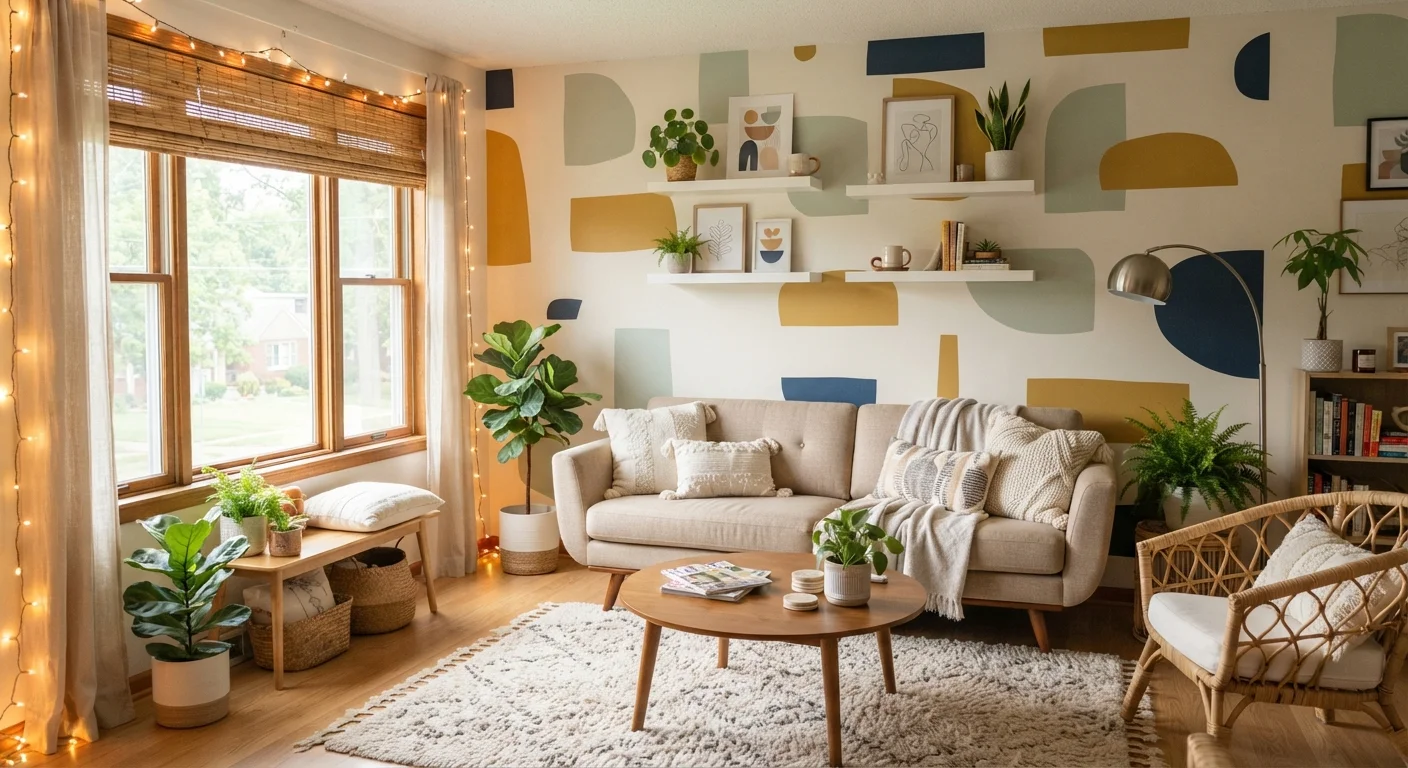
Removable wallpaper — also called peel-and-stick wallpaper — uses a pressure-sensitive adhesive that bonds well to smooth, painted drywall but peels away cleanly without lifting paint. It's available in virtually every pattern imaginable: linen textures, botanical prints, geometric grids, and classic stripes.
Apply it to a single accent wall rather than an entire room to minimize installation time and the risk of imperfect removal. Smooth out air bubbles during installation using a credit card or squeegee. When it's time to leave, peel slowly from a corner at a low angle — this reduces the chance of tearing the paper or stressing the paint underneath.
Pro tip: Walls with a flat or matte paint finish can be trickier. Do a small test patch in an inconspicuous area and wait 24 hours before committing to a full wall.
A single accent wall with peel-and-stick wallpaper transforms a room in an afternoon.
Adhesive Hooks and Removable Hanging Strips
Adhesive hanging strips and hooks are probably the most widely used renter tool — and with good reason. When used within their rated weight limits and removed according to the manufacturer's instructions (typically slow, downward pulls on the tab), they leave painted walls intact.
They're useful for far more than picture frames: coat hooks near entryways, kitchen organization strips inside cabinet doors, bathroom towel hooks, and cable management clips all work well with adhesive fasteners. Just be realistic about weight. Overloading a hook is the most common cause of wall damage.
For framed artwork specifically, look for strips rated for the frame's weight, and use pairs on each side of the frame rather than relying on a single strip. Our article on hanging items safely in rentals goes deeper on options by wall type.
Staying within rated weight limits is the single most important rule for adhesive hooks.
Peel-and-Stick Tile and Floor Overlays
Dated vinyl flooring or boring bathroom tile doesn't have to stay that way. Peel-and-stick tile overlays sit directly on top of existing surfaces, require no adhesive beyond their own backing, and lift away without leaving residue — provided the surface underneath was clean and smooth when you applied them.
They work especially well in bathrooms and kitchens where the original tile is worn or discolored. Measure carefully before ordering — cutting tiles around fixtures and corners takes patience but is very doable with a utility knife and a straight edge.
For rental bathrooms specifically, this upgrade pairs naturally with other low-commitment changes like new shower curtains, removable mirror decals, and peel-and-stick shelf liner. See our bathroom refresh guide for a fuller picture of non-permanent bathroom improvements.
Peel-and-stick tile overlays can transform a dated bathroom floor in a single weekend.
Freestanding Shelving and Furniture-Based Storage
One of the most impactful renter-friendly upgrades costs zero wall damage: freestanding shelving. Leaning ladder shelves, modular cube units, and open bookcases all provide substantial storage and display space without a single screw into drywall.
The key is stability. Taller freestanding shelves should be secured using anti-tip straps anchored to a stud — a small nail hole is far less problematic than a tipped bookcase. If even that isn't acceptable to your landlord, opt for lower, wider units that have a lower center of gravity.
Furniture-based storage (ottomans, beds with drawers, kitchen islands on wheels) follows the same logic: it moves with you and adds zero permanent alteration to the unit. This is especially worth considering if you're in a furnished rental where built-in storage is minimal.
Freestanding shelving delivers serious storage capacity without touching a single wall.
Plug-In Lighting and Removable Fixtures
Standard apartment lighting — a single overhead fixture per room, often with an unflattering bulb — is one of the biggest contributors to that generic rental feel. Replacing it permanently isn't an option for renters, but layering in plug-in alternatives changes the entire atmosphere of a space.
Plug-in pendant lights, wall sconces, and LED strip lighting (which adheres to surfaces using 3M-style tape and peels off cleanly) are all fair game. These require no electrical work whatsoever — just a standard outlet and, in some cases, a cord cover to keep things tidy along the wall.
Smart bulbs in existing fixtures are another easy win: they swap in and out like any bulb and let you control color temperature and brightness, which has an outsized effect on how a room feels. This falls squarely under the home maintenance and improvement basics every renter should know.
Layered plug-in lighting dramatically improves a room's feel without touching the wiring.
Window Film and Removable Treatments
Privacy window film — the frosted or decorative kind — applies to glass with a water-activated backing and removes cleanly without adhesive residue. It's one of the most underused renter upgrades, particularly for ground-floor apartments or bathrooms that feel exposed.
Beyond privacy, decorative films in geometric or botanical patterns add visual interest to plain windows without blocking light. They're particularly useful in rooms where curtains aren't practical or where the window size doesn't match standard curtain panel sizes.
Tension rod curtain systems are the renter's best friend for window treatments: no drilling, fully adjustable, and completely removable. Combined with removable film, they give you full control over light, privacy, and style in any room.
Privacy window film adds both function and style without leaving any residue behind.
Move Out the Same Way You Moved In
Every upgrade on this list shares one goal: reversibility. When the day comes to hand back your keys, you want your landlord to see the same walls, floors, and fixtures they showed you at move-in — ideally in the same or better condition. That means removing everything cleanly, checking for any adhesive residue, and touching up surfaces with a damp cloth or appropriate cleaner.
Test Before You Commit
Before applying any adhesive product — wallpaper, hooks, tile overlays — test it on a small, hidden section of the surface first. Leave it in place for 24 to 48 hours, then remove it slowly to check for paint lift or residue. Different paint finishes and wall conditions react differently, and a quick test can save your deposit. When in doubt, ask your landlord for the paint brand and finish so you can assess compatibility.
If you're renting a place where a pet will also be living, keep in mind that some of these upgrades do double duty. Removable hooks, for instance, can hold leashes, feeding station organizers, and toy bags at accessible heights. Our room-by-room guide for cat-proofing apartments pairs well with the upgrades covered here. And if you want to extend your no-commitment decorating mindset to outdoor areas, outdoor upgrades that work for renters and owners alike covers balconies and patios with the same philosophy.
The best approach is to treat renter-friendly upgrades as a practice in intentional decorating: choose things you genuinely love, install them thoughtfully, and you'll end up with a space that reflects your personality — with zero drama at move-out.