What MERV Ratings Actually Mean
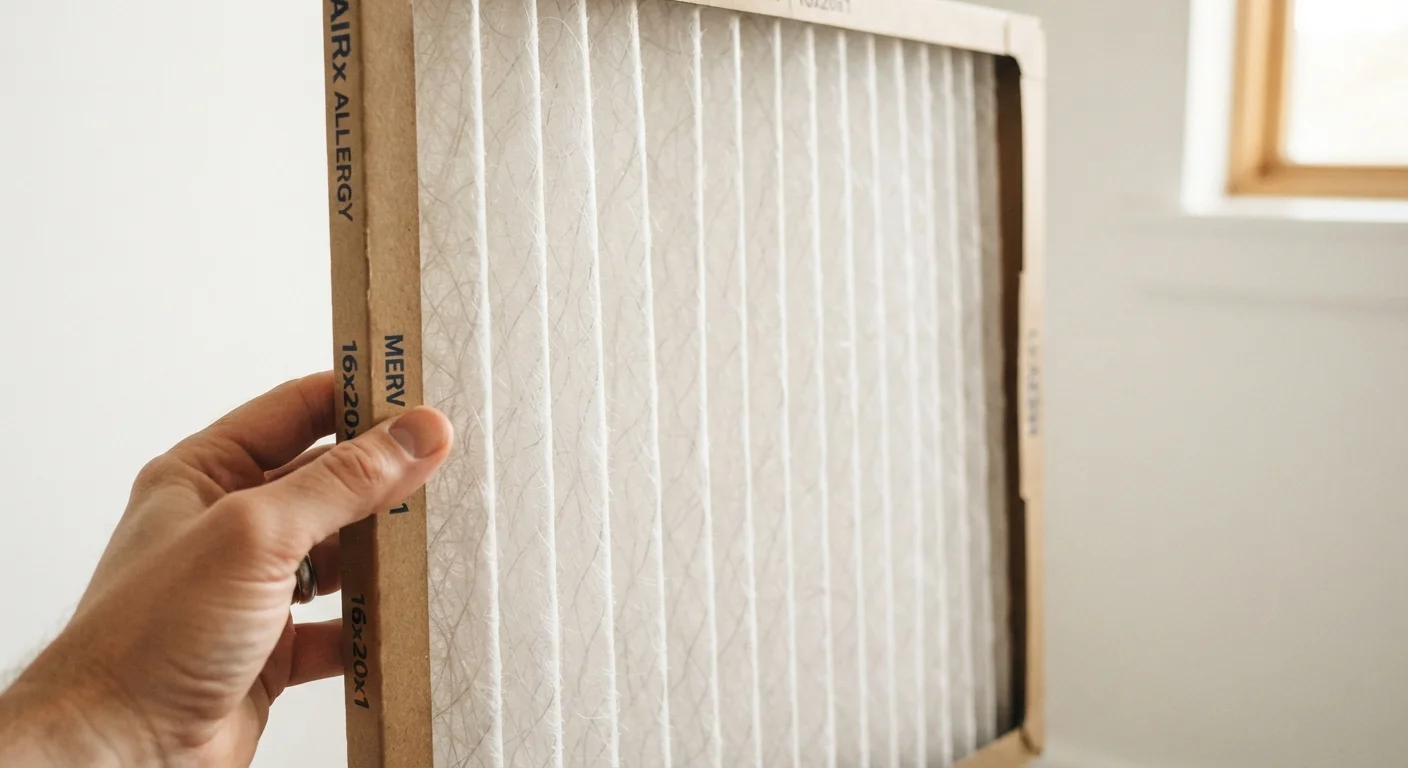
When you pull a filter off the shelf, that MERV number tells you one specific thing: how small a particle the filter can reliably capture. The scale runs from 1 (basic fiberglass, traps large dust and lint) to 16 (used in hospitals and cleanrooms). For most homes, the useful range is MERV 8 to 13.
| MERV scale range | 1 to 16 (residential use) (ASHRAE Standard 52.2) |
| Typical residential recommendation | MERV 8–11 (U.S. EPA guidance on indoor air quality) |
| Standard filter replacement interval | Every 60–90 days (General industry guidance; varies by household) |
| HEPA minimum capture rate | 99.97% of 0.3-micron particles (U.S. Department of Energy definition) |
| Particles captured at MERV 13+ | Smoke, bacteria, some virus carriers (ASHRAE filtration guidance) |
| Filter size format | Length × Width × Depth (inches) |
Here's a practical breakdown by tier:
- MERV 1–4: Disposable fiberglass panels. They protect the furnace from large debris but do very little for air quality.
- MERV 5–8: Entry-level pleated filters. Capture mold spores, dust mite debris, and pet dander — a solid baseline for most households.
- MERV 9–12: Mid-range pleated filters. Add finer dust, lead dust, and some auto-emission particles to the capture list.
- MERV 13–16: High-efficiency filters. Can capture smoke particles, bacteria, and droplet nuclei. Require a compatible HVAC system.
Check Your System's Capacity Before Upgrading
Not every HVAC system can handle a high-MERV filter. A very dense filter on an older or undersized blower can restrict airflow, reduce heating and cooling efficiency, and potentially shorten equipment life. Before jumping to MERV 13 or higher, check your furnace or air handler manual or ask an HVAC technician whether your system is rated for it.
For a broader look at how your HVAC system fits into your home's overall infrastructure, see our whole-home systems overview.
Furnace Filters vs. Standalone Air Purifiers
These two tools address the same problem — airborne particles — but they work in different contexts and shouldn't be treated as interchangeable.
2–5×
More polluted indoors than outdoors on average
According to the U.S. Environmental Protection Agency, indoor air can be two to five times more polluted than outdoor air in typical homes.
MERV 13
Minimum filter efficiency recommended for COVID-era guidance
ASHRAE updated its guidance during the COVID-19 pandemic to suggest MERV 13 as a target where HVAC systems can support it.
20–30%
Potential HVAC efficiency loss from a clogged filter
Industry sources suggest a heavily clogged filter can reduce system efficiency noticeably, though exact figures vary by system type and usage.
Furnace (HVAC) filters are installed in your air handler or return-air duct. They filter air as it circulates through your heating and cooling system, which means they only work when the system is running. They protect both your equipment and the air you breathe, but filtration quality is limited by what your blower motor can push air through.
Standalone air purifiers run independently of your HVAC system and can use true HEPA filters, activated carbon layers, or UV-C light to target specific pollutants. They're especially useful in rooms where you spend the most time — bedrooms, living areas — or in homes where the HVAC system can't support higher-MERV filters.
MERV Rating
Minimum Efficiency Reporting Value — a standardized scale from 1 to 16 that rates how effectively a filter captures airborne particles. Higher numbers mean finer filtration but also greater airflow resistance.
HEPA Filter
High-Efficiency Particulate Air filter. A HEPA-grade filter captures at least 99.97% of particles 0.3 microns in diameter. Commonly found in standalone air purifiers rather than standard HVAC systems.
Static Pressure
The resistance to airflow inside your HVAC system's ductwork. A filter that is too dense can increase static pressure and strain your blower motor over time.
Micron
A unit of measurement equal to one millionth of a meter. Most household dust particles range from 1 to 100 microns; fine particles like smoke can be as small as 0.1 microns.
Pleated Filter
A filter made from folded polyester or cotton paper that provides more surface area than a flat fiberglass filter, allowing better particle capture without sacrificing too much airflow.
Air Changes per Hour (ACH)
How many times per hour a purifier or HVAC system cycles the total volume of air in a room. Higher ACH generally means cleaner air in a given space.
Key differences at a glance:
| Feature | Furnace Filter | Air Purifier |
|---|---|---|
| Coverage area | Whole home (when HVAC runs) | Single room or zone |
| Filter type | MERV-rated media | HEPA, carbon, or multi-stage |
| Ongoing cost | Filter replacement | Filter replacement + electricity |
| Installation | Slide into existing slot | Plug-in, no ductwork needed |
Many households benefit from using both: a quality MERV 8–11 furnace filter for whole-home baseline filtration, and a HEPA air purifier in the bedroom for finer overnight filtration.