
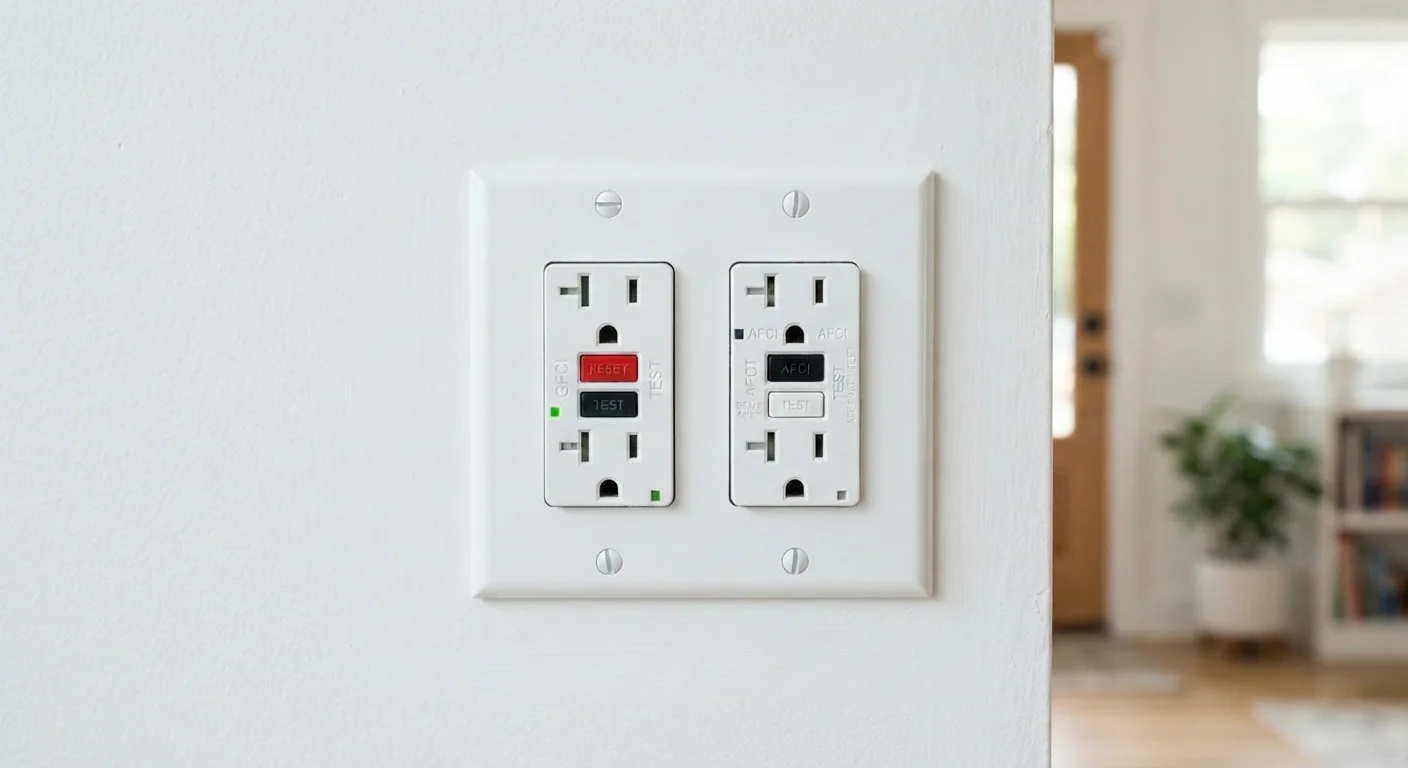
What Each Outlet Actually Does
Despite their similar appearance — both have Test and Reset buttons on the face — GFCI and AFCI outlets are engineered to prevent completely different types of electrical hazards.
A GFCI (Ground Fault Circuit Interrupter) outlet monitors the flow of electricity between the hot and neutral wires. If it detects even a tiny imbalance — as little as 4–5 milliamps, which is enough to cause a fatal shock under wet conditions — it cuts power within milliseconds. This makes GFCI the critical safeguard any time water and electricity could come into contact.
An AFCI (Arc Fault Circuit Interrupter) outlet, by contrast, listens for the distinct electrical signature of an arc fault — an unintended electrical discharge caused by damaged insulation, loose connections, or a cord that's been pinched under furniture. Arc faults don't always trip a standard breaker, but they can ignite surrounding materials. The AFCI detects this abnormal current pattern and shuts the circuit down before a fire can start.
| Criterion | GFCI Outlet | AFCI Outlet |
|---|---|---|
| Hazard it prevents | Electric shock from ground faults | Electrical fires from arc faults |
| Primary risk environment | Wet or damp locations | Living spaces with aging or damaged wiring |
| Trigger threshold | ~4–5 milliamp current imbalance | Abnormal arcing current signature |
| Typical installation point | Individual outlet or circuit breaker | Circuit breaker at the panel |
| Code-required locations | Bathrooms, kitchens, garages, outdoors | Bedrooms, living rooms, most finished spaces |
| DIY replacement difficulty | Moderate (outlet-level swap) | Higher (panel-level work recommended for pros) |
| Dual-function option available | Yes — AFCI/GFCI combo units exist | Yes — AFCI/GFCI combo units exist |
Where Each Type Is Required by Code
The National Electrical Code (NEC) — the baseline standard adopted by most US jurisdictions — specifies where each type of protection is required. Always verify with your local building authority, since states and municipalities can adopt different versions or add local amendments.
GFCI-Required Locations
- Bathrooms (all receptacles)
- Kitchen countertop surfaces within 6 feet of a sink
- Garages and accessory buildings
- Outdoor receptacles
- Crawl spaces and unfinished basements
- Boathouses and near pools or hot tubs
AFCI-Required Locations
- Bedrooms (required since the 2002 NEC)
- Living rooms, family rooms, dining rooms, and dens
- Hallways and closets
- Laundry areas and most finished interior spaces (required in recent NEC editions)
Check Which NEC Edition Your State Follows
The NEC is updated every three years, but individual states adopt new editions on their own schedules — some lag by one or two cycles. This means AFCI requirements that apply in one state may not yet be enforced in another. Before any electrical upgrade or renovation, check with your local building department to confirm the applicable code edition and whether permits are required.
The simplest rule of thumb: wet areas need GFCI; living spaces need AFCI. Many newer homes now use dual-function AFCI/GFCI outlets or breakers where both hazard types overlap, such as a finished basement or a laundry room.
Can You Test and Replace Them Yourself?
Testing both outlet types is a straightforward task any homeowner or renter can perform. Press the Test button — the outlet should lose power. Press Reset to restore it. The Consumer Product Safety Commission recommends testing GFCI outlets monthly.
Replacing a standard outlet with a GFCI outlet is a job many experienced DIYers do themselves, since it typically involves only the wires connected to a single receptacle. That said, electrical work always carries real risk. If you're not confident reading wiring diagrams, if your home has aluminum wiring, or if your panel is outdated, it's worth calling a licensed electrician. See our guide to knowing when DIY is smart and when it's risky to help make that call.
51%
Home fires attributed to electrical failure
The U.S. Fire Administration has consistently identified electrical failures and malfunctions as a leading cause of residential fires, accounting for roughly half of all home fire incidents in some reporting periods.
~300
Electrocution deaths prevented annually by GFCI
The Consumer Product Safety Commission has estimated that widespread GFCI adoption could prevent hundreds of electrocution deaths each year in the United States.
AFCI breakers are installed at the electrical panel rather than at the outlet level, which makes self-installation more complex. Unless you are experienced with panel work, this is generally a task for a licensed electrician. Electrical panels involve potentially lethal voltages even when the main breaker is off — specifically, the utility feed lines remain live.
This article is for general informational purposes only and does not constitute electrical advice. Always verify local code requirements and consult a licensed electrician for any work you are uncertain about.