The System Behind the Signs: Color and Shape Conventions
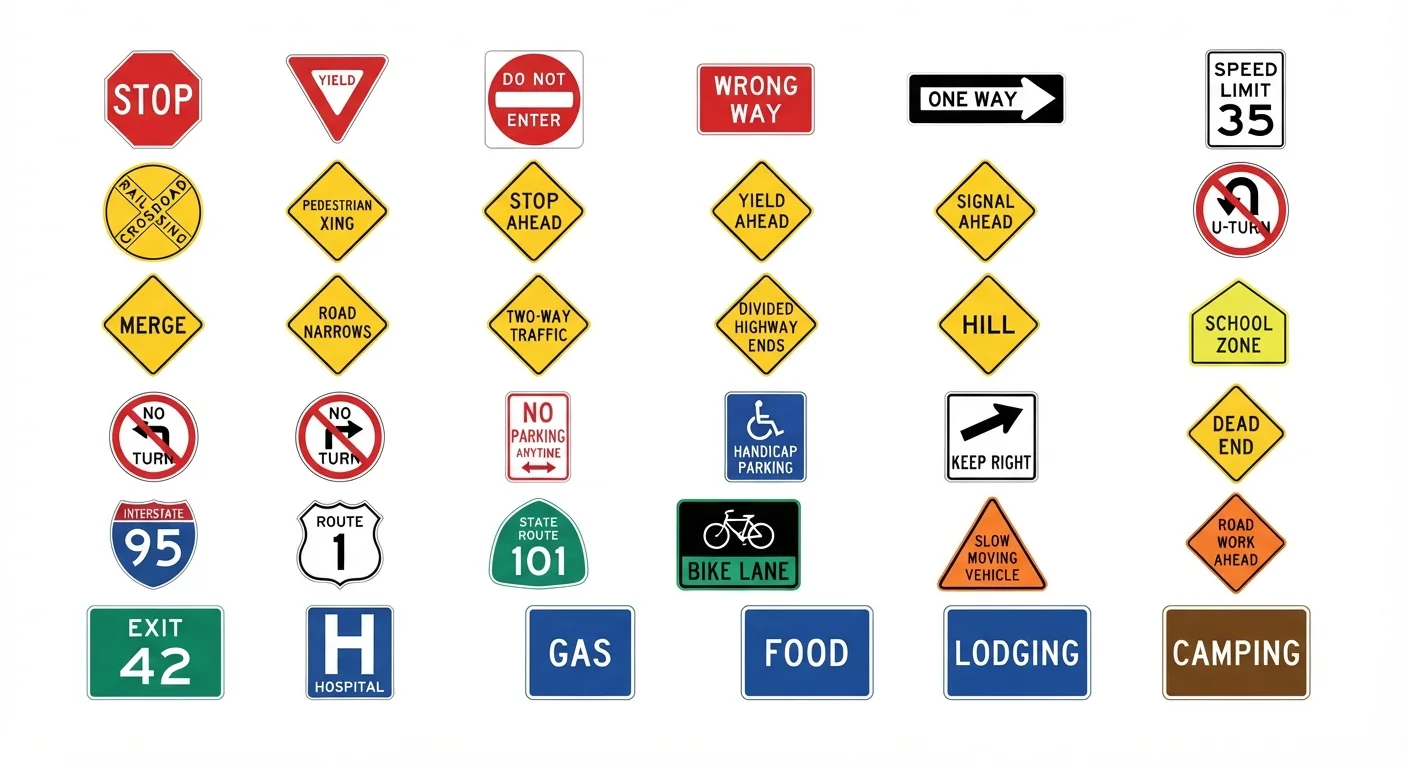
U.S. road signs are built on a standardized system defined by the MUTCD, a federal document that governs how signs look, where they're placed, and what they mean. Understanding the underlying logic - color and shape - lets you decode an unfamiliar sign before you can even read the text.
| Governing standard | Manual on Uniform Traffic Control Devices (MUTCD) (Federal Highway Administration) |
| Total sign categories | 3 primary: Regulatory, Warning, Guide (MUTCD) |
| Stop sign shape | Octagon - unique to stop signs only |
| Work zone sign color | Orange - temporary conditions, legally enforceable speed limits |
| School zone sign shape | Pentagon (5-sided) (MUTCD) |
| Railroad advance warning shape | Circle - yellow with X marking |
Color Coding at a Glance
- Red - Stop, yield, or prohibition (no entry, do not pass)
- Yellow - General warning; conditions ahead require caution
- Orange - Temporary traffic control and work zones
- Green - Directional guidance, mile markers, permitted movements
- Blue - Motorist services (gas, food, lodging, hospitals)
- Brown - Recreational areas, parks, and cultural destinations
- White - Regulatory signs (speed limits, turn restrictions)
- Fluorescent yellow-green - High-priority pedestrian or bicycle zones
Shape Conventions
- Octagon - Stop only
- Triangle (inverted) - Yield only
- Diamond - Warning signs
- Rectangle (vertical) - Regulatory (speed, parking, lane use)
- Rectangle (horizontal) - Guide and informational signs
- Pentagon - School zone or school crossing
- Crossbuck (X shape) - Railroad crossing
- Circle - Railroad advance warning
Shape recognition matters most at speed or in poor visibility. On a foggy night or during a fast highway merge, your brain processes shape before color or text. See our night driving guide for more on reading the road when visibility is low.
Regulatory Signs: Rules You Must Follow
Regulatory signs communicate legal requirements. Ignoring them isn't just dangerous - it's a traffic violation. Most are white and rectangular, though stop and yield signs are the well-known exceptions.
MUTCD
The Manual on Uniform Traffic Control Devices - the federal standard that specifies the design, placement, and meaning of all traffic signs, signals, and pavement markings in the United States.
Regulatory sign
A sign that communicates a legally enforceable rule of the road, such as speed limits, stop requirements, or turn prohibitions. Violating these signs is a traffic offense.
Warning sign
A sign - typically yellow and diamond-shaped - alerting drivers to a potentially hazardous condition or road feature ahead. These do not mandate a specific action but call for heightened attention and appropriate speed adjustment.
Work zone sign
Temporary orange signs used in construction or maintenance areas to redirect traffic, lower speed limits, and alert drivers to workers or changed road conditions. Speed limit reductions in work zones are legally enforceable.
Right-of-way
The legal priority given to one vehicle or pedestrian to proceed before others at an intersection, crossing, or merge point. Yield signs and certain road geometries assign right-of-way.
Crossbuck
The X-shaped white sign installed at railroad grade crossings. It has the same legal standing as a yield sign and requires drivers to look and listen for trains before proceeding.
Commonly Confused Regulatory Signs
| Sign | What It Means | Common Mistake |
|---|---|---|
| Stop | Come to a complete stop before the line; proceed only when clear | Rolling stops - still illegal even when the intersection looks empty |
| Yield | Slow down and give right-of-way; stop only if traffic requires it | Treating it as a suggestion rather than a legal obligation |
| Do Not Enter | Entry prohibited in that direction - often at highway off-ramps | Missing it at night or confusing it with a general warning |
| Wrong Way | You are traveling against traffic flow; reverse or stop immediately | Appearing together with Do Not Enter - both must be heeded |
| No U-Turn | U-turns prohibited at that location | Assuming it only applies during peak hours |
| Keep Right | Stay to the right of a median, island, or divider | Merging left instead, especially on divided highway entrances |
Speed limit signs are also regulatory. A posted number is a legal maximum under ideal conditions - not a target. Conditions like rain, construction, or heavy pedestrian traffic may require driving well below the posted limit.
Warning and Work Zone Signs: What Demands Your Attention
Yellow diamond-shaped signs alert you to changing or potentially hazardous conditions ahead. They don't require a specific action the way regulatory signs do - but they signal that you should adjust your speed and attention. Orange versions of the same shape indicate temporary conditions in construction or work zones, where fines are often doubled by state law.
High-Priority Warning Signs to Know
- Curve / Sharp Curve - Indicates road geometry ahead; slow before entering, not during
- Slippery When Wet - Surface loses traction significantly in rain
- Divided Highway Begins / Ends - Watch for the median appearing or disappearing
- Merging Traffic / Added Lane - Incoming vehicles; adjust speed and position proactively
- Pedestrian / School Crossing - Pentagon shape near schools; reduce speed and watch for foot traffic
- Railroad Crossbuck - Marks an at-grade rail crossing; the crossbuck itself has the same legal weight as a yield sign
- Deer / Animal Crossing - High wildlife activity zone; scan road edges, especially at dawn and dusk
In active work zones, orange signs may include flaggers, lane shifts, and reduced speed limits that carry legal weight. Treat every orange sign as a regulatory sign, not merely advisory. This is especially relevant on highways - the differences between highway and city driving shape how you respond to these signs in each context.
~50%
Of wrong-way crashes occur at night
According to the Federal Highway Administration, nighttime hours account for roughly half of wrong-way driving incidents on divided highways.
2×
Typical fine multiplier in active work zones
Most U.S. states double traffic fines for speeding violations committed in active construction or work zones.
For a broader picture of how signs fit into real-world traffic dynamics, see Reading the Road: What Traffic Patterns Are Telling You.