
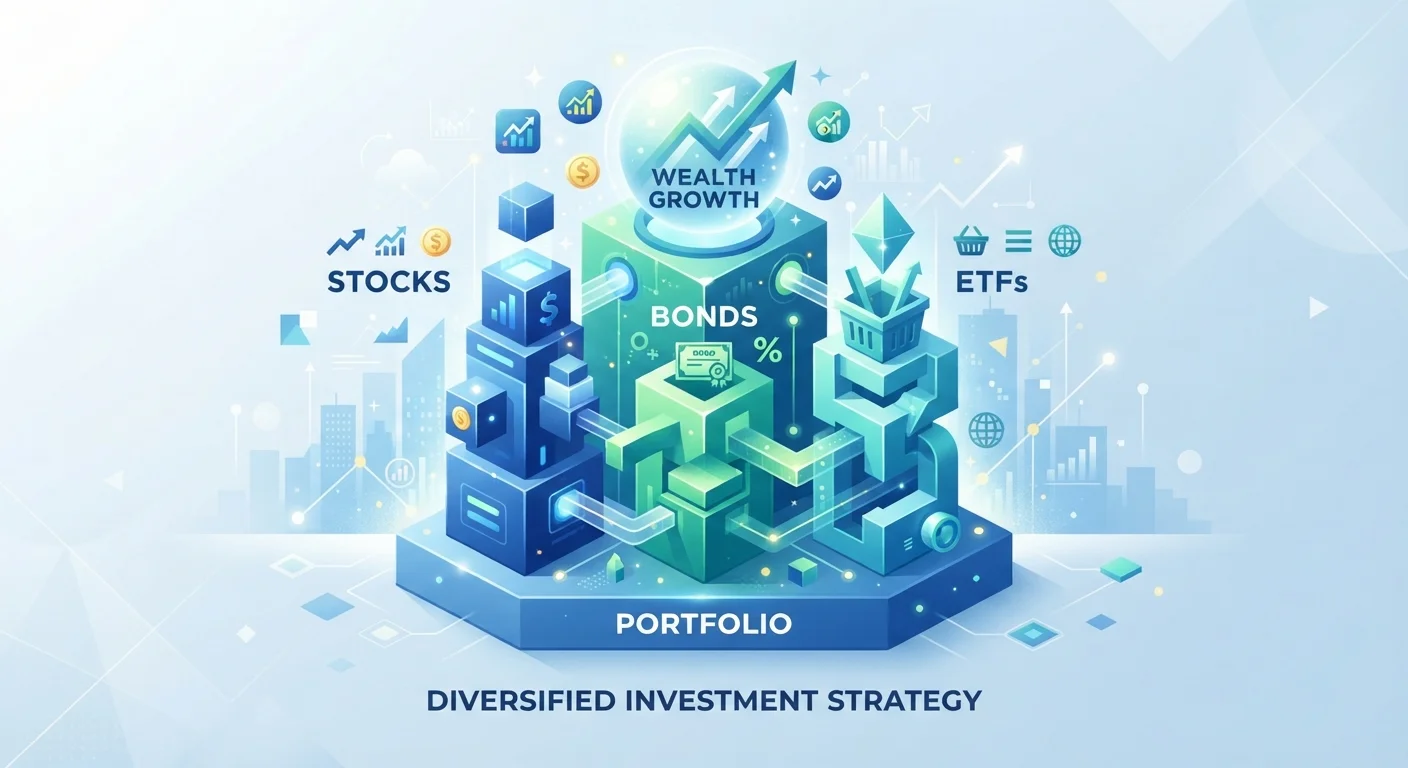
What Stocks, Bonds, and ETFs Actually Are
| What a stock represents | Partial ownership in a company |
| What a bond represents | A loan to a government or corporation |
| How ETFs trade | On a stock exchange, like individual shares |
| Primary stock risk | Price volatility; potential for loss |
| Primary bond benefit | Relative stability and predictable income |
| ETF diversification | One share gives exposure to many underlying assets |
When people talk about investing, they usually mean putting money into three core building blocks: stocks, bonds, and exchange-traded funds (ETFs). Each works differently, carries different levels of risk, and plays a distinct role in a portfolio. Understanding what each one is — before worrying about which to buy — is the foundation of smarter investing.
Stocks represent partial ownership in a company. When a company wants to raise money, it can sell small ownership stakes to the public. Each stake is called a share. If the company grows in value, your shares generally rise in value too. If it struggles, their value can fall. Stockholders may also receive dividends — periodic cash payments distributed from company profits — though not all companies pay them.
Bonds work differently: instead of buying ownership, you're lending money. When a government or corporation issues a bond, it's promising to repay your principal (the original amount) by a specific date — called the maturity date — plus regular interest payments along the way. Bonds are generally considered lower-risk than stocks, but they also tend to offer lower potential returns.
ETFs (exchange-traded funds) are funds that hold a collection of assets — stocks, bonds, or both — and trade on a stock exchange just like individual shares do. Buying one ETF share gives you exposure to every asset inside that fund. They're popular among new investors because they offer built-in diversification and tend to have lower costs than many other fund types. To go deeper on how funds differ by management style, see Index Funds vs. Actively Managed Funds.
The Role Each Asset Plays in a Portfolio
Stock (Share)
A unit of ownership in a company. Stockholders may benefit if the company's value grows, but also bear the risk of losses if it declines.
Bond
A debt instrument where an investor lends money to an issuer (government or corporation) in exchange for regular interest payments and repayment of the principal at maturity.
ETF (Exchange-Traded Fund)
A pooled investment fund that holds a collection of assets and trades on a stock exchange. ETFs offer diversification and are generally accessible at low cost.
Dividend
A payment made by a company to its shareholders, typically from profits. Not all companies pay dividends, and the amount can change over time.
Maturity Date
The date on which a bond's principal is scheduled to be repaid to the investor. Bond terms can range from months to decades.
Asset Allocation
The percentage breakdown of a portfolio across different asset types — such as stocks, bonds, and cash. Allocation decisions are often guided by an investor's goals, timeline, and risk tolerance.
Volatility
The degree to which an investment's value fluctuates over time. Higher volatility means larger price swings — both up and down.
Diversification
The practice of spreading investments across different assets, sectors, or geographies to reduce the impact of any single loss on an overall portfolio.
These three asset types aren't mutually exclusive — most investors hold some combination of all three. The proportion of each is called your asset allocation, and it matters a great deal. See Asset Allocation: Balancing Stocks, Bonds, and Cash at Different Life Stages to understand how those ratios typically shift over time.
Stocks are the growth engine of most portfolios. Over long time periods, stocks have historically outpaced inflation by a meaningful margin — but they can also lose significant value in the short term. That volatility is the trade-off for their higher return potential.
Bonds serve as a stabilizer. During periods when stock markets fall sharply, bonds have often held their value or even increased, helping offset losses. They're commonly used by investors who need more predictable income or who have shorter time horizons — for example, someone closer to retirement.
ETFs function as a delivery vehicle. A stock ETF gives you exposure to many stocks at once. A bond ETF does the same for bonds. Some ETFs track broad market indexes; others focus on specific sectors or regions. For a first-time investor, a low-cost, broadly diversified ETF can be a straightforward starting point for understanding how markets work. Learn more about what happens to your money once it's invested in What Actually Happens When You Invest Money.
Spreading money across these asset types is a fundamental strategy for managing risk. Diversification: Why Spreading Risk Across Assets Is a Core Investing Principle explains why this matters and how it works in practice.
Investing Always Involves Risk
No investment is guaranteed to grow, and all three asset types — stocks, bonds, and ETFs — can lose value. Bonds are generally considered more stable than stocks, but they are not risk-free; interest rate changes, for example, can affect bond prices. Understanding your own risk tolerance and time horizon is essential before investing any money.
Your time horizon — how long before you need the money — is one of the most important factors in deciding how much of each asset type to hold. Short-Term vs. Long-Term Investing breaks down how strategy shifts depending on your goals.
This article is for general informational and educational purposes only. It is not personalized financial, investment, tax, or legal advice. All investing involves risk, including possible loss of principal. Past performance does not guarantee future results. Consider speaking with a qualified financial adviser before making investment decisions.