
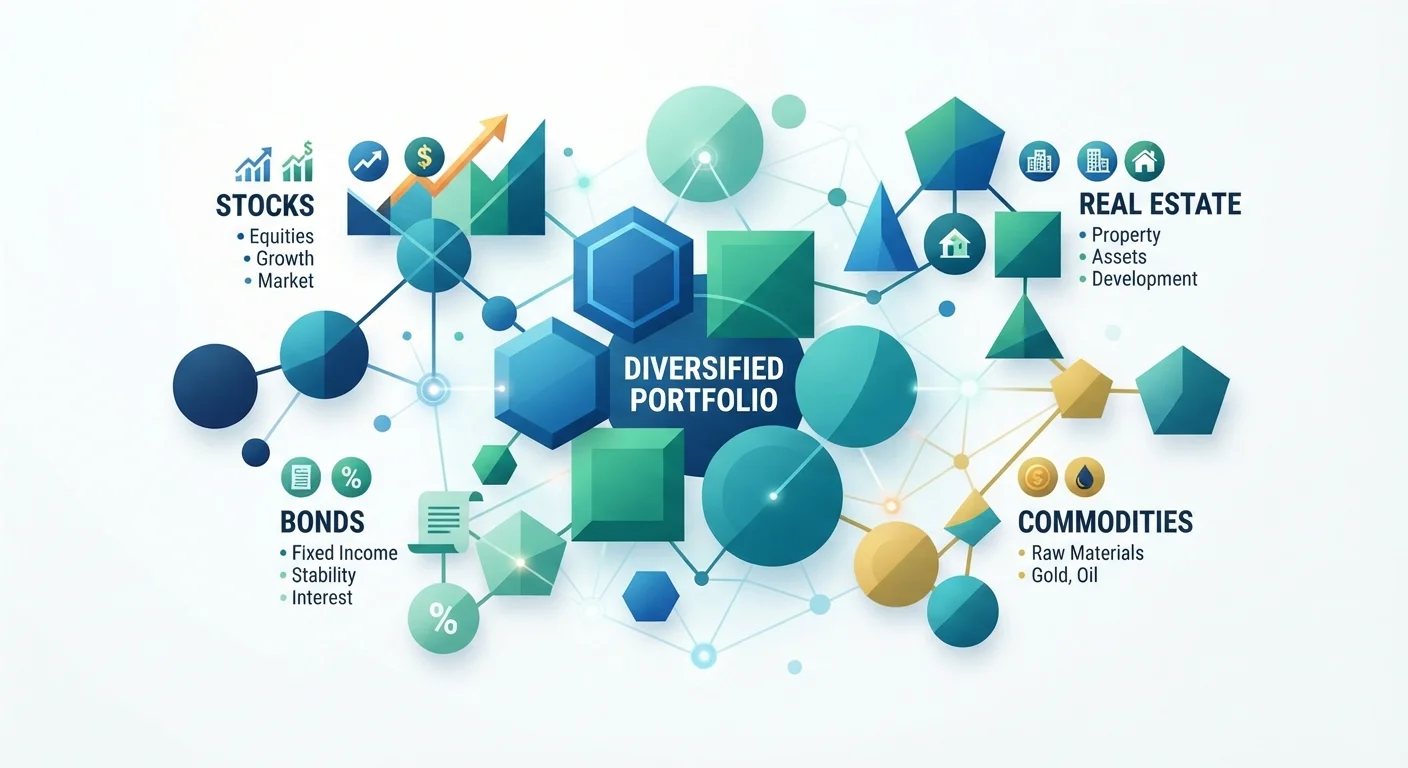
The Simple Idea Behind a Powerful Principle
You have probably heard the old saying: "Don't put all your eggs in one basket." That folk wisdom captures the essence of diversification — and it is one of the most durable ideas in personal finance.
When you invest everything in a single company, you are fully exposed to that company's fate. If it struggles, your portfolio struggles. If it collapses, so does your investment. Diversification is the antidote: by owning a range of different assets, a loss in one area can be offset — at least partially — by stability or gains in another.
This matters because markets are unpredictable. Even experienced professional investors cannot consistently identify which individual stocks, sectors, or asset classes will outperform. Diversification is not an admission of uncertainty — it is a rational response to it. Many people believe investing is too complex or risky to start, but understanding diversification is a great first step. See our common investing myths debunked to challenge other misconceptions that might be holding you back.
What Diversification Actually Looks Like
Diversification is not just about owning more investments — it is about owning investments that behave differently from one another. The goal is low or negative correlation, meaning when one asset falls, another may hold steady or rise.
There are several layers to meaningful diversification:
- Asset classes: Stocks, bonds, real estate, and cash equivalents often respond differently to economic conditions. When stock markets drop sharply, high-quality bonds have historically provided a stabilizing effect in many portfolios — though this relationship is not guaranteed.
- Sectors: Within stocks, spreading across industries (technology, healthcare, energy, consumer goods) limits your exposure to any one sector's downturn.
- Geography: Holding international investments alongside domestic ones means your portfolio is not entirely dependent on the performance of a single country's economy.
~1,000
Number of stocks in some broad market index funds
Broad-market index funds can hold exposure to hundreds or thousands of companies, providing automatic diversification across sectors and market sizes.
~20
Stocks needed to reduce most unsystematic risk
Academic research has historically suggested that a randomly selected portfolio of around 20 uncorrelated stocks eliminates much of the company-specific risk, though broader diversification across asset classes is still recommended.
60/40
Classic stock-bond portfolio split
The 60% stocks, 40% bonds allocation has long been a reference point in diversification discussions, balancing growth potential with stability, though suitability varies by individual goals and risk tolerance.
Understanding how these layers interact with your broader financial goals connects closely to asset allocation strategy, which shapes how you divide your portfolio at different life stages.
The Limits of Diversification
Diversification is powerful, but it has real boundaries. It is most effective at reducing what economists call unsystematic risk — risks tied to a specific company or industry. It cannot fully protect against systematic risk, which is the risk that affects the entire market at once.
During a broad economic recession, for example, stock prices across nearly all sectors tend to fall together. Bonds may provide some buffer, but a severe global downturn can drag down many asset classes simultaneously. This is why diversification is best understood as a risk-reduction tool, not a shield against all losses.
Diversification Is Not the Same as Safety
A diversified portfolio can still lose value — sometimes significantly — during widespread market downturns. The purpose of diversification is to reduce the impact of any single investment failing, not to eliminate all investment risk. Always make sure your investment approach aligns with your personal risk tolerance, time horizon, and financial goals.
Your time horizon also matters significantly. A diversified portfolio is generally better positioned to recover from downturns over a long period. Investors with shorter goals face different trade-offs — a topic explored in our guide on short-term vs. long-term investing strategies.
How to Build a Diversified Portfolio as a Beginner
The good news is that diversification has never been more accessible. You do not need to research hundreds of individual stocks to achieve it.
Index funds and exchange-traded funds (ETFs) are among the most practical tools available to new investors. A single broad-market index fund can give you exposure to hundreds of companies across multiple sectors — automatically. Many people combine a domestic stock index fund, an international stock fund, and a bond fund to achieve diversification across asset classes and geographies with just a few holdings.
Start Simple: One Fund Can Go a Long Way
If choosing multiple funds feels overwhelming, a single broad-market index fund or a target-date fund can provide meaningful diversification from day one. These funds hold a wide range of assets automatically and are designed to require minimal ongoing management. As your knowledge and portfolio grow, you can explore additional layers of diversification.
A consistent investing habit also complements diversification well. Rather than trying to time the market, many investors rely on dollar-cost averaging — investing a fixed amount at regular intervals — to reduce the risk of buying at a market peak.
This article is for general informational and educational purposes only and does not constitute personalized financial, investment, tax, or legal advice. All investing involves risk, including the possible loss of principal. Consult a qualified financial professional before making decisions based on your individual circumstances.