
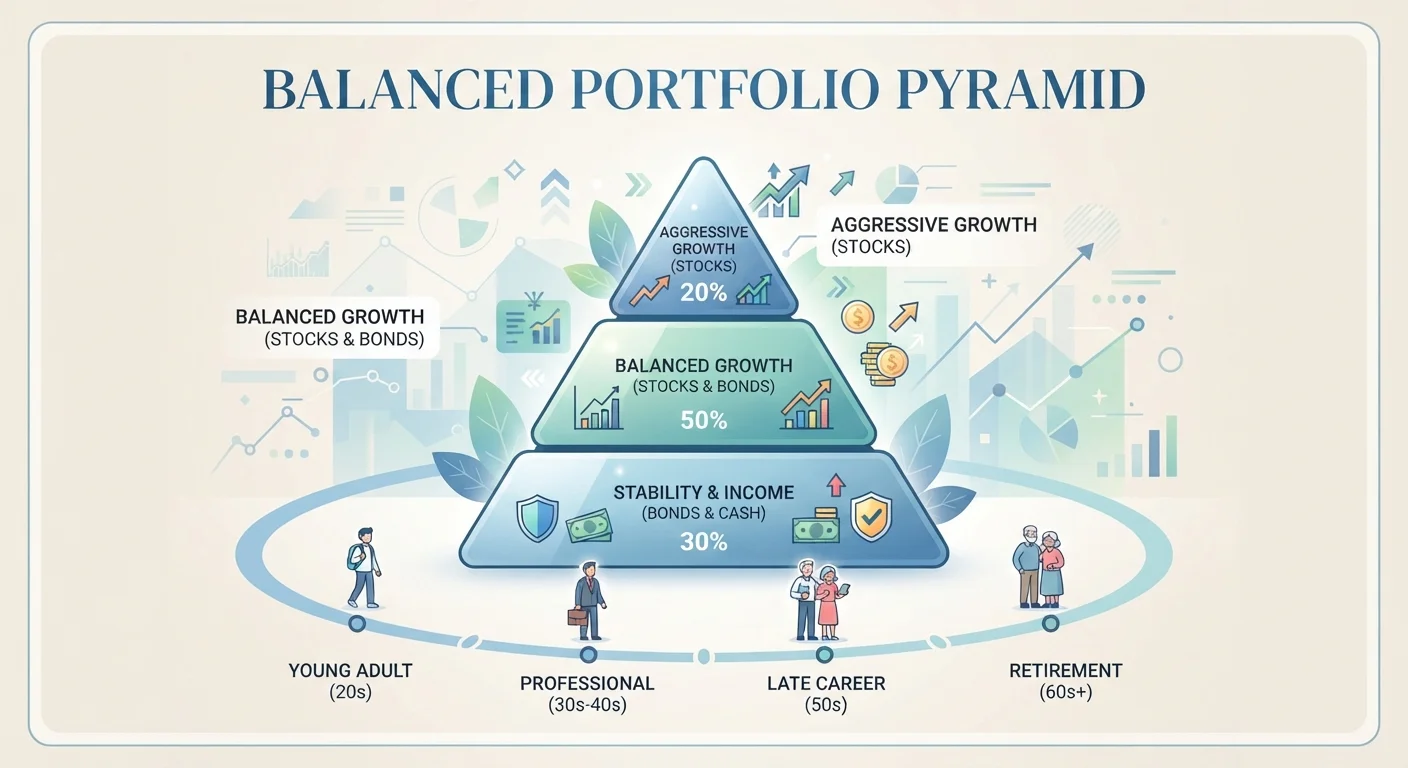
What Is Asset Allocation?
Asset allocation is the process of deciding how to divide your investment portfolio among different categories of assets — most commonly stocks, bonds, and cash. The goal is to build a mix that reflects both your financial objectives and your comfort with risk.
Think of it as a recipe. The proportions you choose determine how your portfolio behaves when markets rise or fall. A portfolio weighted heavily toward stocks will generally grow faster over long periods but also experience sharper drops. A portfolio anchored in bonds or cash tends to be more stable but grows more slowly.
Asset allocation is closely related to — but distinct from — diversification. Diversification is about spreading risk within asset classes (for example, owning many different stocks), while allocation is about how much you put into each class in the first place.
This article is for general educational purposes only and does not constitute personalized investment advice. Consult a licensed financial professional before making decisions about your own portfolio.
The Three Core Asset Classes
Understanding what each asset class does helps you see why the mix matters.
- Stocks (equities): Ownership shares in companies. Stocks have historically offered higher long-term returns than other major asset classes, but they come with significant short-term volatility. A 20–40% decline in a given year is not unusual during downturns.
- Bonds (fixed income): Loans you make to governments or corporations in exchange for regular interest payments and the return of principal at maturity. Bonds are generally less volatile than stocks and can cushion a portfolio during equity sell-offs, though they carry their own risks, including interest rate risk and credit risk.
- Cash and cash equivalents: Savings accounts, money market funds, and short-term Treasury bills. Cash provides stability and liquidity but typically earns the lowest returns over time, often failing to outpace inflation in the long run.
~90%
Portfolio return variation explained by asset allocation
Research attributed to Brinson, Hood, and Beebower (1986, updated 1991) estimated that asset allocation policy explains the large majority of a portfolio's return variability over time.
20–30 yrs
Average retirement span to plan for
According to Social Security Administration life expectancy data, a 65-year-old today can expect to live, on average, into their mid-to-late 80s — meaning portfolios must last decades.
3–6 mos
Emergency fund before investing
Financial educators commonly recommend having three to six months of living expenses in liquid savings before directing money into market investments.
Most portfolios use combinations of all three. The right blend depends heavily on when you need the money and how much short-term loss you can stomach without abandoning your plan.
Why Your Time Horizon Changes Everything
Your time horizon — how long before you need the money — is the single most important factor in choosing an allocation. It determines how much risk you can reasonably absorb.
If you're investing for a goal 30 years away, a market crash today is painful on paper but gives you decades to recover. If you need the money in three years, a 30% drop in your portfolio could seriously derail your plans. This is why short-term and long-term investing require very different strategies.
Use your age as a rough starting point for your bond percentage — for example, age 30 might suggest around 30% bonds — then adjust based on your actual risk tolerance and goals.
This old heuristic is oversimplified, but it illustrates the directional logic: as you age, gradually increasing your bond allocation reduces the impact of market volatility when you have less time to recover.
Before finalizing any allocation, ask yourself: 'If my portfolio dropped 25% next year, would I stay the course?' Your honest answer matters more than any formula.
Behavioral research consistently shows that investors who sell during downturns lock in losses and often miss the recovery — making emotional fit a legitimate portfolio consideration.
Risk tolerance also plays a role beyond math. Even if you have a long time horizon, you need to be honest about whether you'd panic-sell during a severe downturn. An allocation you can't stick with during bad markets is more dangerous than a slightly more conservative one you can hold steady.
Asset Allocation by Life Stage
While every individual's situation is unique, financial educators commonly use life stage as a rough framework for thinking about allocation. These are general illustrations, not prescriptions.
Early Career (20s–early 30s)
With decades of compounding ahead, investors in this stage are typically encouraged to hold a higher proportion of stocks — sometimes 80–90% of their portfolio — to maximize long-term growth potential. Bonds and cash play a smaller role. Before investing at all, it's worth understanding the difference between saving and investing and ensuring you have an emergency fund in place.
Mid-Career (late 30s–50s)
As retirement draws closer, many investors begin gradually shifting toward a more balanced mix — perhaps 60–70% stocks and 30–40% bonds. The goal is to preserve the gains you've built while still growing the portfolio. This is also when financial goals tend to diversify: college savings, mortgage payoff, and retirement may all compete for the same dollars.
Pre- and Early Retirement (late 50s–60s)
With the spending phase approaching, preserving capital becomes a priority. A common shift moves more assets into bonds and cash equivalents while keeping some stock exposure to guard against inflation over a potentially long retirement. Sequence-of-returns risk — the danger of a market crash right before or after you stop working — becomes a real concern.
No Allocation Is Risk-Free
Even conservative portfolios heavy in bonds or cash carry risks — including inflation risk, which can erode purchasing power over time. Holding too little in growth assets like stocks may mean your savings don't keep pace with rising costs. Every allocation involves trade-offs, not the elimination of risk.
Rebalancing: Keeping Your Portfolio on Track
Over time, market movements will push your allocation away from its original targets. If stocks surge, they may come to represent a larger share of your portfolio than you intended — increasing your risk exposure without any deliberate decision on your part.
Rebalancing is the practice of periodically selling some of what has grown and buying more of what has lagged to restore your target mix. Many investors do this annually or when any asset class drifts more than a set percentage — say, 5 percentage points — from its target.
A Simple Rebalancing Trigger
Set a calendar reminder to review your portfolio once a year — a birthday or the start of a new year works well. If any asset class has drifted more than 5 percentage points from your target, consider rebalancing. This prevents emotion-driven decisions and keeps the process systematic.
Inside tax-advantaged retirement accounts like a 401(k) or IRA, rebalancing is generally straightforward and doesn't trigger immediate tax consequences. In taxable brokerage accounts, selling appreciated assets may create a taxable event, so it's worth understanding the implications or speaking with a tax professional before rebalancing there.
Some investors use target-date funds, which automatically shift toward a more conservative allocation as a set retirement year approaches — effectively rebalancing on your behalf.
Common Mistakes to Avoid
Even well-intentioned investors can undermine their strategy through predictable missteps.
- Ignoring allocation entirely: Leaving all contributions in a default money market fund or simply picking funds at random is a form of unintentional allocation — often not a good one.
- Chasing recent performance: Shifting heavily into whichever asset class performed best last year often means buying high and setting yourself up for disappointment.
- Panic-selling during downturns: Locking in losses by selling stocks at the bottom of a market cycle is one of the most common and costly investor behaviors.
- Forgetting to rebalance: A portfolio that's never adjusted can drift far from its intended risk level over time.
- Skipping the foundation: If high-interest debt is accumulating or you have no emergency savings, investing aggressively may not be the right first step. The saving and debt hub covers those foundational steps.
This Is Education, Not Personalized Advice
The life-stage frameworks described here are general illustrations used for educational purposes. Your ideal allocation depends on your specific income, debts, goals, tax situation, and risk tolerance. A licensed financial advisor can help you build a plan tailored to your actual circumstances.
Asset allocation isn't a one-time decision. It evolves as your life changes — career shifts, new dependents, unexpected windfalls, or changes in your risk tolerance all can warrant a fresh look at your mix. Revisiting your allocation periodically, especially after major life events, is a healthy financial habit.