What Each Type of Fund Actually Does
Before comparing the two, it helps to understand what each fund type is designed to do.
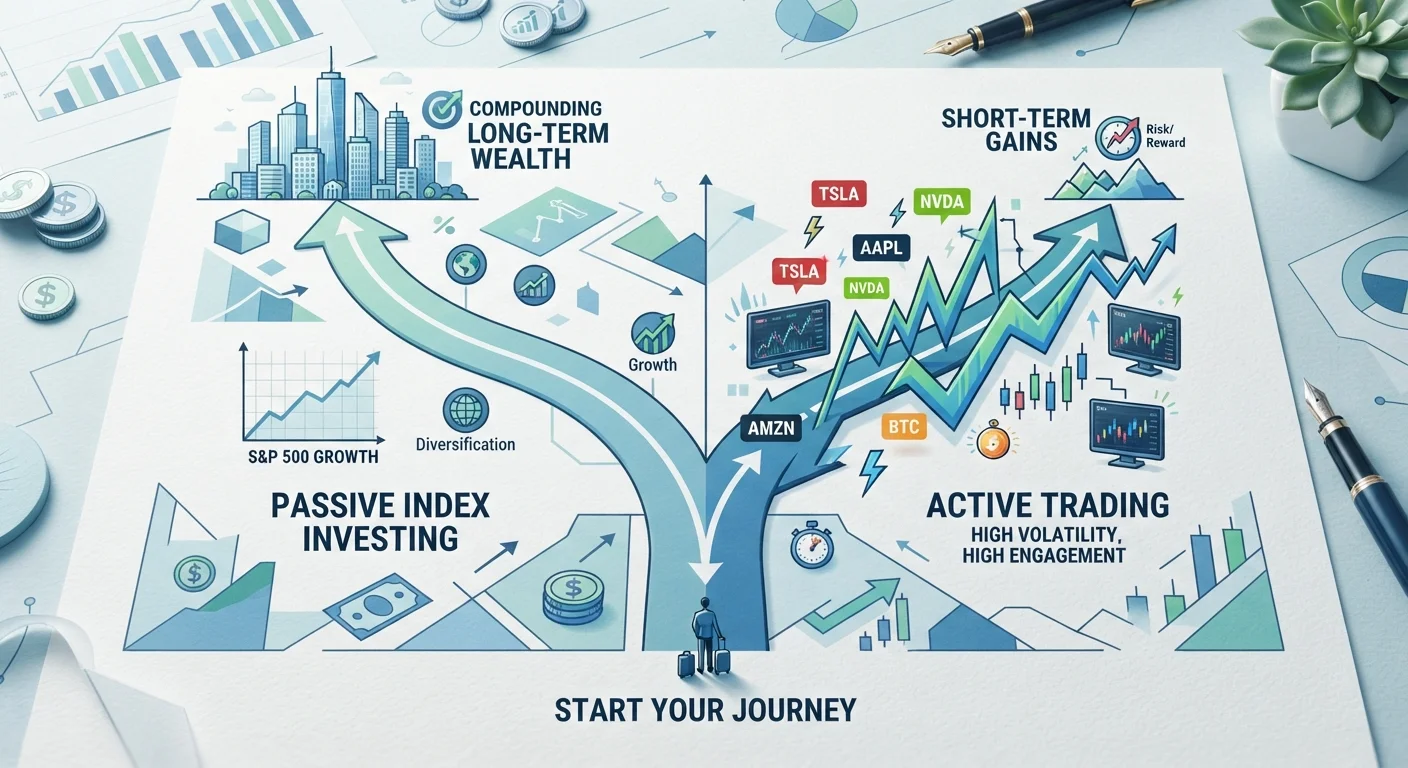
An index fund is a type of investment fund — often structured as a mutual fund or ETF — that aims to replicate the performance of a specific market index, such as the S&P 500 or the total US stock market. It doesn't try to pick winners. Instead, it holds roughly the same securities as the index it tracks, in the same proportions. The strategy is entirely passive: the fund adjusts only when the index itself changes. For more on how ETFs fit into this picture, see our guide to stocks, bonds, and ETFs.
An actively managed fund, by contrast, employs a portfolio manager (or a team) whose job is to make deliberate investment decisions — researching securities, timing market moves, and adjusting holdings — all with the goal of delivering returns that beat a relevant benchmark index. This requires ongoing human judgment and significant research resources.
Both types pool money from many investors, offer built-in diversification, and are regulated investment products. The core difference is strategy: passive tracking versus active decision-making.
The Cost Gap: Expense Ratios Matter More Than You Think
The most concrete difference between these fund types shows up in their fees, specifically the expense ratio — the annual percentage of your invested assets charged to cover fund operating costs.
| Criterion | Index Funds | Actively Managed Funds |
|---|---|---|
| Strategy | Tracks a market index passively | Manager actively selects securities |
| Typical Expense Ratio | 0.03%–0.20% | 0.50%–1.00%+ |
| Goal | Match market returns | Beat the benchmark index |
| Trading Frequency | Low (index-driven only) | High (manager discretion) |
| Tax Efficiency | Generally higher | Generally lower |
| Long-Term Track Record | Beats most active funds after fees | Majority underperform index over time |
Index funds typically carry expense ratios well under 0.20%, with many broad-market funds available at 0.03%–0.10%. Actively managed funds frequently charge 0.50%–1.00% or more annually, reflecting the cost of research staff, trading activity, and manager compensation.
That gap may sound trivial, but it compounds dramatically. On a $10,000 investment growing at 7% annually over 30 years, a 1% annual fee difference can reduce your ending balance by tens of thousands of dollars. For a deeper look at how fees erode returns over time, our article on fees, expense ratios, and returns walks through the math in detail.
~85%
Active large-cap funds underperforming S&P 500
According to S&P Dow Jones Indices SPIVA reports, approximately 85% of large-cap active US funds have trailed the S&P 500 over 15-year periods.
0.03%
Lowest common index fund expense ratios
Broad market index funds are available with annual expense ratios as low as 0.03%, among the lowest costs available to retail investors.
~$30,000+
Potential 30-year cost of a 1% fee difference
On a $10,000 investment growing at 7% annually, a 1% higher annual fee can reduce an ending balance by over $30,000 after 30 years.
Performance: What the Evidence Shows
Active fund managers are often talented, experienced professionals. Yet research has consistently found that the majority of actively managed funds underperform their benchmark index over 10- and 20-year periods, particularly after accounting for fees and taxes. The SPIVA (S&P Indices Versus Active) scorecards, published regularly by S&P Dow Jones Indices, document this pattern across domestic and international fund categories.
This doesn't mean active funds never outperform — some do, and some managers have delivered above-benchmark returns over extended periods. The challenge is identifying those managers in advance, and understanding that past outperformance doesn't reliably predict future results.
Past Performance Is Not a Guarantee
When evaluating actively managed funds, it's tempting to focus on recent strong performers. However, research shows that last year's top-performing active funds frequently fail to maintain that ranking in subsequent years. The SEC requires all fund materials to include a reminder that past performance does not guarantee future results — a rule worth taking seriously.
It's also worth noting that actively managed funds tend to generate more taxable events due to frequent trading, which can reduce after-tax returns in taxable brokerage accounts. Index funds, with their low turnover, are generally more tax-efficient.
Which Approach Fits Your Situation?
There's no single right answer — but there are useful questions to ask yourself.
- What's your time horizon? Long-term investors (think 20+ years) have historically benefited from low-cost index investing due to compounding. Your time horizon shapes your strategy in important ways.
- How involved do you want to be? Index funds require minimal ongoing attention. Active funds may prompt more frequent reviews as manager performance shifts.
- What role does this fund play in your portfolio? Many investors use index funds as core holdings and reserve a smaller allocation for active strategies in areas where they believe manager expertise adds value. Our asset allocation guide explains how to think about this balance.
This article is for general informational and educational purposes only and is not personalized investment advice. Consider consulting a licensed financial adviser before making investment decisions.