Why Investment Fees Matter More Than They Look
When you start investing, the numbers that grab your attention are usually returns — how much a fund grew last year, or what the market did. Fees? They tend to look small: 0.50%, maybe 1%. Easy to overlook.
But investment fees work silently against you every single year, compounding in the wrong direction. Because fees are taken from your returns before they have a chance to grow, their true cost is always larger than the percentage printed on the label.
Consider two hypothetical investors who each put $20,000 into funds earning 7% annually before fees. One is in a fund charging 0.10% per year; the other pays 1.10%. After 30 years, the lower-cost investor ends up with roughly $30,000 more — purely from that 1% annual difference. No extra contribution, no smarter stock-picking. Just lower fees.
Understanding this dynamic is foundational to smart investing. It's also one of the few factors entirely within your control, regardless of how markets perform.
0.03%
Lowest expense ratios on some index funds
Several broad-market index funds and ETFs now carry expense ratios as low as 0.03% annually, according to publicly available fund prospectuses.
~0.50%
Average expense ratio for actively managed U.S. equity funds
Morningstar's annual fee study has found that the asset-weighted average expense ratio for actively managed U.S. equity funds has declined over time but remains well above passive fund averages.
$30,000+
Potential difference from a 1% fee gap over 30 years
Illustrative calculation based on a $20,000 initial investment growing at 7% annually before fees, comparing a 0.10% vs. 1.10% annual expense ratio over 30 years.
Breaking Down the Fee Types You'll Encounter
Fees in investing aren't one-size-fits-all. Here's what you're likely to come across:
- Expense ratio: The most common and important fee. It covers a fund's operating costs and is expressed annually as a percentage of your assets. It's automatically deducted from the fund's performance, so it's invisible on your account statement — but very real.
- Management fee: A component within the expense ratio paid to the portfolio manager. Actively managed funds, which employ professionals to pick investments, charge higher management fees than passively managed index funds.
- 12b-1 fee: A marketing and distribution fee some funds charge, also embedded in the expense ratio. Worth noting when comparing similar funds.
- Transaction fees: Some brokerages charge a fee each time you buy or sell a fund or stock. Many platforms now offer commission-free trading, but always verify before you invest.
- Account maintenance fees: Flat annual or monthly charges for keeping an account open. Often waived if you maintain a minimum balance.
- Advisory fees: If you use a financial adviser or robo-adviser, you may pay an additional layer of fees on top of the fund's own expense ratio.
These costs can stack. An actively managed fund with a 1.00% expense ratio combined with a 0.50% advisory fee means 1.50% of your money is working for costs — not for you. For context on how this layering of costs compares to other financial trade-offs, see our article on index funds vs. actively managed funds.
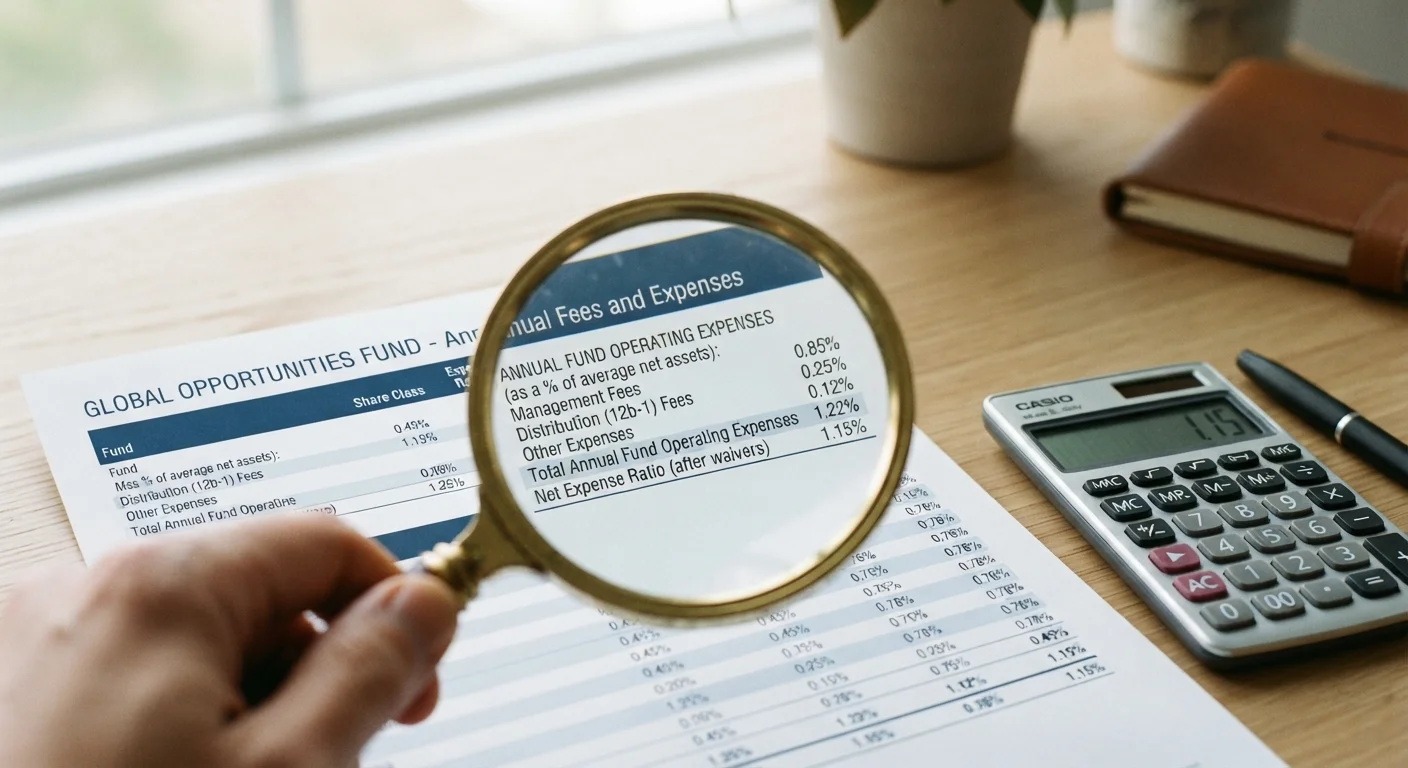
Look for the 'Total Annual Fund Operating Expenses' Line
When reviewing a fund, go straight to the fee table in its prospectus or summary prospectus. The 'Total Annual Fund Operating Expenses' line gives you the all-in expense ratio, including management fees and any 12b-1 fees. This single number is your most reliable comparison point across similar funds.
Index Funds, Active Funds, and the Cost Difference
One of the clearest illustrations of how fees affect outcomes is the comparison between actively managed funds and passively managed index funds.
Actively managed funds hire portfolio managers who research investments and make decisions aimed at outperforming the market. That expertise comes at a cost — typically 0.50% to 1.50% or more annually. Passive index funds simply track a market index (like the S&P 500) with minimal human intervention, which keeps expenses very low — often below 0.10%.
Research has consistently shown that a majority of actively managed funds fail to beat their benchmark index over long time periods, in part because they have to overcome their higher cost burden before they can outperform. That doesn't make active funds inherently wrong for every investor, but it does make cost an especially important consideration when comparing options.
Your investment time horizon matters here too. If you're investing for decades, the compounding drag of higher fees becomes increasingly significant. Learn more about how time horizon shapes strategy in our guide to short-term vs. long-term investing.
How to Evaluate and Minimize Your Investment Costs
You don't need to become a fee expert to make smarter decisions. A few practical habits go a long way:
- Read the fund's prospectus or fund fact sheet. The expense ratio and all associated fees must be disclosed. Look for the "Annual Fund Operating Expenses" table.
- Use fund screeners. Most brokerage platforms allow you to filter funds by expense ratio, making it easy to compare similar options side by side.
- Watch out for fee layering. Add up the fund's expense ratio plus any advisory or platform fee to understand your true total annual cost.
- Avoid unnecessary account fees. If a platform charges account maintenance fees, check whether meeting a minimum balance waives them — or whether a different platform is simply more cost-efficient for your situation.
- Be cautious with frequent trading. Even on commission-free platforms, frequent buying and selling can trigger tax events that erode returns, similar to a hidden fee.
Think of managing investment costs the same way you'd think about managing any recurring expense — consistently applying small improvements adds up significantly over time. If you're working to understand all the hidden costs in your financial life more broadly, our Budgeting Basics hub is a useful companion resource.
“In investing, you get what you don't pay for. Costs matter enormously in investing, and one of the ways investors can improve their returns is by paying attention to the costs of the funds they own.”
— John C. Bogle, Founder of Vanguard and pioneer of low-cost index fund investing
This article is for general informational and educational purposes only. It is not personalized financial or investment advice. Past performance does not guarantee future results. Consult a qualified financial professional before making decisions based on your individual circumstances.