
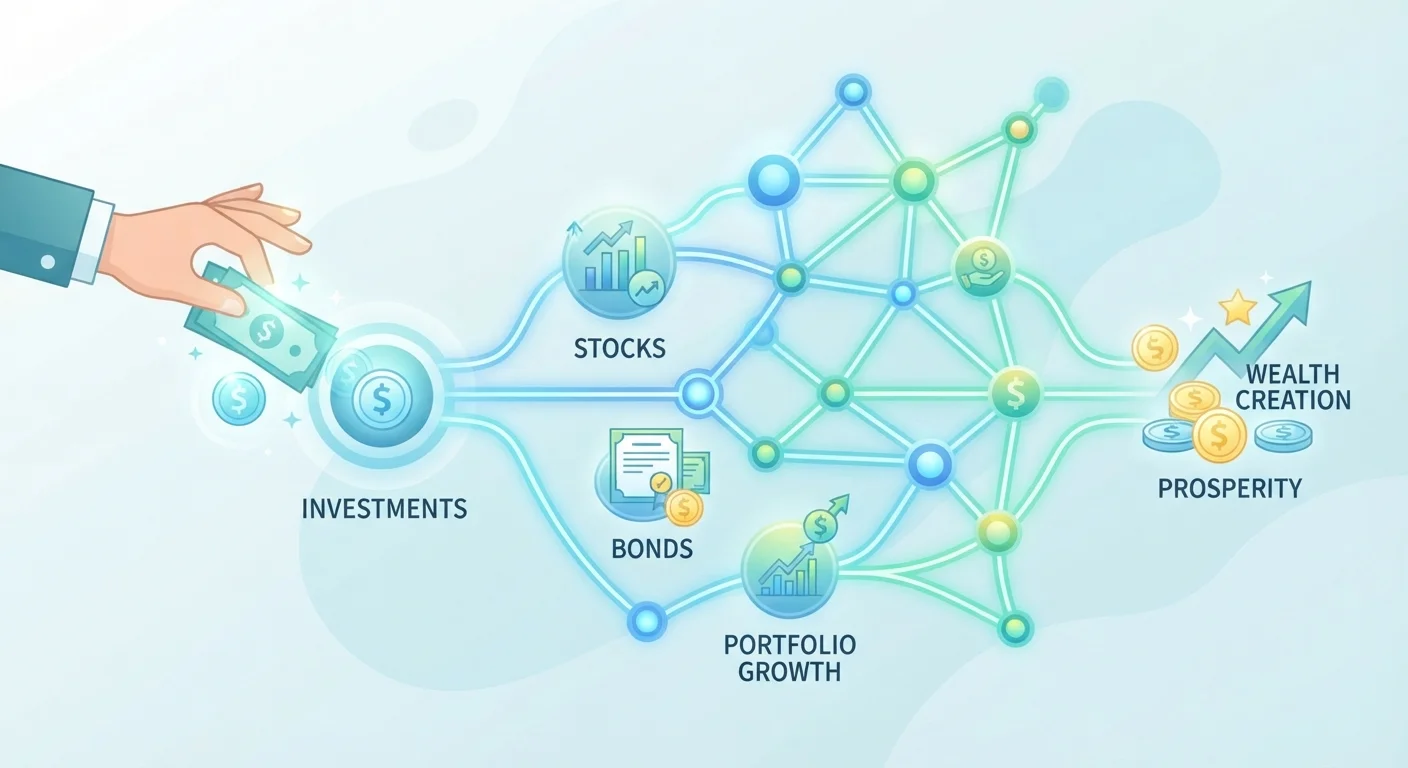
The Basic Mechanic: Your Money Doesn't Just Sit There
When you deposit money into a savings account, it earns a small amount of interest. When you invest, something fundamentally different happens: your money is exchanged for an ownership stake or a debt instrument in an economic entity — a company, a government, or a pool of assets.
Think of it this way. A company needs $10 million to build a new factory. Rather than borrowing from a single bank, it can sell shares of stock to thousands of investors. Each investor contributes a small amount and, in return, owns a fraction of the company. If the factory succeeds and the company grows more profitable, those shares become more valuable. That's the core mechanic — capital flows toward productive use, and investors share in the outcome.
The same principle applies to bonds: you're essentially lending money to a government or corporation, which agrees to pay you back with interest over time. Understanding the distinction between saving and investing is the first step to deciding where your money belongs.
How Returns Are Generated
Investment returns don't appear from nowhere. They're tied to real economic activity. Here are the three main ways investors make money:
- Price appreciation: You buy an asset and later sell it for more than you paid. This works because the underlying business or asset has grown in value — or because other investors are willing to pay more for it.
- Dividends: Some companies distribute a portion of their profits directly to shareholders, usually quarterly. These are called dividends and represent a share of real earnings.
- Interest: When you own bonds or bond funds, you earn interest — a predetermined rate paid by the borrower (a company or government) in exchange for use of your money.
Most investors experience a mix of all three, depending on what they own. Stocks, bonds, and ETFs each generate returns differently — understanding those differences helps you match assets to your goals.
~10%
Historical average annual return of U.S. stocks
The S&P 500 has historically averaged roughly 10% annual returns before inflation over the long run, though individual years vary significantly and past performance does not guarantee future results.
3–4%
Long-run average U.S. inflation rate
The Federal Reserve targets 2% annual inflation; historically, U.S. inflation has averaged around 3–4% over long periods, illustrating why holding cash can erode purchasing power over time.
58%
Share of U.S. adults who own stock
According to Gallup polling, roughly 58% of American adults report owning stock either directly or through funds like 401(k)s, a figure that has held relatively steady in recent years.
The Role of Risk (and Why It Can't Be Avoided)
Here's the uncomfortable truth: no investment is guaranteed. When you invest, you're accepting uncertainty in exchange for the potential of growth. A company can underperform. A market can drop sharply. A bond issuer can default. These aren't hypothetical — they happen.
That said, risk isn't something to run from. It's something to understand and manage. Diversification — spreading money across different types of assets — is one of the most widely used tools for managing investment risk without abandoning growth potential entirely.
Risk and Reward Are Linked
Generally, investments with higher potential returns carry higher risk of loss, and lower-risk investments tend to offer more modest returns. This tradeoff is sometimes called the risk-return relationship, and it's a foundational concept in investing. There's no universally 'safe' investment that also delivers high guaranteed returns — claims to the contrary are a common warning sign of fraud.
The key insight most beginners miss is that not investing also carries a risk: the risk that inflation erodes your purchasing power over time. A dollar kept under a mattress buys less in 20 years than it does today. Investing is one of the most established ways people try to stay ahead of inflation over the long run.
If you're worried that investing is just another word for gambling, common investing myths worth fact-checking address exactly that concern.
Why Time Is the Variable That Changes Everything
Investing rewards patience. When returns are reinvested — meaning dividends or interest earn their own returns — the effect compounds over time. A modest annual return, sustained over decades, can produce dramatically more wealth than a higher short-term return that's quickly withdrawn or disrupted.
This is why most personal finance educators emphasize starting early, even with small amounts, rather than waiting until you have a large sum to deploy. Time in the market gives compounding room to work. Compound interest is the mechanic that makes early investing matter — and it works quietly in the background the longer your money stays invested.
Your time horizon also shapes what kinds of investments make sense. Short-term and long-term investing require different strategies — someone saving for a vacation in two years should approach investing very differently than someone saving for retirement in 35 years.
“The stock market is a device for transferring money from the impatient to the patient.”
— Warren Buffett, Investor and Chairman of Berkshire Hathaway
This article is for general informational and educational purposes only and does not constitute personalized financial, investment, tax, or legal advice. Consult a qualified financial professional before making investment decisions.