How Compound Interest Actually Works
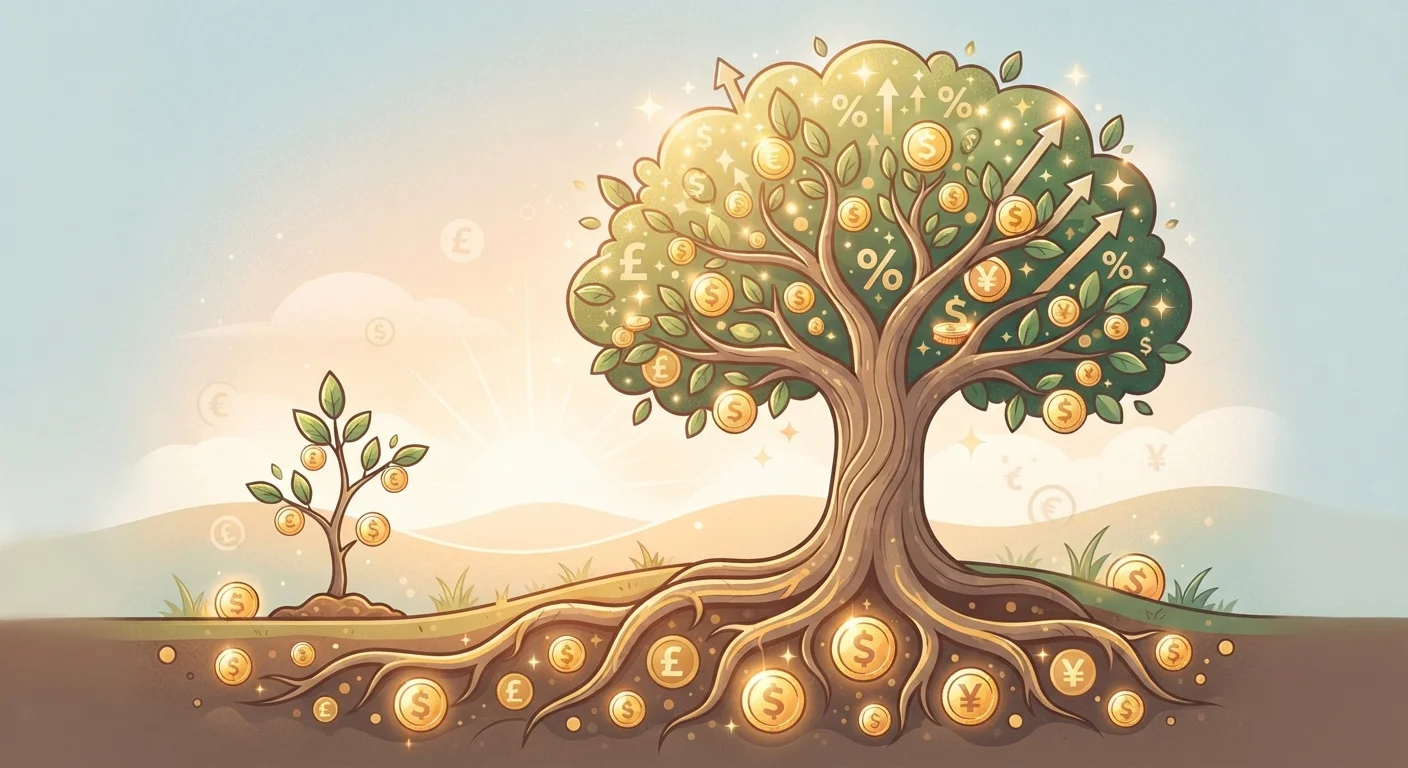
The mechanic is straightforward, but its long-term effect is often underestimated. Imagine you invest $1,000 at a 7% annual return. After year one, you've earned $70 in interest — bringing your balance to $1,070. In year two, that 7% is applied to $1,070, not just the original $1,000. You earn $74.90 instead of $70. The difference seems small at first, but it compounds every single year.
After 30 years, without adding another dollar, that $1,000 grows to roughly $7,612 — more than seven times the original amount. The mathematical formula behind this is: A = P(1 + r/n)nt, where P is principal, r is annual interest rate, n is compounding periods per year, and t is time in years. You don't need to memorize the formula; what matters is understanding what drives the outcome: rate, frequency, and — most critically — time.
For a plain-language primer on financial terminology like APR and APY, see our glossary for new earners.
7×
Growth of $1,000 at 7% over 30 years
A one-time $1,000 investment compounding at 7% annually reaches approximately $7,612 after 30 years, with no additional contributions.
72
Rule of 72: years to double your money
Divide 72 by your annual return rate to estimate how many years it takes to double an investment — at 6%, that's roughly 12 years.
10 years
Head start that can offset lower contributions
Financial educators widely illustrate that starting a decade earlier can offset the need for significantly larger future contributions to reach the same balance.
Why Time Is the Most Valuable Variable
Two investors contribute the same total amount of money. Investor A starts at 22 and contributes $200 per month for 10 years, then stops completely. Investor B starts at 32 and contributes $200 per month for 30 years, never stopping. Assuming identical 7% annual returns, Investor A — who contributed far less — can end up with a comparable or larger balance at retirement. That outcome isn't magic; it's the compounding of an extra decade of growth.
This is why the most common guidance from financial educators is consistent: the earlier you start, the less you may need to contribute over your lifetime to reach the same destination. Waiting even a few years can require significantly higher future contributions to close the gap.
Start With What You Have
You don't need a large sum to benefit from compounding. Even $25 or $50 per month invested consistently gives compounding time to work. The habit of investing regularly — and not withdrawing early — matters more than the size of initial contributions.
For more on how time horizon shapes your overall strategy, see our explainer on short-term vs. long-term investing.
Compounding Works Both Ways — Including in Debt
Compounding is a neutral mechanic. It amplifies whatever it's applied to — including balances you owe. When you carry a credit card balance at 20% APR and only make minimum payments, interest is charged on your remaining balance each month. That interest is then added to the principal, and next month's interest is calculated on the new, higher total. Left unchecked, a modest balance can double in a few years without any new spending.
Understanding this is especially important because the same principle that builds wealth in an investment account can quietly increase what you owe. If you're managing high-interest debt while also trying to start investing, see what high-interest debt really costs over time for a clear look at the numbers.
Compounding Frequency Makes a Difference
Interest that compounds daily grows slightly faster than interest that compounds annually at the same stated rate. When evaluating savings accounts or investment accounts, look for the APY (Annual Percentage Yield) rather than the APR — APY reflects the effect of compounding frequency and gives a more accurate picture of actual annual growth.
Putting Compounding Into Practice
Understanding compounding intellectually is the first step. Putting it to work is the second. The practical implications are concrete: consistency matters more than perfect timing, starting small is better than waiting until you can start big, and avoiding high-interest debt is just as important as growing investments.
Compounding requires an actual vehicle — an account where returns are reinvested rather than withdrawn. Tax-advantaged retirement accounts, for instance, allow reinvested gains to compound without being taxed year over year, which can meaningfully increase outcomes over decades. This is general information; a qualified financial professional can help you evaluate which account types make sense for your specific situation.
If you're still deciding whether investing is the right next step versus building savings first, understanding the difference between saving and investing is a useful foundation. And if you want to understand what actually happens to money once it's invested, see what actually happens when you invest.
“Compound interest is the eighth wonder of the world. He who understands it, earns it; he who doesn't, pays it.”
— Attributed to Albert Einstein, Widely circulated attribution in personal finance education — original source unverified, but the principle it describes is mathematically accurate
This article is for general informational and educational purposes only and does not constitute personalized financial, investment, or tax advice. Consult a qualified financial professional before making decisions about your own money.