Why This Choice Matters More in a Small Kitchen
In a compact kitchen, every design decision is amplified. Upper wall space does double duty - it affects both how much you can store and how large the room feels. Open shelving and traditional upper cabinets represent two fundamentally different answers to the same constraint, and neither is universally superior.
The honest difference comes down to a trade-off: visual spaciousness versus maintenance ease. Open shelves pull walls back visually, letting light move through and making tight spaces feel less boxed in. Upper cabinets do the opposite - they close off the wall but keep everything out of sight and protected from cooking residue.
Understanding which trade-off fits your actual lifestyle, not just your Pinterest board, is the real starting point here.
| Criterion | Open Shelving | Upper Cabinets |
|---|---|---|
| Visual impact | Opens up the space, reduces wall weight | Can feel heavy; manageable with light finishes |
| Maintenance | Weekly dusting and wiping required | Low - contents protected behind doors |
| Storage capacity | Limited by what looks intentional | Higher - hides varied and imperfect items |
| Install cost (new build) | Generally lower | Generally higher |
| Renter-friendliness | Requires landlord approval for wall mounts | Existing cabinets need no modification |
| Grease and dust protection | None - items fully exposed | Good - doors block airborne residue |
| Access speed | Instant - everything visible | Slightly slower - requires opening doors |
Open Shelving: The Real Benefits and Hidden Costs
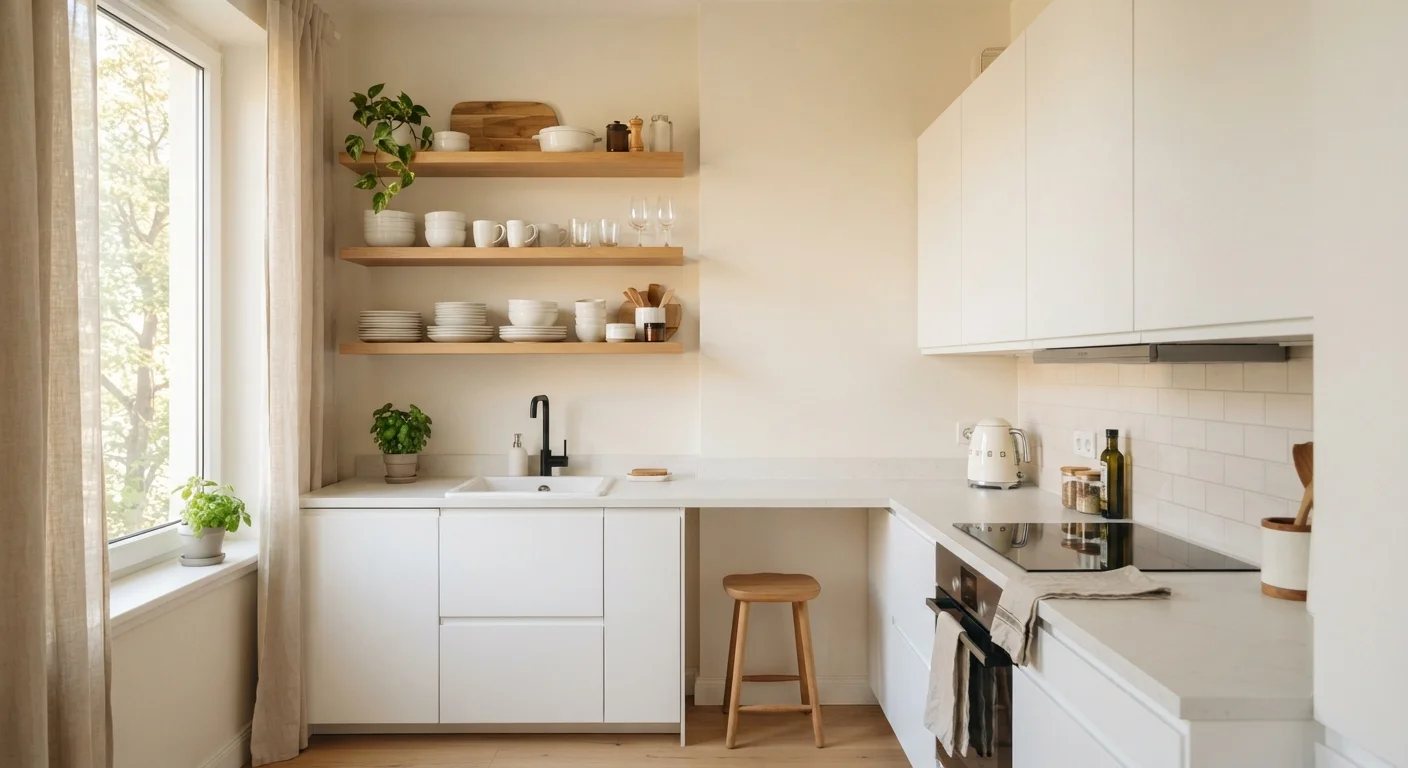
Open shelves genuinely do make small kitchens feel larger. By removing the visual bulk of cabinet boxes and doors, you create depth and allow the eye to travel further - a principle similar to how visual tricks expand compact outdoor spaces.
Beyond aesthetics, open shelves offer instant access - no hunting through closed cabinets, and frequently used items stay visible and within reach. They're also generally less expensive to install than full upper cabinets if you're doing a renovation from scratch.
The honest downside? Grease, steam, and dust settle on everything. In an active kitchen, open shelves require wiping down at least weekly, and every item on display needs to look intentional. If your storage includes a mix of mismatched containers, rarely-used appliances, and half-empty boxes, open shelves will broadcast that clutter rather than hide it.
~30%
Perceived space increase from open shelving
Interior design professionals commonly estimate that removing upper cabinet doors can make a kitchen feel up to 30% more open, primarily due to reduced visual mass.
2-3×
More frequent cleaning needed vs. cabinets
Home organization experts generally suggest open kitchen shelves need wiping two to three times more often than closed cabinet interiors in an actively used kitchen.
Upper Cabinets: Dependable but Potentially Oppressive
Standard upper cabinets earn their place in small kitchens through sheer practicality. They protect your dishes, dry goods, and glassware from grease and airborne particles - genuinely important in a kitchen where the stove and prep area sit just feet from your storage wall. They also impose no daily tidiness standard; what's inside stays inside.
The drawback in a small kitchen is visual heaviness. A full run of upper cabinets - especially in a dark finish or floor-to-ceiling height - can make a narrow galley or single-wall kitchen feel like a corridor. This is where cabinet finish, height, and door style become important mitigation strategies. Glass-front doors, lighter paint colors, and stopping cabinets a few inches below the ceiling all help reduce that closed-in feeling.
For renters sharing a space with a cat or other pets, cabinets also offer a practical benefit - keeping food items and fragile dishware out of reach. If that's relevant to your setup, the room-by-room guide to cat-proofing an apartment covers kitchen considerations in more detail.
Making the Hybrid Approach Work
Most small kitchens benefit from a deliberate mix. A common strategy: keep upper cabinets on one side of the kitchen - typically above the stove and sink where grease and steam are highest - and introduce open shelves on the adjacent wall or at the end of a run.
This approach concentrates closed storage where it's most protective while using open shelves to display curated items: a consistent set of ceramic mugs, a small collection of cookbooks, or a row of labeled dry-goods jars. The result looks intentional rather than default.
If you're a renter considering this, check your lease before removing any cabinet doors or mounting new shelf hardware. Even minor wall modifications can trigger restoration obligations. A lower-commitment version is to use freestanding shelf units that sit on the counter rather than mount to the wall - they add open-shelf aesthetics without permanent changes.
This article is for general informational purposes only. Always verify local building codes and lease terms with the appropriate professionals before making structural or semi-structural changes to your home.