Start Here: Serving Size and Calories
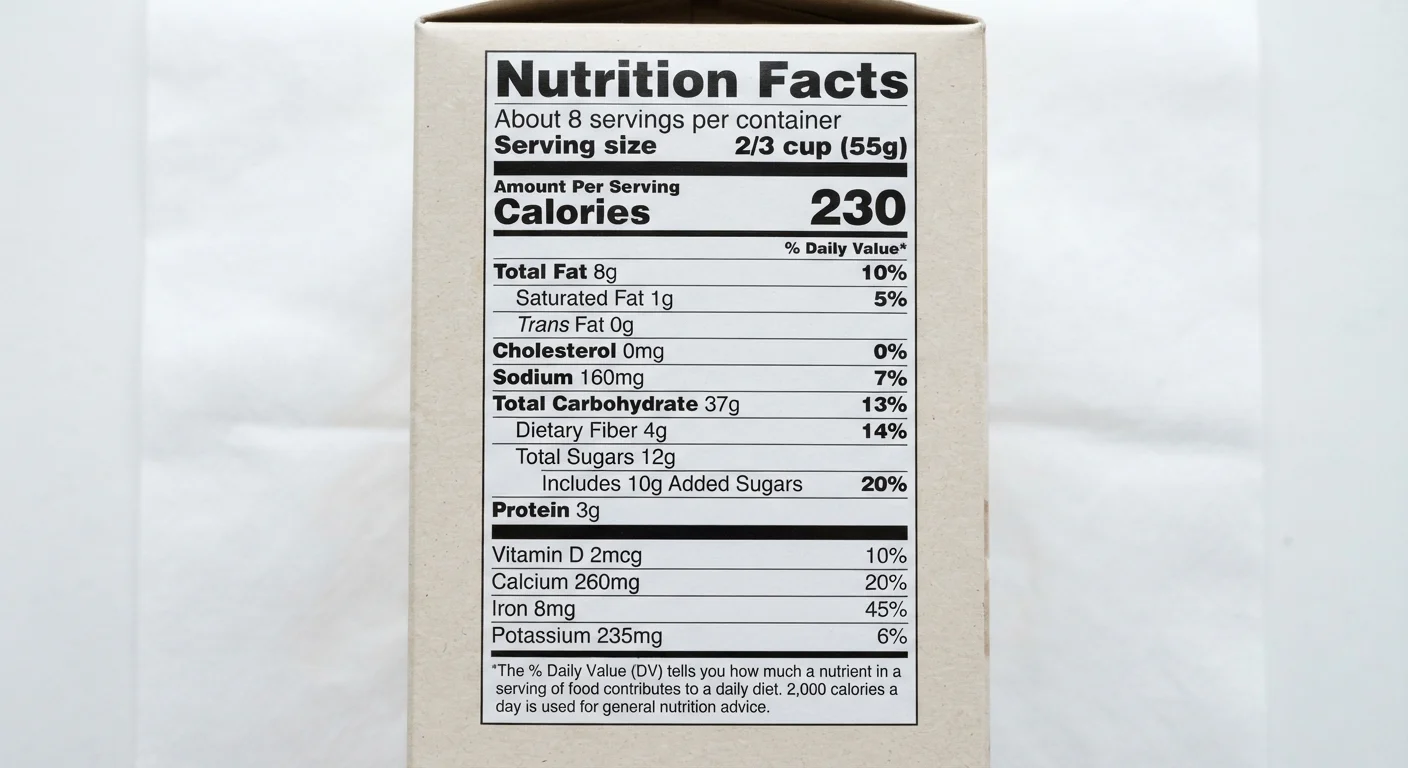
Everything on a Nutrition Facts label is tied to one foundational number: the serving size. It's listed at the very top, and all the nutrients, percentages, and calories below it reflect that one serving - not necessarily the whole package.
This distinction matters more than it sounds. A bag of chips listing 150 calories per serving might contain three servings. Eat the whole bag and you've consumed 450 calories, triple the sodium, and triple the fat shown. The FDA updated Nutrition Facts label rules (fully phased in by 2020) to require serving sizes reflect amounts people realistically eat, making this easier to gauge.
Directly below serving size is the calorie count. Calories measure the energy a food provides. There's no universally correct number to aim for per meal - individual needs vary based on age, activity level, body size, and health status. For general context, the FDA bases its percentage daily values on a 2,000-calorie reference diet, but this is a benchmark, not a prescription. See our guide to nutrition fundamentals for a deeper look at how energy needs work.
| Serving size basis | Reflects realistic consumption amounts per FDA rules updated by 2020 (U.S. Food & Drug Administration) |
| Calorie reference diet | 2,000 calories/day (used to calculate %DV) (FDA Nutrition Facts label guidelines) |
| Low %DV threshold | 5% DV or less per serving (FDA) |
| High %DV threshold | 20% DV or more per serving (FDA) |
| Added sugars requirement | Must be listed separately from total sugars since 2020 (FDA label update rule) |
| Declared allergens | 9 major allergens required by law (milk, eggs, fish, shellfish, tree nuts, peanuts, wheat, soybeans, sesame) (FASTER Act, FDA) |
The Nutrient Breakdown: What to Limit and What to Get Enough Of
Below calories, the label splits into two general categories: nutrients most Americans get too much of, and nutrients many people don't get enough of.
Nutrients to Limit
- Saturated fat: Linked to cardiovascular risk when consumed in excess. The American Heart Association recommends keeping this in check.
- Sodium: High intake is associated with elevated blood pressure in some people. Look for patterns across your whole day, not just one item.
- Added sugars: Listed separately from total sugars since 2020. These are sugars added during processing, not naturally occurring ones. They contribute calories with little nutritional benefit. Our article on how added sugars hide on ingredient lists explains the many names they go by.
Nutrients to Prioritize
- Dietary fiber: Supports digestive health and is associated with reduced chronic disease risk.
- Vitamin D, calcium, iron, and potassium: These are flagged because many Americans fall short. Higher intake from food is generally encouraged.
Understanding what carbs, proteins, and fats actually do in your body can help these numbers feel more meaningful. For vitamins and minerals, our micronutrients quick-reference guide provides helpful context.
Serving Size
The standardized amount of food the label's nutrition information is based on. It's set to reflect how much people typically eat in one sitting, not necessarily the entire package.
% Daily Value (%DV)
A percentage showing how much a nutrient in one serving contributes to a general daily reference amount, calculated based on a 2,000-calorie diet. It helps compare foods and assess nutrient content at a glance.
Added Sugars
Sugars introduced during food processing or preparation, distinct from naturally occurring sugars found in whole fruit or plain dairy. They appear as a separate line on updated Nutrition Facts labels.
Saturated Fat
A type of fat found in animal products and some plant oils that is solid at room temperature. High dietary intake is associated with increased LDL (low-density lipoprotein) cholesterol in some people.
Dietary Fiber
A type of carbohydrate the body cannot fully digest. It supports digestive health, helps regulate blood sugar, and is associated with reduced risk of certain chronic diseases.
Sodium
A mineral used in food processing and preservation. Diets high in sodium are associated with elevated blood pressure in some individuals, making it one of the key nutrients to monitor on labels.
Percent Daily Value: A Useful Compass
The % Daily Value (%DV) column is one of the label's most practical tools - and one of the most misunderstood. It shows how much of a nutrient one serving contributes toward a general daily reference amount, based on a 2,000-calorie diet.
A simple rule of thumb recognized by nutrition educators: 5% DV or less is considered low for a nutrient; 20% DV or more is considered high. Use this to quickly compare similar products or to identify foods that are notably high in sodium or low in fiber.
%DV Is a Reference, Not a Personal Target
The percent daily values on nutrition labels are calculated using a 2,000-calorie reference diet - a standard set for comparison purposes, not a recommendation for everyone. Your actual needs may be higher or lower depending on your age, sex, activity level, and health status. Use %DV as a relative guide to compare products and spot nutritional extremes, not as a strict daily scorecard.
The %DV is not a target to hit for every food - it's a reference tool. A single food being high in sodium doesn't mean your whole day is, and one low-fiber item doesn't define your diet. The goal is balance across meals. For practical strategies that don't involve math, see our article on building a balanced plate without counting calories.
The Ingredient List: What's Actually in the Food
The ingredient list appears below the Nutrition Facts panel and follows a strict rule: ingredients are listed in descending order by weight. Whatever appears first makes up the largest proportion of the product.
A few practical tips for reading it:
- If a form of sugar (cane syrup, dextrose, maltose, honey, etc.) appears in the first three ingredients, the product is likely high in added sugar.
- Long ingredient lists aren't automatically bad - some minimally processed foods have many components. Short lists aren't automatically better either.
- Watch for allergens: the FDA requires the top nine allergens (milk, eggs, fish, shellfish, tree nuts, peanuts, wheat, soybeans, and sesame) to be clearly declared.
The ingredient list and Nutrition Facts panel work best together. A product might show moderate sugar on the label but list three different sweeteners in the ingredients - each individually lower-ranked but collectively significant.
This article is for general informational purposes only and does not constitute medical or dietary advice. Individual nutritional needs vary. Please consult a registered dietitian or qualified healthcare professional for guidance tailored to your specific health situation.