Why Parallel Parking Feels So Hard
Parallel parking triggers anxiety in even experienced drivers for a simple reason: it's a multi-step spatial task performed in public, under time pressure, with other drivers watching. The car's geometry is working against your intuition - the rear of the vehicle swings in the opposite direction from the steering wheel, which means everything feels backwards at first.
Most new drivers attempt the maneuver by feel and guesswork, which produces inconsistent results. The fix is a repeatable, angle-based sequence that removes guesswork entirely. Once you understand which reference points to watch and when to change your steering, the skill becomes predictable. If you're still building broader driving confidence, see our guide for new drivers heading out solo for foundational skills to complement this one.
Practice in an Empty Parking Lot First
Set up two markers - cones, trash cans, or cardboard boxes - to simulate parked cars and rehearse the full sequence without traffic pressure. Even just 30 minutes of deliberate practice will make real-street attempts significantly less stressful.
What You'll Need Before You Start
What you will need
A vehicle with functioning mirrors
Side and rearview mirrors are essential for monitoring clearances on both ends of the space during the maneuver.
Rear parking sensors or a backup camera
Provides additional distance reference when reversing toward the curb - useful but not required.
Open parking lot with cones or markers
Used for practice runs before attempting parallel parking on active city streets.
Step-by-Step: The Parallel Parking Sequence
Follow these steps in order every time. Consistency is what makes the maneuver reliable - resist the urge to improvise mid-sequence until you've built solid muscle memory through practice.
Check Blind Spots Throughout the Maneuver
Parallel parking requires you to reverse in a busy environment where cyclists, pedestrians, and other vehicles can appear suddenly. Never rely solely on mirrors - physically check your blind spots before and during the reverse. A collision during parking, however slow, is still a collision.
Find and size up the space
Identify a gap that is at least 1.5 times the length of your vehicle - for most sedans, that means roughly 20-22 feet. Anything shorter puts you in a frustrating, grinding back-and-forth that rarely ends cleanly. Drive slowly past the space to judge its length relative to your car before committing.
Signal and position alongside the front car
Activate your right turn signal to alert following traffic that you're preparing to park. Pull up parallel to the car in front of the empty space, aligning your rear bumper roughly even with that car's rear bumper. Maintain about 2-3 feet of lateral distance between your vehicle and theirs.
Begin reversing and turn the wheel sharply toward the curb
Shift into reverse and begin moving slowly backward. As you start rolling, steer toward the curb (right, in typical US street parking). The goal is to guide your rear end into the space at roughly a 45-degree angle. Keep your speed very low - walking pace or slower.
Straighten the wheel when your car hits 45 degrees
When your vehicle is at approximately a 45-degree angle to the curb - you'll see the rear car's full front end in your driver-side mirror - straighten your steering wheel briefly while continuing to reverse slowly. This motion brings the rear of your car deeper into the space.
Turn the wheel sharply away from the curb
As your front bumper clears the rear bumper of the car ahead of you, turn the steering wheel sharply away from the curb (left). Continue reversing. This swings your front end into the space and begins to straighten your vehicle parallel to the curb.
Straighten up and adjust your position
Once your car is roughly parallel to the curb, straighten the wheel and creep forward or backward to center yourself in the space. Aim for 12-18 inches from the curb - close enough to be legal and safe, but not so close your doors can't open. Turn off your signal.
Common Mistakes and How to Avoid Them
The most frequent error is starting the reverse before properly aligning with the front car. If your starting position is off, every subsequent angle will compound that error. Take an extra few seconds to get your initial alignment right - it saves frustration.
Another common problem is moving too fast. Parallel parking should happen at a near-crawl. Speed removes your ability to make small corrections and gives you less time to notice obstacles. Slow down even further than you think is necessary.
Don't Attempt a Gap That's Too Small
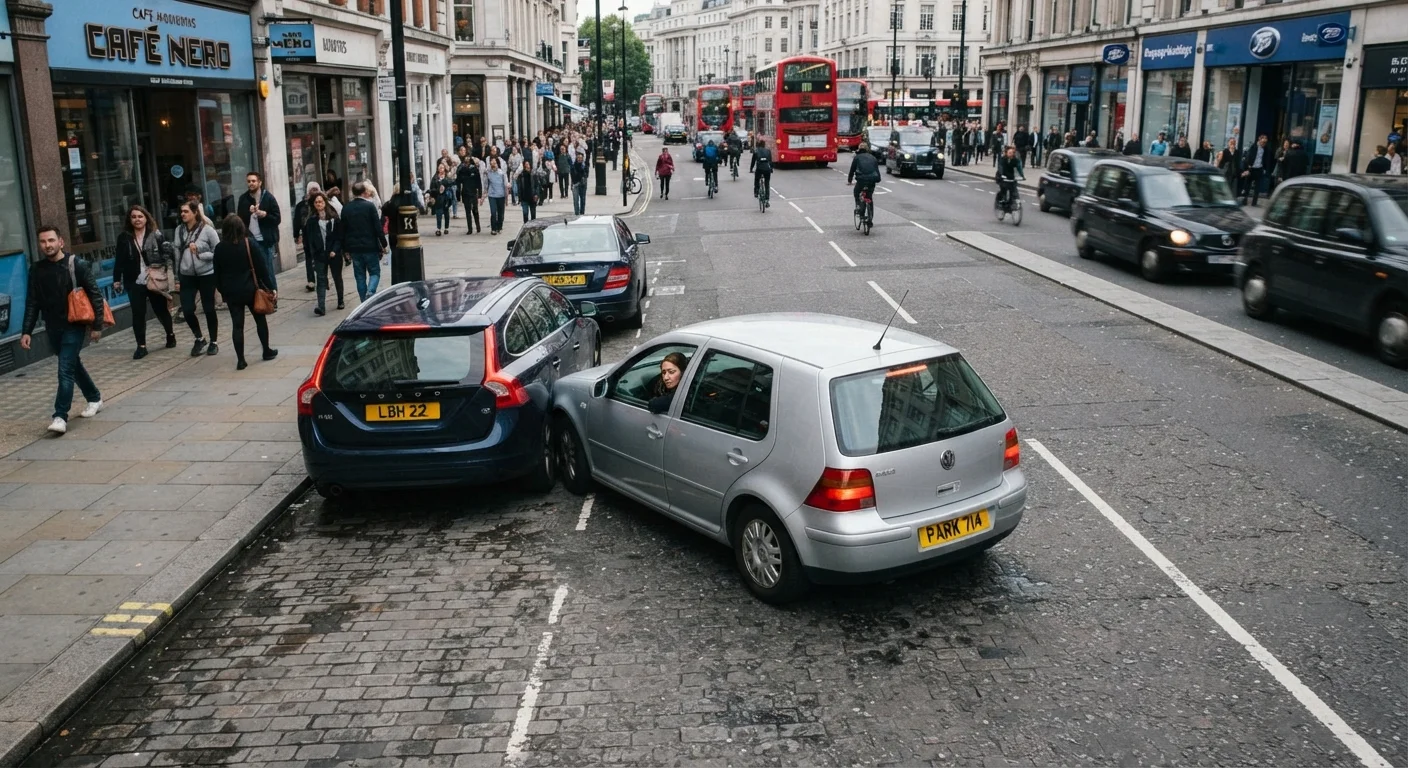
If a space looks tight, it probably is. Attempting to squeeze into an undersized gap dramatically increases the chance of bumper contact with the cars in front of or behind you. When in doubt, keep looking - another space will open up.
Finally, many drivers stop checking their surroundings once they begin reversing. Situational awareness doesn't pause during parking. Cyclists and pedestrians frequently pass between parked cars - your mirrors and blind-spot checks need to be active throughout. This same attentiveness to your environment is what reading traffic patterns is all about: anticipating what's around you before problems develop.