Why Gutters Fail Quietly
Gutters are one of those home systems you barely notice — until they stop working. Their job is straightforward: channel rain off your roof and away from your foundation. But because they sit out of direct sightlines, early failure often goes unnoticed for months, sometimes years. By the time water is seeping into a basement or rotting out fascia boards, the damage is already expensive.
The good news is that gutters telegraph trouble well before things get serious. You just have to know what signals to look for — and when to look for them. If you're new to homeownership, this is exactly the kind of system to get familiar with early. Our guide to your first year of homeownership covers the broader maintenance calendar, but gutters deserve their own focused attention.
When to Schedule a Professional Inspection
If your home is more than 15 years old and the gutters have never been replaced or professionally inspected, a one-time assessment by a licensed gutter contractor is a reasonable precaution — even if you haven't noticed obvious problems. Older gutters may have deteriorated joints, inadequate hanger spacing, or undersized downspouts that don't meet current best practices. An inspection costs relatively little compared to the repairs that can follow undetected failure.
Warning Signs to Watch For
Water spilling over the sides during rain
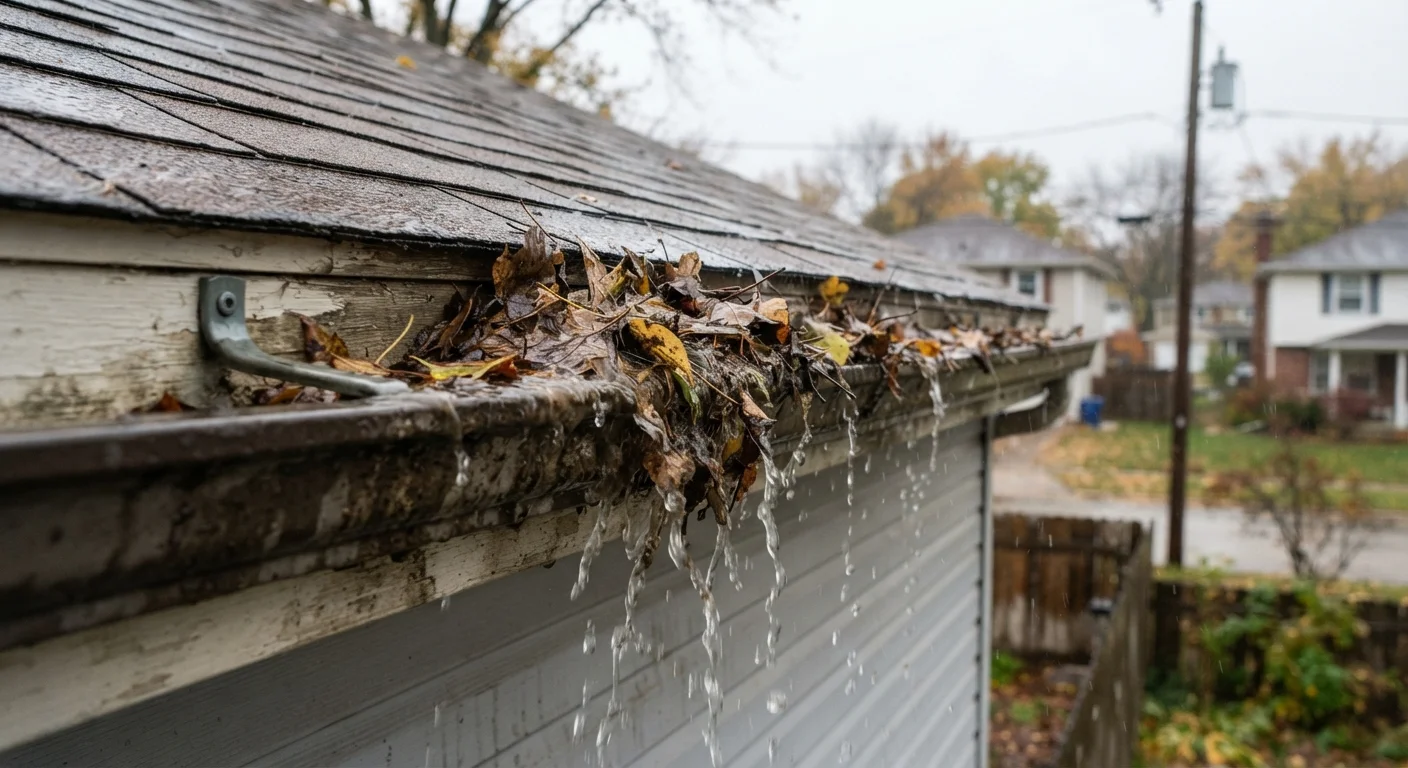
Overflow during a rainstorm is the most visible early sign, but it's easy to misread. Many homeowners assume it means the gutter is full of debris — and that's often true. But overflow can also signal that the gutter has lost its proper slope (called pitch), meaning water pools instead of draining toward the downspout. It can also mean the downspout itself is blocked deep inside where you can't see.
Check the overflow location carefully. Consistent overflow at one spot, even after cleaning, usually points to a pitch or capacity problem rather than clogs alone.
Overflow in the same spot after cleaning almost always signals a pitch or capacity issue.
Gutters visibly pulling away from the fascia
Run your eye along the gutter line from the ground. If any section has a gap between the back of the gutter and the fascia board — or if the gutter looks like it's drooping away from the roofline — the hangers (the metal brackets holding it up) have likely failed or pulled loose. This happens gradually from the weight of debris, standing water, and freeze-thaw cycles.
A gutter that's separating from the fascia isn't just cosmetic. Water will pour directly behind it, saturating the fascia, soffit, and eventually the wall framing beneath.
A gap between gutter and fascia means water is already running where it shouldn't be.
Peeling paint or rust stains on the fascia or siding
Paint doesn't peel randomly. If you see bubbling, flaking, or rust-colored streaks on the wood or siding directly below your gutter line, persistent moisture is almost certainly the cause. This can come from a leaking joint, a crack in the gutter itself, or a section with inadequate slope that allows water to sit and slowly wick outward.
These stains are often the first indoor-adjacent warning sign — if moisture is getting into the fascia, it's working toward your walls. Catching and addressing this early can prevent the need for significant carpentry repairs later.
Rust streaks or peeling paint beneath the gutter line are moisture red flags, not just cosmetic issues.
Pooling water or erosion at the base of your home
Walk around your foundation after a heavy rain. If you see standing water, muddy trenches, or soil erosion directly below a downspout or along the foundation wall, your gutters aren't directing water far enough away from the home — or they're not draining at all. Downspout extensions should carry water at least three to four feet from the foundation; some experts recommend more depending on your soil type and grading.
Foundation water intrusion is among the most costly residential repairs. It's worth emphasizing that early gutter correction is far less expensive than waterproofing a basement or addressing structural settlement.
Erosion near your foundation after rain is a direct sign that water isn't being routed away effectively.
Mildew, mold, or damp patches in the basement or crawl space
Interior moisture problems have many causes, but if you notice new or worsening dampness in your basement or crawl space following rainy periods, don't overlook the gutters as a potential source. When water pools against the foundation — due to gutter overflow or a failed downspout — it can work through concrete over time, especially in older homes.
This is the point where the problem has already moved indoors. If you're seeing this, check the gutters and grading outside before assuming the fix lies inside. Addressing the exterior drainage first may resolve the interior symptoms. For related plumbing and moisture signals, it's also worth understanding what your home's water pressure can tell you as part of a broader water-management check.
New basement dampness after rain often traces back to exterior drainage — check gutters before looking inside.
Sagging sections or visible standing water in the gutter
After a dry spell, look along the gutter from ground level. Any section that appears to dip or bow in the middle is retaining water rather than draining it. You may even see a waterline or rust mark inside the gutter trough showing where water habitually sits. Standing water accelerates rust in steel gutters, warps aluminum, and adds enough weight to pull hangers loose over time.
This is a structural warning sign that the gutter's slope needs correction. It's one of the more straightforward repairs when caught early — usually a matter of repositioning hangers — but it becomes a bigger job if the fascia underneath has already begun to soften or rot.
Visible sag in a gutter section means water is pooling there regularly — a structural fix is needed soon.
Do a Quick Check After Every Major Storm
You don't need to climb a ladder to spot most early warning signs. After a significant rain, walk the perimeter of your home and watch where water is going — or not going. Look for overflow, pooling near the foundation, and any new staining on fascia or siding. A five-minute ground-level inspection twice a year catches the majority of problems while they're still minor.
What to Do When You Spot a Problem
Not every gutter issue requires a contractor. Cleaning out debris, resealing a joint, or repositioning a loose hanger are tasks many homeowners can handle safely from a stable ladder on a single-story home. But working at height carries real risk — before you climb anything, review what's genuinely safe to DIY versus what's better left to a professional. Our article on knowing when DIY is smart and when it's risky lays out the honest tradeoffs.
For problems involving sagging sections, fascia rot, or gutters pulling away from the roofline on upper stories, contact a licensed gutter contractor. Get a written estimate and ask specifically what's causing the failure — not just what they plan to fix. Understanding the root cause (improper slope, undersized downspouts, inadequate hangers) helps you avoid the same problem recurring.
Whatever you decide, act promptly. Gutter problems tend to compound: a small leak feeds wood rot, which weakens the fascia, which causes more sagging. Catching issues in the early-warning stage — the signs listed above — is almost always cheaper and simpler than addressing the downstream consequences.