How Vietnam's Geography Shapes Your Trip
Vietnam runs roughly 1,650 kilometers from its northern border with China down to the tip of the Ca Mau Peninsula. That length matters: it means the country has meaningfully different climates, cuisines, dialects, and cultural rhythms depending on where you are. Treating Vietnam as a single, uniform destination is the fastest way to arrive with wrong expectations.
For planning purposes, most travelers and travel resources divide the country into three broad zones — the North, Central Vietnam, and the South. Each zone has anchor cities, signature landscapes, and travel styles that don't overlap much. First-time Southeast Asia visitors are often caught off guard by how dramatically the experience shifts over a few hundred kilometers.
Reunification Express
The national rail line connecting Hanoi in the north to Ho Chi Minh City in the south, passing through major cities in between. It's a common and scenic way to travel between Vietnam's regions.
UNESCO World Heritage Site
A location recognized by the United Nations as having outstanding cultural, historical, or natural significance worth preserving. Vietnam has several, including Ha Long Bay and the Hoi An Ancient Town.
Wet season / dry season
Vietnam's climate is governed by monsoons rather than traditional four seasons. Each region has a wet season (heavy rainfall) and a dry season, and these do not align across all three regions simultaneously.
Old Quarter (Hanoi)
The historic commercial district of Hanoi, dating back centuries, organized around trades and guilds. It's one of the most visited and most walkable areas in northern Vietnam.
Mekong Delta
The low-lying river delta region in southern Vietnam where the Mekong River meets the sea. It's an agricultural heartland characterized by canals, floating markets, and rice paddies.
Before mapping out an itinerary, it helps to understand what each region actually offers — and what it demands of you in terms of timing, pacing, and preparation.
The North: Hanoi, Ha Long Bay, and Hill Country
Northern Vietnam is the cultural and historical heartland of the country. Hanoi, the capital, is a city of layered colonial architecture, narrow Old Quarter streets, and a slower pace than its southern counterpart. The city rewards walkers and people-watchers more than checklist tourists.
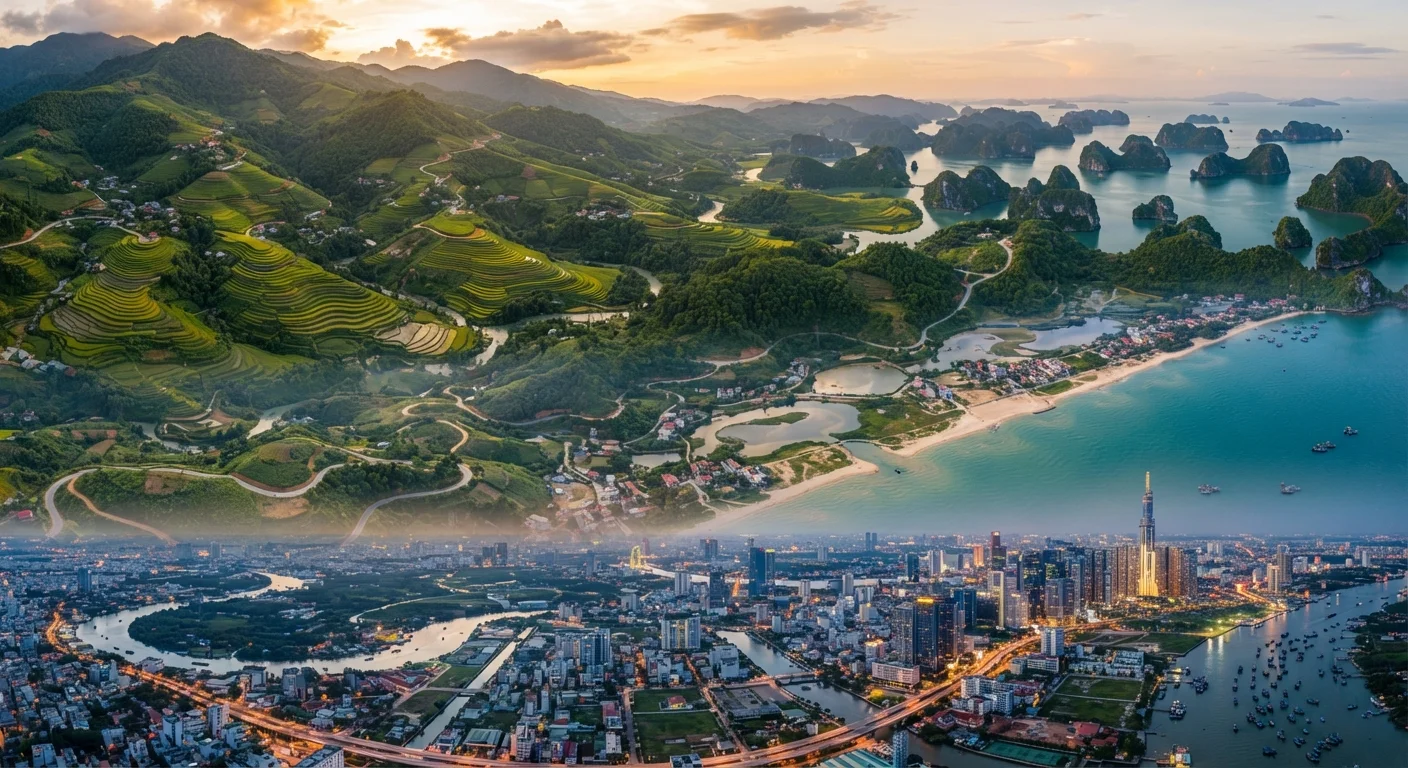
Beyond the capital, the north's two defining draws are Ha Long Bay — a UNESCO World Heritage site of limestone karsts rising from emerald water — and the mountainous northwest, particularly the Sapa region, where terraced rice fields and ethnic minority villages define the landscape. Sapa is best reached by overnight train or bus from Hanoi.
Book Sapa Trains Early
Overnight trains from Hanoi to Lao Cai (the gateway station for Sapa) fill up quickly, especially on weekends and during Vietnamese holidays. If Sapa is on your itinerary, confirm this leg of travel as early as possible. Flexible travelers can sometimes find last-minute tickets, but it's a risk not worth taking in peak season.
Climatically, the north experiences four seasons — a rarity in Southeast Asia. Winters (December to February) can be cool and overcast, sometimes dropping below 15°C in Hanoi. If you're planning to hike in Sapa during this window, pack layers. Spring (March to April) is generally considered the most comfortable period for northern travel.
The north is where Vietnamese culture feels most distinct from its neighbors — food is less sweet, architecture leans French-colonial and traditional Chinese, and the pace is measured. It's a strong starting point for first-timers arriving by international flight into Noi Bai Airport.
Central Vietnam: History, Coast, and Culture
Central Vietnam is the country's historical spine. The cities of Hue, Da Nang, and Hoi An sit within roughly 120 kilometers of each other and collectively hold an outsized share of Vietnam's UNESCO-listed sites, imperial history, and beach access.
Hue served as Vietnam's imperial capital under the Nguyen dynasty and retains its citadel, royal tombs, and elaborate pagodas. Hoi An is a remarkably preserved 15th-century trading port with lantern-lit streets, tailors, and one of Vietnam's most photogenic old towns. Da Nang, positioned between them, functions more as a modern city and transit hub, with beaches and a growing food scene.
Central Vietnam's Weather Window Is Narrow
Unlike the north and south, central Vietnam's optimal travel window is relatively compressed — roughly February through August. Tropical storms and persistent rain can make coastal activities impractical outside this range. If your trip spans multiple regions, plan to be in the central zone during its dry period and build the rest of your itinerary around that anchor.
Central Vietnam's weather is the most complicated in the country. The region faces the South China Sea and receives heavy rainfall from roughly September through December, often from tropical storms. Visiting between February and August gives the best chance of dry, beach-friendly conditions. If you're planning coastal activities, check regional forecasts carefully and build flexibility into your schedule.
The food in this region is worth traveling for on its own. Hue's cuisine — known for its spice and complexity, a legacy of royal court cooking — is distinct from anything you'll eat in the north or south.
The South: Ho Chi Minh City and the Mekong Delta
Ho Chi Minh City (still widely called Saigon) is Vietnam's commercial engine — dense, fast, and loud in ways that can feel overwhelming on arrival. The city's energy is genuine rather than curated. War Remnants Museum, Reunification Palace, and the Ben Thanh Market area are the most-visited landmarks, but the city's neighborhoods — especially Districts 3 and 4 — reward time spent simply eating and walking.
The Mekong Delta, south and west of the city, offers a direct counterpoint: a flat, water-laced agricultural region where life moves by boat and canal rather than motorbike. Day trips are possible from Ho Chi Minh City, but an overnight stay in Can Tho gives a far more grounded picture of delta life. The shift from urban to rural travel in this part of Vietnam is especially pronounced — infrastructure, accommodation, and pace all change sharply once you leave the city limits.
The south is warm year-round, with temperatures generally staying above 25°C. The dry season runs from December through April, making it the most comfortable period for outdoor exploration. The wet season brings afternoon downpours but rarely disrupts full-day travel.
Ho Chi Minh City Traffic Is Not a Cliché
The motorbike traffic in Ho Chi Minh City genuinely requires adjustment. Crossing streets follows a logic that isn't intuitive to most Western visitors — walk slowly and steadily, don't stop suddenly, and let traffic flow around you. Give yourself a day to calibrate before renting any vehicle or attempting busy intersections alone.
Practical Orientation: Moving Between Regions
Getting between regions is straightforward but takes more time than maps suggest. Key options include:
- Domestic flights: The fastest option. Hanoi to Ho Chi Minh City takes about two hours. Multiple carriers operate these routes, and prices vary significantly by how far in advance you book.
- The Reunification Express train: Runs the full length of the country. Slower than flying but scenic and a genuine travel experience — especially overnight sleeper berths between Hanoi and Da Nang or Da Nang and Ho Chi Minh City.
- Open-tour sleeper buses: A budget staple. Comfortable enough for shorter legs (Hoi An to Nha Trang, for example), but overnight buses on longer routes mean arriving stiff and sleep-deprived.
A north-to-south or south-to-north itinerary is logical and avoids backtracking. Most first-time visitors arrive into either Hanoi or Ho Chi Minh City and exit the other, treating the journey as a traversal rather than a loop.
Verify all visa and entry requirements directly with official Vietnamese government sources or your own government's travel advisory well before departure — entry rules can and do change.
Vietnam National Administration of Tourism
Vietnam's official tourism authority provides destination overviews, seasonal information, and entry requirement guidance. A useful starting point for verifying current travel conditions directly from a government source.
U.S. Department of State – Vietnam Travel Advisory
The official US government source for current travel advisories, safety conditions, visa information, and entry requirements for Americans visiting Vietnam. Always check this before booking.
Rome2rio
A route-planning tool that maps out transport options — trains, buses, flights, and ferries — between any two points in Vietnam, with approximate journey times and cost ranges to inform your planning.