The Big Picture: Japan Is Not One Experience
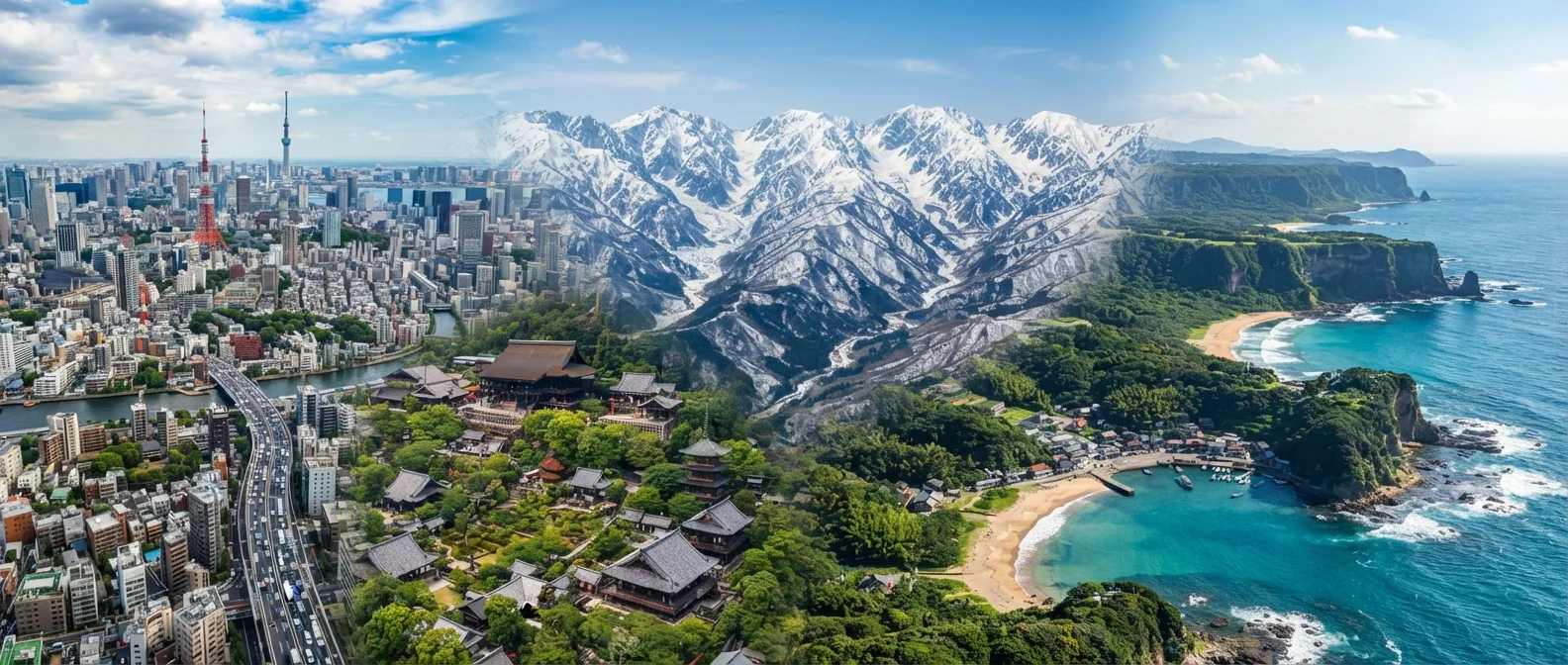
Many travelers book Japan as if it were a single destination with a uniform experience. It isn't. The country stretches roughly 1,500 miles from its northern tip in Hokkaido to the southernmost islands of Okinawa — a span that covers boreal forests, alpine terrain, dense megacities, and coral reefs. Lumping these together into a generic "Japan trip" sets up a planning mismatch.
The regional variation isn't just geographic. Dialects shift noticeably by region. Food culture changes dramatically — ramen styles alone differ from city to city. Locals in Osaka are famously more outgoing than the famously reserved demeanor often associated with Tokyo. Even cost structures vary: rural ryokan (traditional inns) in less-visited prefectures can cost significantly less than equivalent stays in Kyoto during peak season.
For a traveler deciding where to go, this means region selection is a genuine decision with real consequences — not just a pin on a map.
47
Prefectures across Japan's four main islands
Japan's 47 prefectures each have distinct administrative identities, local cuisines, and tourism profiles that vary substantially from one to the next.
~1,500 mi
North-to-south span of the Japanese archipelago
The distance from Hokkaido's northern coast to Okinawa's southernmost islands is comparable to traveling from Maine to Florida — representing dramatic climate and cultural variation.
3 hrs
Shinkansen travel time, Tokyo to Osaka
Despite being in different cultural regions with distinct food scenes and local identities, Tokyo and Osaka are connected by frequent high-speed rail service.
Key Regions and What They Actually Deliver
Kanto (Tokyo and surroundings): Japan's most populous region and the country's cultural and economic center. Expect world-class transit, enormous variety in neighborhoods, and a pace that rewards explorers who go beyond the obvious stops. What first-time visitors actually encounter in Tokyo is often very different from the highlight reel.
Kansai (Kyoto, Osaka, Nara, Kobe): This is historical Japan — centuries-old temples, traditional craft culture, and Japan's most debated food scene. Kyoto is slower, more preserved, and draws enormous crowds at peak times. Osaka runs louder and cheaper, with a street food culture that's a destination in itself. They're 30 minutes apart but feel like different cities from different eras.
Hokkaido: Japan's northernmost main island rewards travelers with wide open landscapes, exceptional skiing in winter, and lavender fields in summer. It's less crowded than central Honshu and requires more logistical planning — distances between destinations are larger and public transit is thinner outside Sapporo.
Okinawa: Subtropical, beach-oriented, and culturally distinct from mainland Japan due to its Ryukyuan heritage. It's a genuinely different travel experience — snorkeling, local Awamori spirits, and a relaxed pace. Flights rather than rail are the way to get there.
Planning Your Route Around Regional Realities
The most common planning mistake is underestimating travel time between regions. Bullet trains are fast but the distances are real — Tokyo to Sapporo by Shinkansen takes about four hours and forty minutes; Tokyo to Naha, Okinawa requires a flight. Budget both time and cost honestly before you lock in your itinerary.
Seasonality matters enormously by region. Cherry blossom season (typically late March through April) draws the largest crowds to Kyoto and Tokyo and sends accommodation prices upward. If crowds are a concern, consider timing your Kansai visit for early November, when fall foliage is stunning and slightly less saturated with tourists. Hokkaido's best skiing runs January through February; Okinawa's beach season peaks from May through September.
For travelers who want to move beyond urban settings, rural regions like Tohoku, Shikoku, and the Japan Alps offer immersive experiences — but logistics require more preparation. What changes when you leave the city behind is a genuine shift in how you plan transport, accommodation, and daily rhythm.
Match Your Trip Length to Your Region Count
A common planning error is fitting too many regions into too few days. A focused one-week trip through Kansai — Osaka, Kyoto, Nara, and Kobe — will feel richer than a sprint across four different regions. Consider adding a second region only if you have at least 10 to 12 days total.
Setting Realistic Expectations Before You Book
Japan's reputation for efficiency, safety, and beauty is well-earned, but every region comes with its own friction points. Kyoto's most famous temples are genuinely crowded during peak seasons. Hokkaido winters are serious — temperatures in Sapporo regularly fall well below freezing. Okinawa's resort towns cater heavily to domestic tourism, so menus and signage may be less English-friendly than Tokyo's tourist centers.
The goal isn't to lower expectations — Japan delivers — but to align them accurately. Choosing a region because it matches your interests, travel style, and timing will produce a more satisfying trip than defaulting to whatever appears first in a Google search.
“Japan rewards the traveler who does their homework not just on the country, but on the specific region they're visiting. The planning frame should be 'which Japan?' before it's ever 'when to go.'”
— Travel Smart Editorial Team, Regional travel research and editorial
Before finalizing any route, verify entry requirements, current travel advisories, and regional transit options through official government and tourism sources. Conditions, pricing, and schedules change.