What Each Type Actually Covers
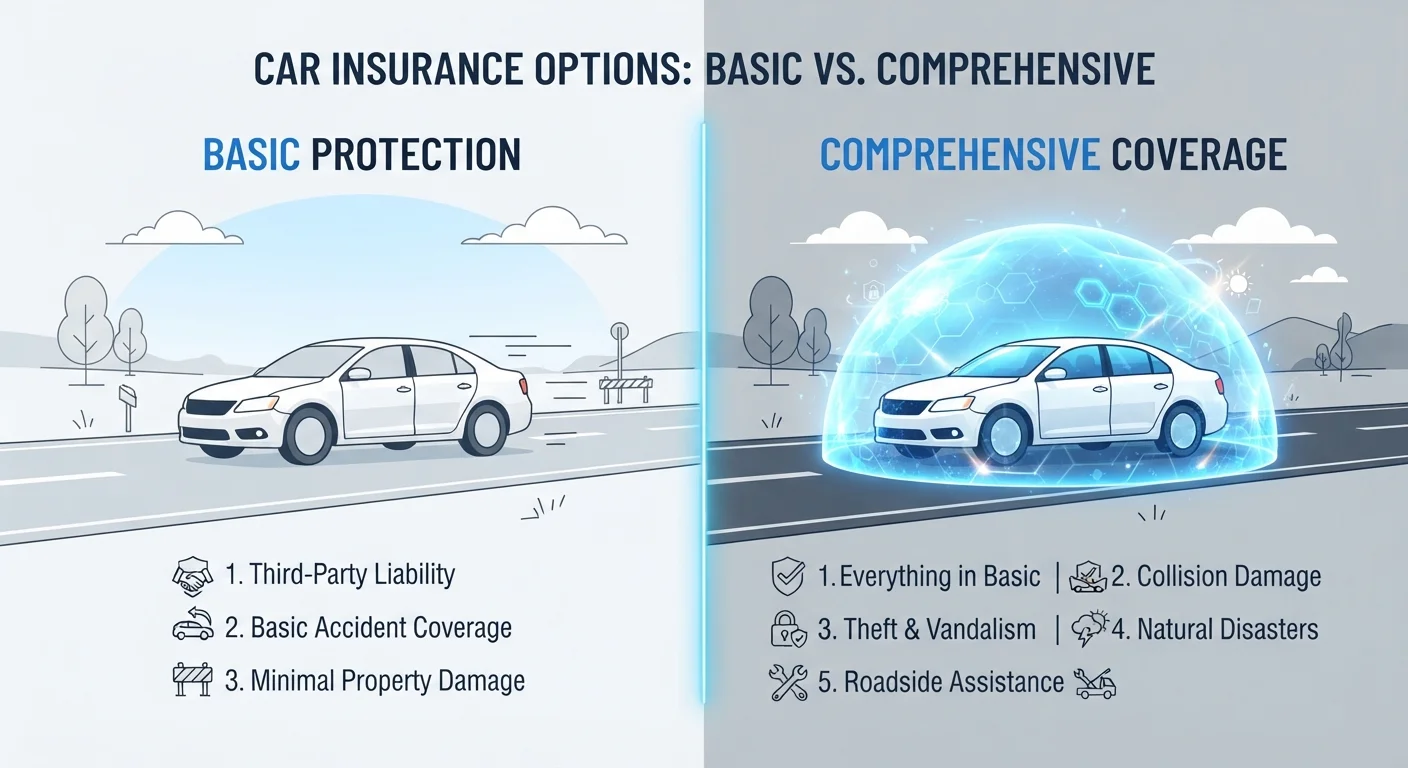
Liability-only insurance - often called minimum coverage - pays for bodily injuries and property damage you cause to other people in an at-fault accident. It satisfies the legal requirement to carry insurance in virtually every U.S. state, but it does nothing to repair or replace your own vehicle after a crash.
Full coverage isn't a single product; it's shorthand for a policy that combines three components: liability (required by law), collision (covers damage to your car from crashes, regardless of fault), and comprehensive (covers non-collision events like theft, fire, hail, flooding, and animal strikes). Together, these three layers protect you, other drivers, and your own asset. For a deeper breakdown of what each policy section means, see our Car Insurance Decoded guide.
| Criterion | Liability-Only | Full Coverage |
|---|---|---|
| Covers damage to others | Yes | Yes |
| Covers your own vehicle (collision) | No | Yes |
| Covers theft, weather, fire | No | Yes (comprehensive) |
| Required by state law | Yes (minimum required) | Includes state minimum |
| Required by lenders | No | Yes |
| Monthly premium | Lower | Higher |
| Best for vehicle age | Older, low-value cars | Newer or financed cars |
The Cost Trade-Off
The premium gap between liability-only and full coverage can be significant. Full coverage costs more because it takes on more risk on your behalf. Your deductible - the amount you pay before insurance kicks in on a claim - also plays a role: a higher deductible generally lowers your premium but increases out-of-pocket exposure when something goes wrong.
~$700+
Average annual cost difference
According to industry data, full coverage typically costs several hundred dollars more per year than liability-only, though exact figures vary widely by driver profile, location, and vehicle.
1 in 8
Drivers who are uninsured
The Insurance Research Council has estimated roughly one in eight U.S. drivers carries no insurance, underlining the risk of relying on liability-only coverage without uninsured motorist protection.
A common rule of thumb is to reconsider full coverage when your annual premium cost exceeds roughly 10% of your car's current market value. If your car is worth $4,000 and you're paying $600 a year for collision and comprehensive, you're paying a large share of the car's value each year to protect it. That said, this is a general framework - not a formula that applies universally to every situation.
If you're buying or already own a financed vehicle, this calculation is largely made for you: lenders require full coverage as a condition of the loan. Learn more about a related gap in that coverage with our gap insurance explainer.
Legal Requirements and Lender Rules
Every U.S. state requires drivers to carry a minimum level of liability insurance, though the specific dollar limits vary by state. These minimums exist to protect other road users - not you. Driving without at least the state minimum exposes you to license suspension, fines, and personal liability for damages you can't cover.
State minimums are often expressed as three numbers (e.g., 25/50/25), representing: maximum payout per injured person, per accident, and for property damage. These limits are frequently described by insurance professionals as a starting floor, not a recommended level of protection - a serious accident can easily exceed them, leaving you personally responsible for the difference.
State Minimums vs. Adequate Protection
Meeting your state's minimum liability requirement keeps you legal, but those limits can be exhausted quickly in a serious accident involving medical bills or significant property damage. Many insurance professionals suggest carrying liability limits above the state minimum if your finances allow it. Review your state's specific requirements through your state's department of motor vehicles or insurance commissioner's website.
If you're navigating auto insurance for the first time, our first insurance policy guide covers the core decisions you'll need to make before committing to a policy.
When Claims Go Wrong
Coverage type matters not just when you buy a policy, but when you file a claim. Liability-only policyholders who are involved in a collision where they're at fault - or hit by an uninsured driver - have no collision coverage to fall back on. Without uninsured motorist coverage (a separate add-on), repair costs come entirely out of pocket.
Full coverage doesn't guarantee smooth claims either. Insurers can deny claims for reasons ranging from policy exclusions to disputed fault. Understanding your rights after a denial matters regardless of your coverage level - our claim denial guide walks through how to respond.
This article is for general informational purposes only and does not constitute insurance, legal, or financial advice. Coverage requirements, terms, and costs vary by state and individual circumstances. Consult a licensed insurance professional for guidance specific to your situation.