
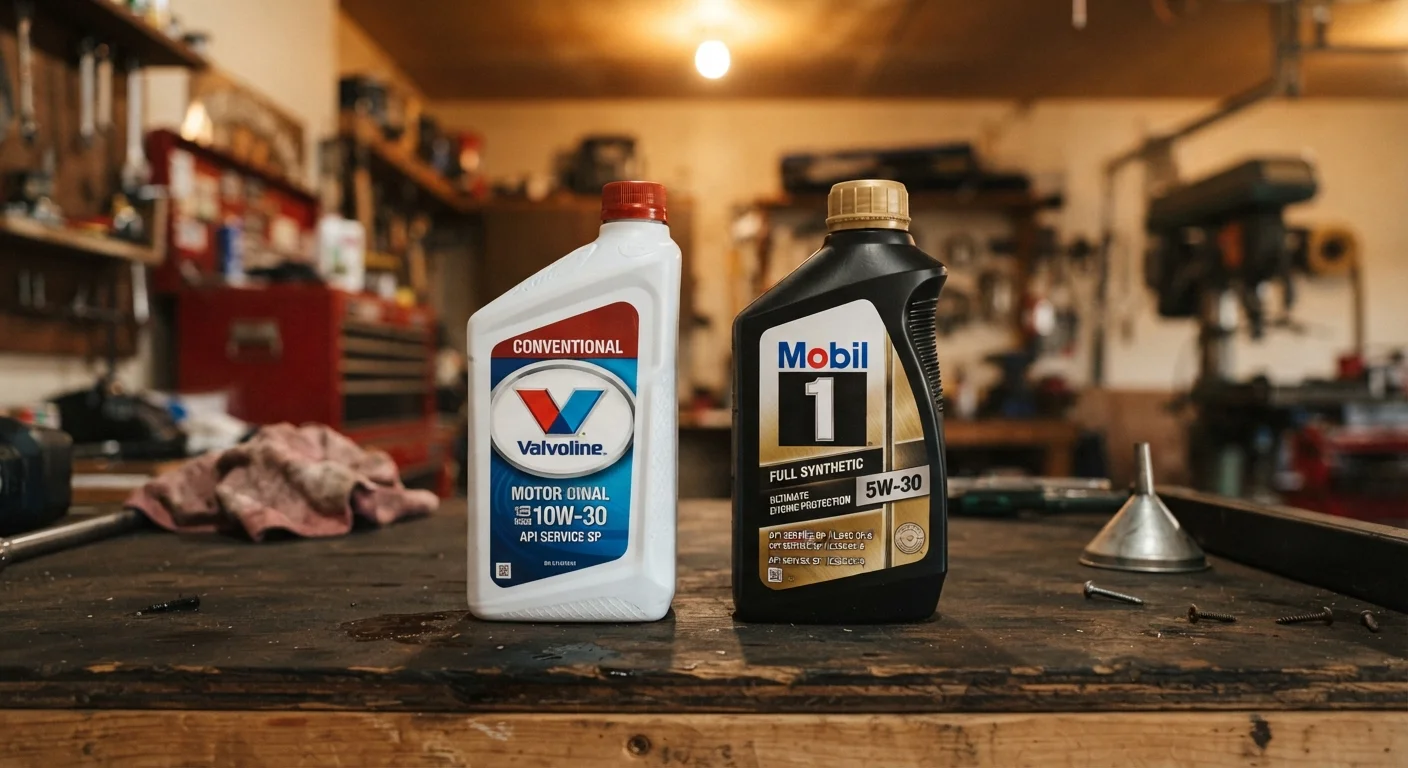
What Actually Makes Them Different
At the most basic level, both types of motor oil do the same job: lubricate engine components, reduce friction, carry away heat, and suspend contaminants until your next oil change. The key difference lies in how each oil is made.
Conventional motor oil is refined directly from crude oil. The refining process removes many impurities, but the resulting product still contains a mix of hydrocarbon molecule sizes and shapes. That variability affects how consistently the oil performs under pressure and temperature changes.
Synthetic motor oil is either fully synthesized from chemical compounds or made from a heavily processed base stock. The molecules are more uniform in size, which translates to more predictable behavior - better flow at cold temperatures, greater resistance to breakdown at high temperatures, and reduced sludge formation over time.
There's also a middle-ground product - synthetic blend oil - which mixes conventional and synthetic base stocks. It offers some performance benefits over full conventional at a price between the two. Check your owner's manual before assuming a blend meets your engine's specification.
For a broader look at where motor oil fits among all the fluids your car depends on, see our Car Fluids 101 guide.
| Criterion | Synthetic Oil | Conventional Oil |
|---|---|---|
| Base source | Chemically engineered compounds | Refined crude oil |
| Molecule consistency | Uniform - more predictable | Variable - less consistent |
| Cold-temperature flow | Excellent | Adequate to good |
| High-heat stability | Superior | Moderate |
| Typical change interval | 7,500-10,000+ miles (varies by spec) | 3,000-5,000 miles (varies by spec) |
| Cost per quart | Higher | Lower |
| Sludge resistance | High | Moderate |
| Required for turbocharged engines | Often yes | Rarely |
Cost, Intervals, and What Your Manual Says
Synthetic oil typically costs more per quart than conventional. For many drivers, that price gap is the deciding factor - but it's worth doing the math before assuming conventional is always the cheaper route.
7,500-10,000 mi
Typical synthetic oil change interval
Many automakers specify these intervals for vehicles running full synthetic oil, per manufacturer owner's manuals.
~2-3×
Price difference per quart
Synthetic oil generally costs roughly two to three times more per quart than conventional, though extended intervals can reduce the overall annual cost difference.
Because synthetic oil resists breakdown longer, it can support extended change intervals. Many vehicle manufacturers specify intervals of 7,500 to 10,000 miles or more for engines running full synthetic. Conventional oil is more commonly associated with shorter intervals, though the old 3,000-mile rule has long since been overtaken by modern engine and oil technology. To understand why that benchmark no longer applies, see Oil Change Intervals: The Old 3,000-Mile Rule Is Outdated.
The single most important step is checking your vehicle's owner's manual. It will specify the oil viscosity grade (such as 5W-30 or 0W-20) and whether synthetic is required, recommended, or optional. Some turbocharged engines and high-performance vehicles require full synthetic - using conventional in these engines can accelerate wear and potentially void warranty coverage. On the flip side, running synthetic in an engine designed for conventional is generally safe, but it's not a performance upgrade if the engine wasn't designed for it.
Viscosity Grade Still Matters
Choosing between synthetic and conventional is only part of the equation. Your engine also needs the correct viscosity grade - the numbers like 5W-30 or 0W-20 on the label. Using the wrong viscosity, regardless of oil type, can affect lubrication and fuel economy. Always match the grade specified in your owner's manual, and don't assume a thicker oil offers better protection in modern engines.