Breaking Down the Three Categories
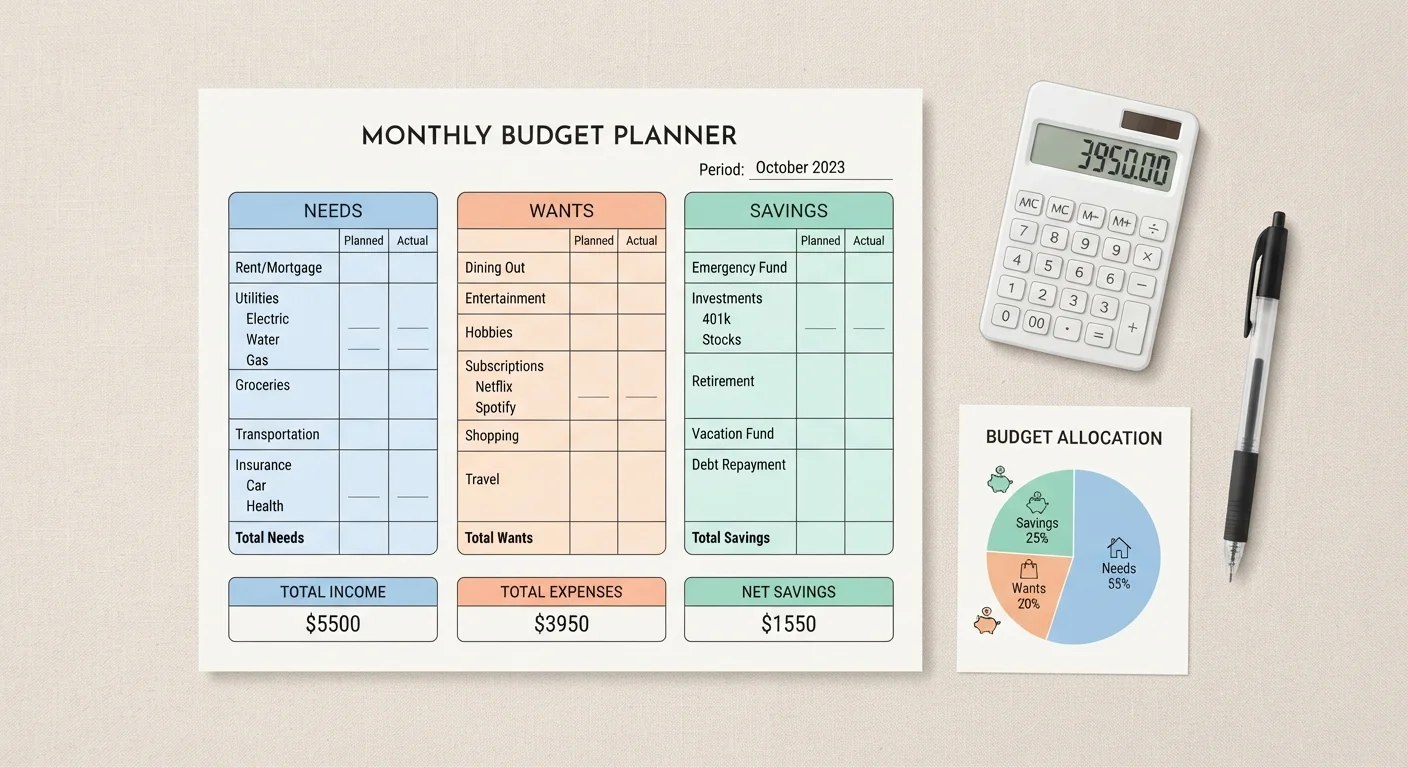
The 50/30/20 rule works by sorting every dollar of your take-home pay into one of three buckets. Understanding what belongs in each category is the foundation of making this framework actually work for you.
50% — Needs
Needs are non-negotiable expenses. These are bills and costs you must pay to maintain basic living and meet your financial obligations. Common examples include:
- Rent or mortgage payments
- Groceries and household essentials
- Utilities (electricity, water, internet)
- Health insurance premiums
- Transportation costs required for work
- Minimum payments on loans and credit cards
Notice that minimum debt payments sit in the needs category — you have a legal obligation to pay them. Any extra payments you choose to make above the minimum move into the 20% bucket.
30% — Wants
Wants are lifestyle expenses that add comfort, enjoyment, or convenience — but that you could live without if necessary. This category includes dining out, entertainment subscriptions, gym memberships, travel, and shopping for non-essentials. The wants category is also where most budgets leak unnoticed, which is why a spending audit can be eye-opening before you apply the rule.
20% — Savings and Debt Repayment
This final bucket is where you build financial momentum. It covers:
- Emergency fund contributions
- Retirement account deposits (such as a 401(k) or IRA)
- Extra debt payments beyond the minimum
- Short-term savings goals like a down payment
Directing at least 20% here consistently is what separates a budget that feels good on paper from one that actually changes your financial trajectory over time. For more on how savings and debt repayment work together, explore guidance from the Saving & Debt hub.
50%
Maximum share of income for needs
The 50/30/20 framework caps essential expenses at half of after-tax income to preserve room for saving and discretionary spending.
20%
Target savings and debt repayment rate
Consistently directing 20% of take-home pay toward savings and extra debt payments is considered a strong personal finance baseline by many financial educators.
73%
Americans living paycheck to paycheck (approximate)
Surveys from multiple years have found a majority of US adults report difficulty covering expenses between paychecks, underscoring the value of a structured spending plan.
How to Apply the Rule to Your Own Income
Applying the 50/30/20 rule takes three short steps.
- Find your monthly after-tax income. Add up your net pay from all sources — your paycheck after taxes, any freelance income after estimated taxes, or side income.
- Calculate your three targets. Multiply your monthly take-home pay by 0.50, 0.30, and 0.20 to get your dollar limits for each bucket.
- Compare your current spending to those limits. Use bank statements or a spending tracker to see where your money actually goes. If you've never done this before, our plain-English guide to your first monthly budget walks you through the process.
The point of this comparison isn't to feel bad about your current habits — it's to see clearly where adjustments are possible and where they're not.
Start With One Month of Real Data
Before adjusting your spending, spend one full month tracking what you actually buy — not what you plan to buy. Many people are surprised by how much their wants category already consumes. Seeing real numbers makes the 50/30/20 targets feel concrete rather than abstract.
When the Rule Needs Adjusting
The 50/30/20 rule is a guideline, not a guarantee. Several common situations call for a modified approach.
High Cost-of-Living Areas
If you live in a city where rent alone consumes 40% of your take-home pay, hitting the 50% ceiling for all needs becomes nearly impossible. In this case, temporarily shrink the wants category to 15–20% and keep saving at least something toward the 20% target — even a smaller amount builds the habit.
High Debt Loads
If you're carrying significant student loans or credit card balances, you may want to redirect money from the wants category to accelerate debt repayment. Paying down high-interest debt faster is often a better return than any savings vehicle at a similar rate.
Lower Income Ranges
For people earning close to or below median wages, essentials may consume 60–70% of income before there's anything left for wants or savings. The framework still has value — it identifies the gap and creates a target to work toward as income grows.
The Rule Covers After-Tax Income Only
If your employer automatically deducts 401(k) contributions from your paycheck before you receive it, those contributions are already outside your take-home pay — meaning your 20% savings target may be partially or fully met before you even begin budgeting. Factor in any pre-tax savings when calculating how much more you need to set aside.
The 50/30/20 rule is just one approach among several. If it doesn't feel like the right fit, see how it compares to other popular frameworks side by side. Regardless of the method you choose, the principles behind durable budgets tend to look the same — explore budgeting principles that hold up over time to understand the habits underneath any good system.
Once your budget is stable and the 20% savings habit is consistent, that foundation supports the next major financial step — building toward investing. The Investing Essentials hub covers what comes next.
This article is for general informational and educational purposes only and does not constitute personalized financial advice. Consult a qualified financial professional for guidance specific to your situation.