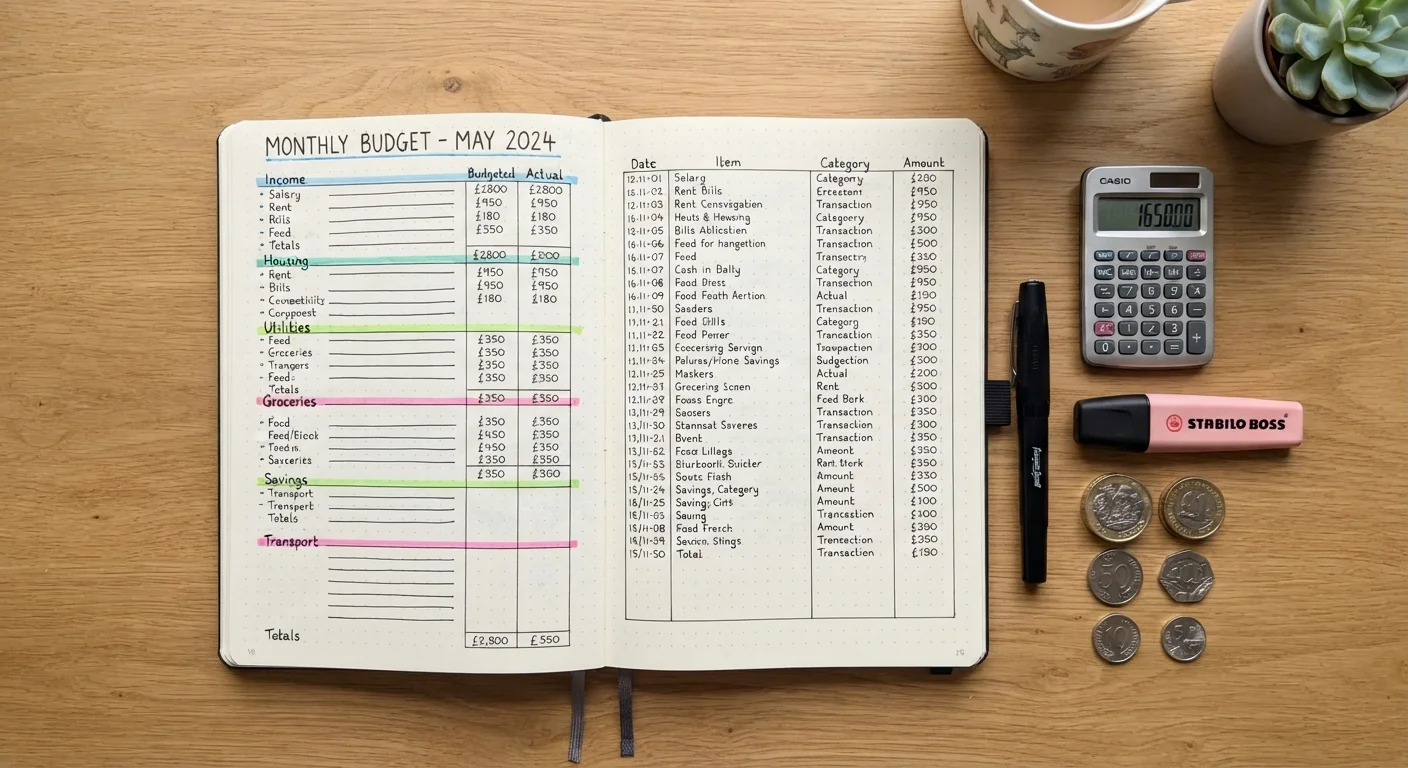
Use this structured checklist to review your income, categorise your expenses, and spot patterns before you build or revise your monthly budget.
Key Takeaways
A spending audit reveals actual habits, not the habits you assume you have.
Gathering 60–90 days of transaction history gives you a reliable baseline.
Categorising expenses into fixed, variable, and discretionary groups clarifies where flexibility exists.
Subscription and recurring charges are common sources of unnoticed spending.
A completed audit gives you the data needed to build or revise a realistic budget.
Why a Spending Audit Comes Before a Budget
Most budgeting advice starts with the budget itself — pick a method, assign numbers, stick to it. But if those numbers aren't rooted in what you actually spend, the budget is little more than optimistic fiction. A spending audit flips the order: first you look clearly at reality, then you decide what to change.
Think of it as taking financial inventory. Just as a store wouldn't set a purchasing plan without knowing what's on the shelves, you shouldn't plan your spending without knowing where your money currently goes. The audit you're about to run isn't about shame or judgment — it's about clarity.
Once you've worked through this checklist, you'll have the raw material to build your first real monthly budget or to tighten one that isn't working. You may also want to explore how different budgeting frameworks compare once you've seen your numbers clearly.
Required
Bank and Credit Card Statements
The primary source of transaction data for the audit — pull at least three months from every account you use.
Required
Spreadsheet (e.g. Google Sheets or Excel)
Helps you total and average spending by category without specialised software.
Required
Calculator or Phone Calculator App
Useful for quick percentage calculations when comparing category totals to your income.
Optional
Personal Finance Tracking App
Can automate transaction categorisation after the initial audit to maintain visibility month to month.
Optional
Notebook or Printed Worksheet
A physical record helps some people stay focused while reviewing statements — use whatever format keeps you engaged.
The Spending Audit Checklist
Work through each group in order. Some steps take only a few minutes; others — like manually categorising transactions — may take longer the first time. Mark each item as you complete it.
Gather Your Financial Records
Collect bank and credit card statements covering the past 60–90 days to capture a representative spending period.Must
Download or print transaction histories from every account you use for spending, including digital wallets and payment apps.Must
Note your total take-home income (after taxes and deductions) for the same period so you have a complete picture.Must
Locate any paper receipts for cash purchases and add them to your records — cash spending is easy to overlook.Should
Identify and Categorise Every Expense
Label each transaction as Fixed (same amount every month, e.g. rent), Variable (changes month to month, e.g. groceries), or Discretionary (optional spending, e.g. dining out).Must
Group transactions into spending categories such as housing, transportation, food, utilities, healthcare, entertainment, clothing, and personal care.Must
Total each category across all three months, then calculate the monthly average for each.Must
Flag any transaction you don't recognise immediately — unclear charges may be forgotten subscriptions or errors worth investigating.Should
Audit Subscriptions and Recurring Charges
List every recurring charge, including streaming services, gym memberships, software subscriptions, and annual renewals.Must
Check whether you have actively used each subscription in the past 30 days — note those you haven't.Must
Verify the exact amount charged for each recurring item, as prices often increase quietly over time.Should
Identify duplicate services — for example, multiple music or cloud-storage subscriptions serving the same purpose.Should
Analyse Spending Patterns
Calculate what percentage of your take-home income goes to each major category and compare it to your general expectations.Must
Identify your top three spending categories outside of fixed costs — these typically hold the most opportunity for adjustment.Must
Look for seasonal or irregular expenses (annual insurance premiums, holiday spending) that may have skewed one month's data.Should
Note spending that occurred during emotionally significant moments — stress, boredom, or celebration — as these patterns often repeat.Nice to have
Compare your food-at-home spending versus dining-out spending as a quick check on one of the most common variable cost categories.Should
Check the Gap Between Income and Spending
Subtract total monthly average spending from monthly take-home income to find your current surplus or deficit.Must
If you have a deficit, identify which categories are most over-extended and mark them for review.Must
If you have a surplus, confirm whether it is being intentionally saved or is simply unaccounted for in your day-to-day spending.Should
Set Priorities for What Comes Next
Write down one to three specific spending areas you want to adjust — keep it concrete rather than a vague resolution to 'spend less.'Must
Decide on a method to track spending going forward, whether that's a spreadsheet, a notebook, or an app.Should
Schedule a follow-up review date — 30 days from now — to measure whether your patterns have shifted.Nice to have
Averages Can Hide Important Outliers
A three-month average is a useful baseline, but one unusually expensive month — say, a car repair or medical bill — can skew your results significantly. When you spot a category that looks unusually high, check whether one large one-time expense is inflating the number before drawing conclusions. Similarly, a month with very low spending due to travel or staying with family may understate your true regular costs.
After finishing the checklist, your numbers won't lie. Use them. A completed audit pairs naturally with ongoing spending-tracking methods so progress doesn't stop here. If debt repayment or building an emergency fund is a priority, the Saving & Debt hub offers actionable next steps grounded in the same realistic approach.
This article is for general informational and educational purposes only and does not constitute personalised financial advice. For guidance specific to your financial situation, consider consulting a qualified financial professional.
Personal Finance Editorial Team is the collective byline for our editorial team and contributor network. Articles published under this byline or an editorial pen name are researched, written, and reviewed according to our editorial standards for clarity, consistency, and independence before publication.
The content provided on our blog site traverses numerous categories, offering readers valuable and practical information. Readers can use the editorial team’s research and data to gain more insights into their topics of interest. However, they are requested not to treat the articles as conclusive. The website team cannot be held responsible for differences in data or inaccuracies found across other platforms. Please also note that the site might also miss out on various schemes and offers available that the readers may find more beneficial than the ones we cover.