
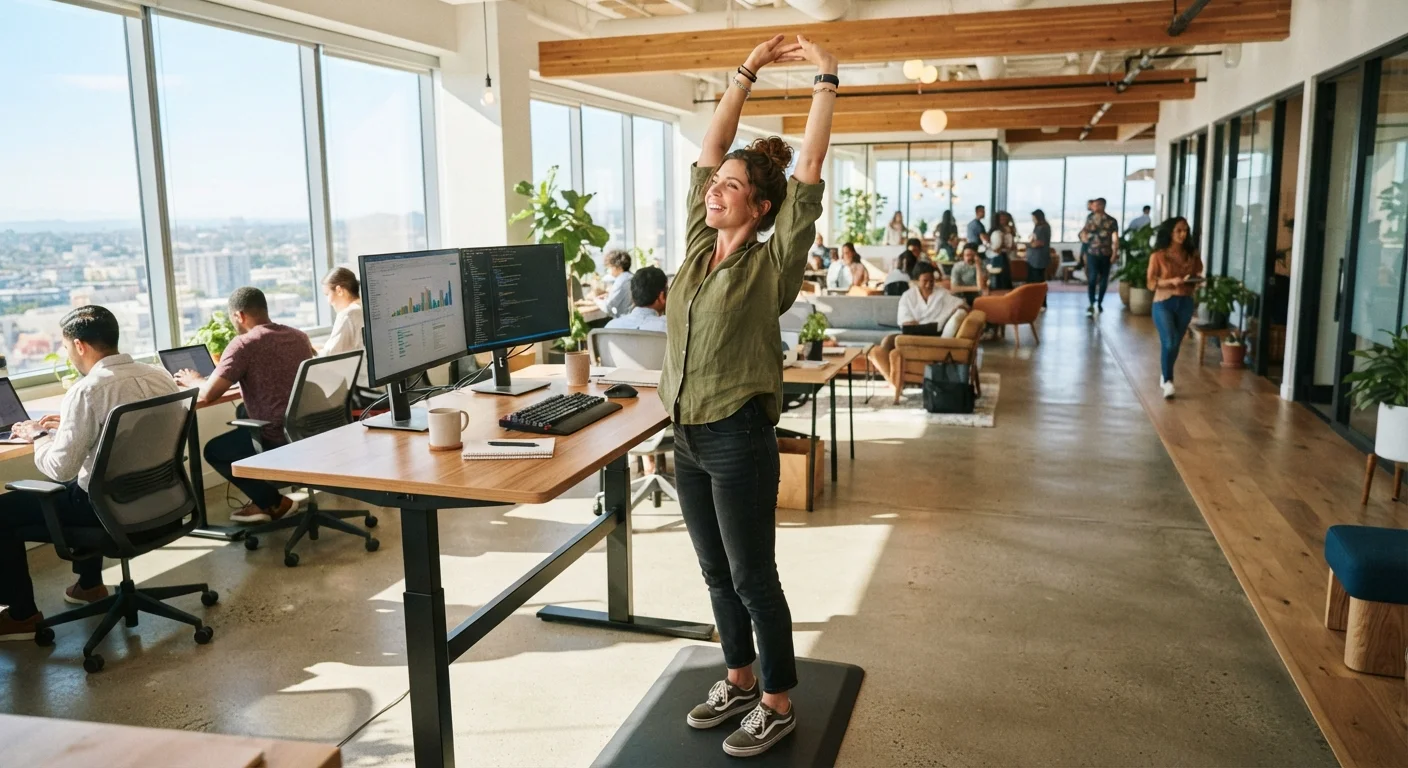
Why Your Desk Job Deserves a Second Look
If you spend most of your workday sitting, you're in very good company - and facing a very real health challenge. Research published in outlets like the AJE and cited by the CDC consistently shows that prolonged sedentary time is associated with increased risk of cardiovascular disease, metabolic issues, and musculoskeletal discomfort, independent of whether someone exercises during off-hours. In other words, an evening run doesn't fully cancel out eight consecutive hours of sitting.
The encouraging news: you don't need a radical lifestyle overhaul. Small, strategic movement breaks scattered throughout your workday can make a meaningful difference. This isn't about judgment - most of us didn't design our own work environments - it's about finding realistic, sustainable ways to move more within the constraints you already have. If you're also thinking about building a broader fitness routine, our guide to fitting workouts into a packed schedule is a useful companion read.
Set a movement timer every 45-60 minutes
Your body wasn't designed to hold a single position for hours. Setting a recurring reminder - via your phone, computer, or a wearable - to get up every 45 to 60 minutes is one of the most evidence-supported ways to interrupt prolonged sitting. When the alert fires, stand up, walk to refill your water, do a brief stretch, or simply pace for 90 seconds. The activity doesn't need to be intense; the interruption itself is the point. Even light-intensity movement breaks have been associated with improved blood glucose regulation and reduced fatigue in office worker studies.
The interruption itself matters - even 90 seconds of movement can reset your body's response to prolonged sitting.
Use walking meetings when possible
Not every meeting requires a screen. Phone calls, one-on-ones, and casual check-ins are natural candidates for a walking format. Walking meetings have been studied in workplace contexts and are associated with increased creative thinking and improved mood - benefits that go beyond physical activity alone. If your work is fully remote, a walking call via earbuds works just as well. Propose it as a default for certain meeting types rather than an exception; most colleagues adapt quickly once it becomes a shared norm.
Walking meetings can boost creative thinking and mood while quietly adding steps to your day.
Hydrate strategically to create movement cues
Keeping a smaller water bottle at your desk - rather than a large one you rarely refill - creates a natural trigger to stand up and walk to the kitchen or water station more often. This isn't a trick; it's habit engineering. The bonus: staying adequately hydrated is independently linked to better concentration and reduced afternoon fatigue. If you work from home, designate a refill point that's a floor or a room away from where you sit. The friction is the feature.
A smaller water bottle means more refill trips - and more reasons to stand up throughout the day.
Incorporate desk-friendly stretches and mobility work
Several common tension areas - the hip flexors, shoulders, chest, and neck - become compressed or shortened during long sitting sessions. Simple, seated or standing stretches targeting these areas require no equipment and minimal space. Examples include shoulder rolls, seated spinal twists, chest openers (clasping your hands behind your back and gently lifting), and hip flexor stretches performed while standing at your chair. A 2-3 minute mobility sequence between tasks can reduce discomfort and support better posture over time. If you experience persistent pain, consult a healthcare professional rather than pushing through it.
A 2-3 minute mobility sequence between tasks can ease tension and support better posture over time.
Take the longer route - intentionally
Micro-decisions about distance add up meaningfully across a full workday. Choosing the bathroom on a different floor, parking farther away, taking stairs instead of the elevator, or walking to a colleague's desk rather than sending a message are all low-effort ways to accumulate steps without carving out dedicated exercise time. Wearable trackers and phone pedometers can make this tangible - watching a step count rise throughout the day provides its own momentum. This strategy pairs naturally with rethinking how you use your time at work, since small intentional choices often outperform rigid schedules.
Choosing the longer route to the bathroom or stairs can meaningfully increase your daily step count.
Explore a standing desk or balance tool if accessible
Standing desks, desk converters, and balance boards or cushions are increasingly common in office environments and are worth requesting through your employer's ergonomics or wellness program if one exists. Research suggests that alternating between sitting and standing - rather than standing all day, which brings its own discomfort - offers the best outcomes for back pain and energy levels. If a standing desk isn't available, a stable surface like a kitchen counter can serve the same purpose during remote work. Note that standing for very long periods without movement is not inherently better than sitting; the goal is variation, not substitution.
Alternating between sitting and standing is more effective than replacing one with the other entirely.
Start Where You Are
None of the strategies below require a gym membership, expensive equipment, or a flexible employer. They're designed to slot into real workdays - the kind with back-to-back meetings, tight deadlines, and lunch eaten at the keyboard. Pick one or two that feel genuinely doable first, then build from there. Research on habit formation suggests that anchoring a new behavior to an existing routine - a concept behavioral scientists call "habit stacking" - makes it far more likely to stick.
Make Movement the Path of Least Resistance
The most effective movement habits are ones that happen almost automatically. Try placing your phone charger across the room so you have to stand to check it, or setting your default for one-on-one calls to 'walking' in your calendar. When movement is built into your environment rather than relying on willpower, it becomes far easier to sustain over weeks and months.
And if you've noticed that long screen sessions are also affecting your mood or mental clarity, it may be worth exploring how digital habits quietly erode mental wellbeing - movement and mindful tech use often go hand in hand. For a broader look at what the science says about activity and mood, see movement as medicine.
This article is for general informational purposes only and is not a substitute for professional medical advice. If you have a health condition that may affect your ability to exercise, please consult a qualified healthcare provider before making changes to your activity level.