
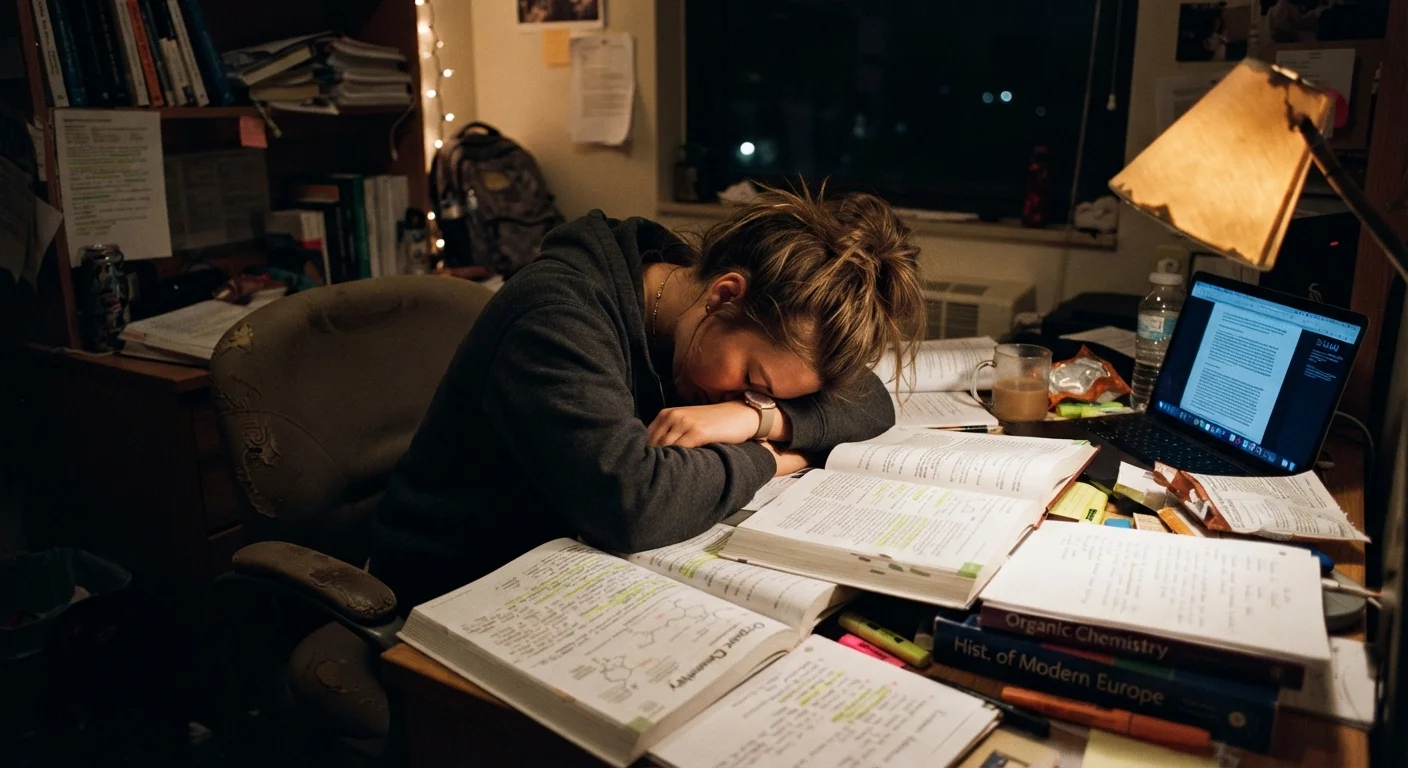
More Than Stress: What Burnout Actually Is
The word "burnout" gets used loosely — but in research, it has a specific meaning. Psychologist Christina Maslach's foundational work frames burnout as a triad of exhaustion, cynicism, and reduced efficacy. In academic settings, this translates to a student who is not just tired, but emotionally depleted, disengaged from coursework, and beginning to doubt whether their effort has any point.
That distinction matters. A student who is stressed about finals is experiencing pressure; a student who no longer cares whether they pass is experiencing something structurally different. Stress can coexist with motivation. Burnout erodes it.
Burnout Is Not a Character Flaw
A persistent cultural narrative frames burnout as evidence of weakness or poor self-discipline. Research does not support this framing. Burnout correlates with high conscientiousness and early high engagement — it often affects the students who cared the most. Recognizing this can reduce the shame that prevents students from seeking support.
This article provides general educational information about academic burnout. It is not a substitute for advice from a licensed mental health professional. If you are struggling significantly, please reach out to your campus counseling center or a qualified clinician.
What the Research Says Drives It
Workload is the obvious suspect — and it is a real factor. But studies consistently show that workload alone doesn't predict burnout as reliably as the combination of high demands and low resources. Resources in this context include autonomy over how you study, meaningful relationships with peers and instructors, and a sense that the work connects to something you value.
~40%
College students reporting burnout symptoms
Multiple surveys of US college populations have found roughly 40% of students reporting significant burnout symptoms during their academic career, though methodologies vary.
2nd–3rd year
Peak burnout risk period in college
Research consistently identifies the middle years of a degree program — when novelty fades and demands intensify — as the highest-risk window for burnout onset.
3x
Burnout risk gap: isolated vs. connected students
Studies on college wellbeing have found students who report social isolation face substantially higher burnout rates than those with strong peer and mentor relationships.
Research published in academic psychology journals has identified several recurring drivers in college populations:
- Perceived lack of control over deadlines, course formats, and assessment methods amplifies exhaustion faster than raw difficulty alone.
- Social disconnection — particularly isolation from peers — removes a key psychological buffer against academic stress.
- Value misalignment, where students feel their coursework bears no relationship to their actual goals, accelerates cynicism.
- Poor sleep and recovery habits interrupt the physiological restoration that keeps cognitive performance and emotional regulation functional.
It's worth noting that some coping strategies students reach for instinctively can actually deepen the problem over time. Common stress coping patterns like avoidance or rumination may offer short-term relief while worsening long-term burnout risk.
Structural Factors Institutions Often Overlook
Much burnout conversation focuses on individual students — their habits, resilience, and time management. But researchers increasingly argue that institutional design plays an underappreciated role. Courses scheduled back-to-back with no cognitive breathing room, grading systems that punish experimentation, and limited access to mental health services all create environments where burnout is structurally more likely regardless of individual effort.
Students who feel anonymous in large lecture courses, or who have no accessible mentor relationship, report higher burnout rates than those in environments with greater relational support — even when workload is comparable. This suggests that belonging and recognition are not soft extras but functional components of academic sustainability.
Talk to an Adviser Before You Hit a Wall
Academic advisers are trained to help students navigate exactly the kind of course-load and motivation challenges that precede burnout. Reaching out when you first notice warning signs — not after you've stopped attending class — gives you more options and more time to course-correct. Most campuses also offer counseling services at no extra cost to enrolled students.
Evidence-Based Strategies Worth Knowing
Research on burnout intervention points to several categories of response — though it's important to acknowledge that most studies are correlational, and no single strategy works universally.
- Recovery scheduling: Building deliberate non-academic recovery time — not just "breaks" between study sessions, but genuine disengagement — is associated with lower exhaustion scores in student samples.
- Reconnecting with purpose: Reflective exercises that help students articulate why their field matters to them have shown modest effects on reducing cynicism in controlled studies.
- Seeking relational support: Talking to an academic adviser, counselor, or trusted peer — rather than withdrawing — is consistently linked to better outcomes than isolation.
- Boundary-setting on availability: Students who set limits on night-time studying and constant email responsiveness report better recovery over time.
If you're weighing whether to push through to graduation or reconsider your path, it helps to think clearly about what comes next. Thinking through graduate school versus entering the workforce is a separate decision, but one worth making from a grounded place rather than a burned-out one.
Recognizing the Early Warning Signs
Burnout rarely announces itself dramatically. It typically builds in stages — starting with enthusiasm, moving through stagnation, then frustration, and eventually apathy. Students often don't identify what they're experiencing as burnout until they're already deep in the apathy phase.
Earlier signals worth paying attention to include: chronic fatigue that doesn't respond to a full night's sleep, increasing procrastination that feels different from ordinary reluctance, a growing sense of detachment from coursework you once found interesting, and physical symptoms like persistent headaches or disrupted appetite. These are not moral failures — they are signals that the demand-resource balance has broken down.
The pattern has some overlap with what pulls self-directed learners off track: motivation loss and gradual withdrawal are common early markers in both contexts. The critical difference is that in formal education, institutional support structures exist specifically to help — and using them early is more effective than waiting for a crisis.
This article is for general informational and educational purposes only and does not constitute mental health advice. If you are experiencing symptoms that significantly affect your functioning, please consult a qualified mental health professional.