
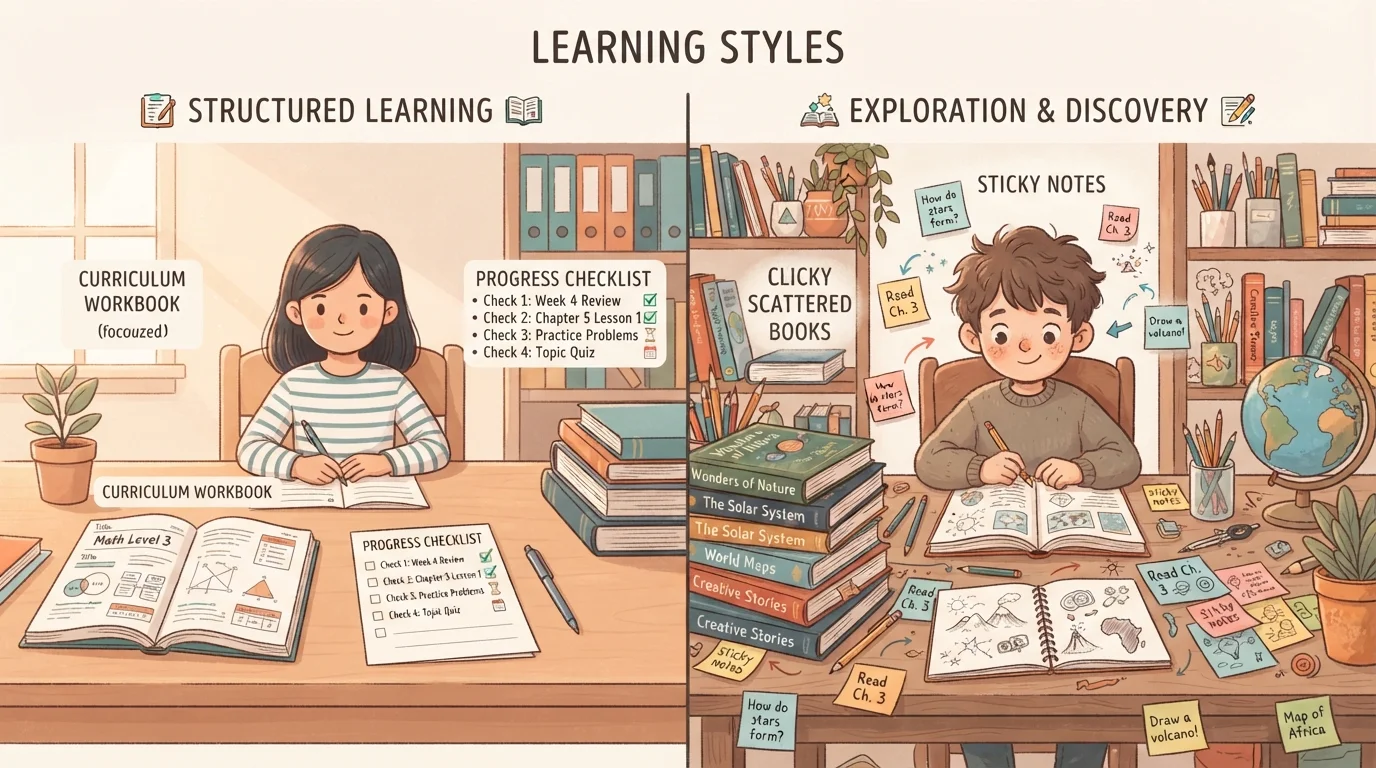
What Each Approach Actually Looks Like
A structured course delivers learning through a pre-designed sequence: modules follow a logical order, assessments measure progress, and a syllabus sets expectations upfront. This format spans everything from university classes and professional bootcamps to self-paced MOOCs on platforms that offer completion certificates. The defining feature is that someone else — an instructor, curriculum designer, or institution — has made most of the architectural decisions for you.
Open-ended exploration, by contrast, puts the learner in the driver's seat without a map. You might spend three weeks reading primary sources on behavioral economics, pivot to watching documentary series, then dive into a related podcast — all without a grade or deadline. This is the territory described in self-education research as highly autonomous but demanding in terms of internal motivation.
Neither format is monolithic. A structured course can still leave room for personal projects; an exploratory learner can impose their own milestones. The distinction is really about who controls the sequence and accountability mechanisms.
| Criterion | Structured Courses | Open-Ended Exploration |
|---|---|---|
| Who controls the sequence | Instructor or curriculum designer | The learner |
| Accountability mechanism | Deadlines, assessments, certificates | Self-imposed; intrinsic motivation |
| Best entry point | New to a field with prerequisite knowledge | Sampling interests or extending existing skills |
| Credential visibility | Typically recognised by employers | Must be demonstrated through portfolio or projects |
| Flexibility | Limited; set by syllabus | High; adapts to interests and schedule |
| Risk of knowledge gaps | Lower; curriculum designed to fill gaps | Higher; depends on learner's self-awareness |
| Typical cost | Varies; often higher than free resources | Can be very low using free resources |
| Metacognitive development | Moderate; scaffolded by design | High; navigating independently builds the skill |
The Case for Structure: When a Curriculum Earns Its Keep
Structure is most valuable when the knowledge domain has a non-negotiable learning sequence. Programming, statistics, and foreign languages all have prerequisite concepts — trying to learn recursion before understanding functions, for example, tends to create confusion rather than insight. A well-designed course front-loads the foundational material so you don't hit invisible walls.
Structure also reduces a cognitive burden researchers call desirable difficulty overload — the point at which managing what to learn next consumes energy better spent on actually learning. If you're entering a field with no prior knowledge, choosing your own path means constantly evaluating unfamiliar resources against unfamiliar standards. A course offloads that curation work.
~58%
MOOC completion rate challenge
Research published in journals covering online education consistently finds completion rates for open-enrollment online courses below 15%, highlighting that structure alone doesn't guarantee follow-through without personal motivation.
2–3x
Retention advantage of self-chosen topics
Studies on self-determination theory suggest learners working on autonomously chosen tasks show meaningfully stronger long-term retention compared to assigned content, according to Deci and Ryan's foundational research.
For career-focused learners, structured programs often carry recognisability. Employers and hiring managers are more likely to understand a certificate from a known provider than a self-assembled reading list, even if the latter reflects deeper engagement. For a fuller picture of how structured versus self-directed credentials signal value in the job market, see this comparison of certification and self-directed learning.
The Case for Exploration: When Open-Ended Learning Outperforms
Research on intrinsic motivation consistently shows that learners who choose their own topics demonstrate greater persistence and deeper retention compared to those completing externally assigned content. Open-ended exploration taps directly into that dynamic: when you're following genuine curiosity, you're more likely to spend extra hours on a topic simply because it's interesting.
Exploratory learning also builds a skill that structured courses rarely teach explicitly — learning how to learn. Navigating a topic without a syllabus forces you to evaluate sources, synthesise across formats, and identify what you don't yet know. These metacognitive skills are among the most transferable assets a self-directed learner can develop. The glossary of self-directed learning concepts covers metacognition and related frameworks in plain language.
Exploration is also the natural starting point for learners at the interest-discovery stage. If you haven't yet committed to a field, a structured course is a substantial investment in something you're not sure about. Browsing broadly first is strategically sound — a principle explored more fully in deciding between depth and breadth in learning.
A Note on 'Unstructured' vs. 'Undisciplined'
Open-ended exploration is not the same as learning without intention. The most effective exploratory learners still set time blocks, keep notes, and periodically review what they've covered. The absence of an external syllabus doesn't mean the absence of personal discipline — it means that discipline is self-generated. If you want to explore freely without losing momentum, budget and time considerations are worth planning upfront; the guide to independent learning on a budget covers accessible resources that support self-directed study.
Blending Both: A Practical Framework
Most experienced self-learners don't choose one mode permanently — they move between them based on their current goal and knowledge level. A useful mental model: use structured courses to establish foundations and credentials, then switch to open-ended exploration to extend, personalise, and deepen that base.
Concretely, this might look like completing a structured introduction to data analysis, then spending several months reading academic papers, following practitioner blogs, and experimenting with personal datasets — all without a syllabus guiding you. The course gave you the grammar; exploration lets you develop a voice.
If you're building this kind of hybrid approach from scratch, the guide to building a personal learning plan offers a practical walkthrough for designing a schedule that incorporates both modes. And if you're starting from zero, The Self-Learner's Starter Kit is a strong first stop for establishing foundational habits before committing to either approach.