
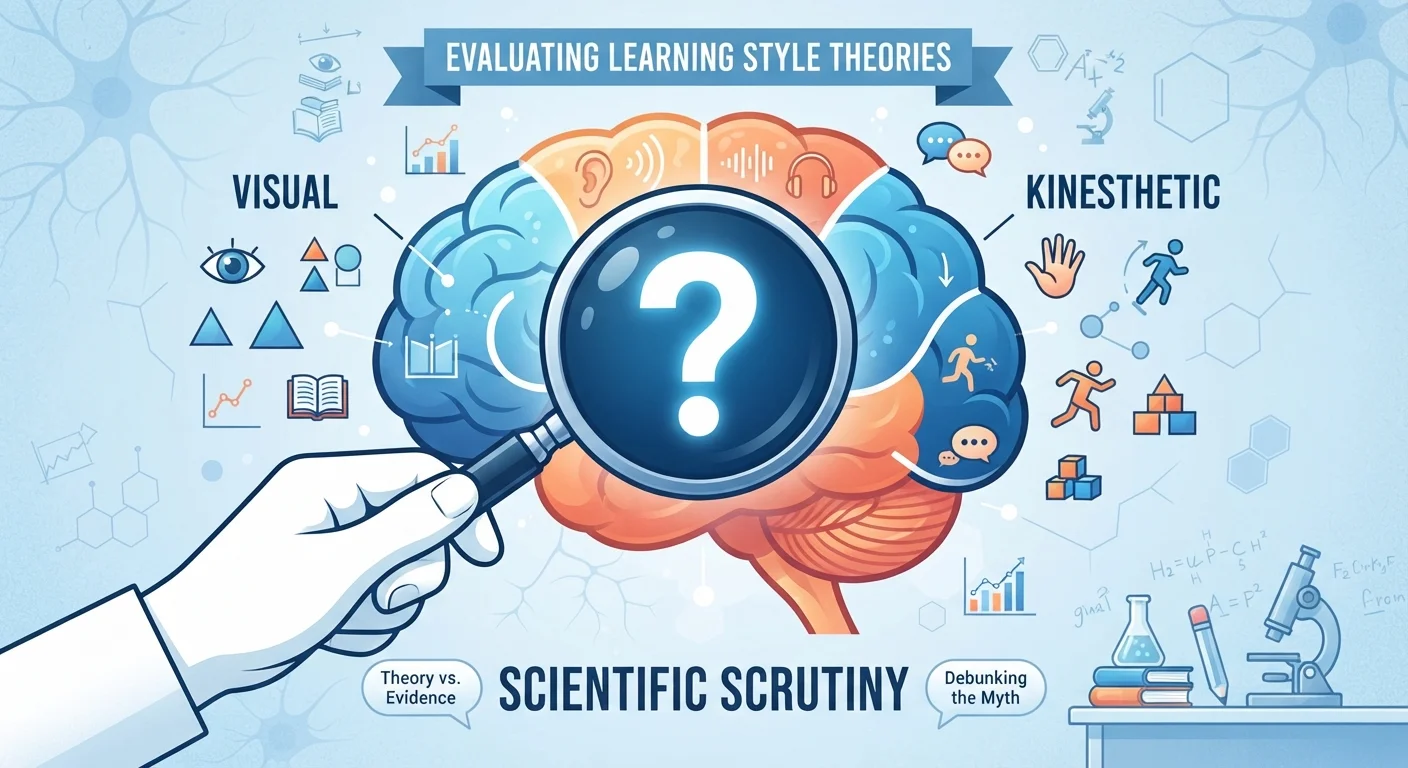
Where the Learning Styles Myth Comes From
The idea that each person is predominantly a visual, auditory, or kinesthetic learner—often called the VAK model—became enormously popular in education during the 1980s and 1990s. Schools embedded it into lesson planning, teachers received training around it, and countless students were told to identify their "type" as a key to academic success.
The concept is intuitive and appealing: if you struggle with dense textbooks, maybe you're just a hands-on learner. That framing feels validating. But validation and validity are not the same thing. Researchers began systematically reviewing the evidence base and found it wanting. A widely cited 2008 review by psychologists Harold Pashler and colleagues, published in Psychological Science in the Public Interest, concluded that the hypothesis—that instruction matched to a learner's preferred style produces better results—had not been supported by controlled studies.
Understanding why the myth persists is part of becoming a more self-aware learner. For a deeper look at how memory and cognition actually drive learning, see the cognitive principles behind self-directed learning.
Myth
Everyone has a fixed learning style—visual, auditory, or kinesthetic—and learns best when taught in that format.
Fact
Controlled research has not found that matching instruction to a preferred style meaningfully improves learning outcomes.
The "meshing hypothesis"—that aligning teaching to a student's learning style produces better results—has been tested in numerous controlled studies. Reviews of that literature, including the influential 2008 Pashler et al. analysis, consistently find that the evidence does not support the hypothesis. Preferences exist, but preferring a format is not the same as learning more effectively from it.
Myth
If you identify your learning style early, you can use it to succeed in any subject.
Fact
Narrowing yourself to one modality may actually limit your learning, since most complex subjects require multiple modes of engagement.
Learning mathematics, for example, involves reading symbols, working through problems by hand, visualizing graphs, and explaining reasoning aloud. No single modality covers all of that. Students who restrict themselves to one preferred format may skip the varied practice that builds genuine competence. A multi-modal approach—reading, doing, discussing, revisiting—tends to produce more durable understanding across domains.
Myth
The learning styles model is backed by extensive scientific research.
Fact
The model is widely used but is not strongly supported by peer-reviewed experimental evidence; education researchers classify it as a persistent myth.
Learning styles inventories have been developed and sold for decades, lending them an air of scientific authority. However, instruments like the VARK questionnaire measure preferences or tendencies, not learning capacity. When researchers attempt the critical test—does style-matched instruction outperform mismatched instruction on objective assessments?—the evidence consistently fails to confirm the model. Many researchers label VAK-style frameworks "neuromyths."
Myth
Struggling with a particular format (e.g., reading) means you're simply not that type of learner.
Fact
Difficulty with a format usually reflects skill level, prior knowledge, or content complexity—not a fixed neurological style.
Attributing struggle to a fixed learning type can discourage learners from developing skills in challenging but important formats. Someone who finds dense reading difficult may benefit from building vocabulary, background knowledge, or active reading strategies—not from avoiding text altogether. Growth in any domain typically requires working through initially uncomfortable formats, not routing around them.
Myth
Using learning styles in the classroom is harmless, even if the science is uncertain.
Fact
Labeling students with fixed style categories can create limiting expectations and steer them away from beneficial, varied instruction.
When students internalize a style label, they may self-select out of instructional formats they perceive as incompatible with their type. Teachers may also underinvest in delivering content in diverse ways. The practical cost is real: reduced exposure to varied, evidence-based strategies like retrieval practice, elaborative interrogation, and concrete examples—all of which have stronger empirical backing than style-matching.
What the Evidence Actually Supports
Decades of cognitive science research point toward strategies that benefit nearly all learners, regardless of any stated preference. Retrieval practice—testing yourself on material rather than re-reading it—consistently improves long-term retention. Spaced repetition (distributing study sessions over time) outperforms cramming. Interleaving different subjects or problem types in a single session builds more flexible understanding than blocked practice.
96%
Teachers who believe in learning styles
A 2012 survey of teachers across multiple countries found that roughly 96% endorsed the learning styles myth, illustrating how widespread the belief remains in practice.
~250%
Retention boost from retrieval practice
Research published in <cite>Science</cite> by Roediger and Karpicke (2006) found that self-testing dramatically outperformed repeated study in long-term retention of material.
0
Rigorous studies confirming the meshing hypothesis
The 2008 Pashler et al. review found no adequately controlled studies demonstrating that style-matched instruction outperforms mismatched instruction on objective learning measures.
Crucially, these techniques work because of how human memory is structured, not because of individual style differences. The brain consolidates information through repeated retrieval and meaningful connection-making—processes that apply universally. Preferences for how material is presented can influence enjoyment and initial engagement, but they don't appear to determine how deeply something is learned.
If you're building your own study system, a personal learning plan grounded in evidence will serve you far better than one organized around a single style label. And if terms like "interleaving" or "metacognition" are new to you, the glossary of self-directed learning concepts is a practical starting point.
Preferences Are Real; Fixed Styles Are Not
Having a preference for how information is presented is genuine and worth noticing—it can guide how you initially approach new material. But treating that preference as a fixed, defining trait can hold you back. The most effective independent learners stay curious about many formats and choose strategies based on what the evidence and the subject demand, not on a category they were assigned in middle school. Explore underused learning resources that span multiple modalities to expand your toolkit.