
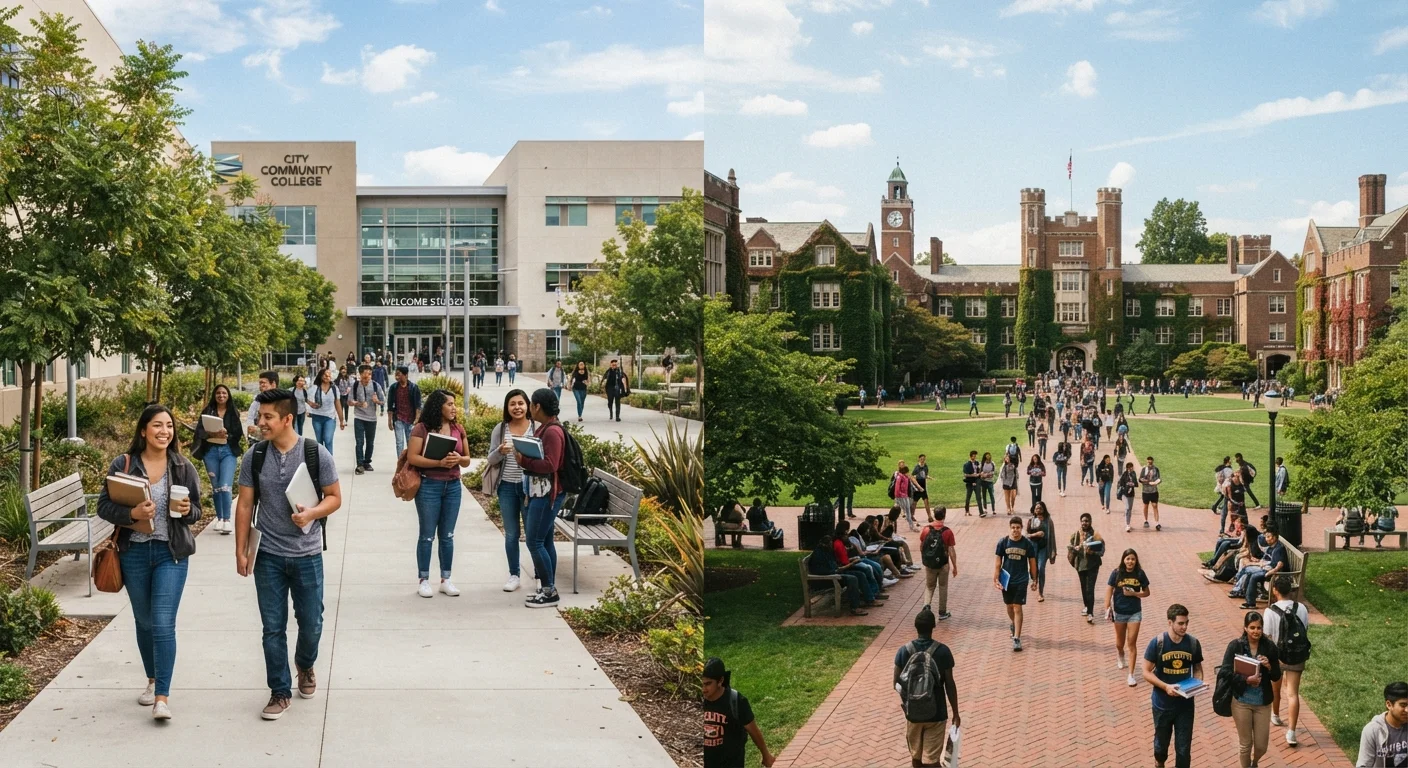
The Cost Difference Is Real — But Not the Whole Story
According to data from the College Board, the average annual tuition and fees at a public two-year college is roughly one-quarter of what students pay at a public four-year institution — and an even smaller fraction of private university costs. For students paying out of pocket or taking on loans, that gap compounds quickly over multiple years.
But cost isn't a single number. Factor in living expenses, opportunity costs, and the length of time to complete a degree, and the comparison becomes more nuanced. A student who starts at community college, transfers successfully, and completes a bachelor's degree in five total years may pay less overall than a student who stays four years at a university — or they may not, depending on aid packages and local housing costs.
For students weighing cost against institutional prestige, it's worth reading how in-state and out-of-state tuition compares beyond the sticker price, since that analysis applies equally when choosing between institution types.
| Criterion | Community College | Four-Year University |
|---|---|---|
| Average annual tuition (public) | ~$3,900 | ~$11,260 |
| Degree types offered | Certificates, Associate degrees | Bachelor's, Master's, Doctoral |
| Time to workforce credential | 1–2 years | 4+ years |
| Transfer pathway | Yes, with articulation agreements | N/A (starting point) |
| Campus resources | More limited | Broader (research, housing, clubs) |
| Class sizes | Generally smaller | Varies; large lecture common |
| Alumni network scale | Local/regional focus | National or global reach |
Transfer Pathways: Real Opportunity With Real Conditions
One of the most common plans among community college students is to complete general education requirements at lower cost and then transfer to a four-year university. Many states have formal articulation agreements — contracts between institutions that guarantee credit transfer for specific courses — making this pathway genuinely viable.
The catch: articulation agreements are not universal or automatic. Credits earned in non-transferable courses, or at institutions without a standing agreement, may not count toward your intended bachelor's program. Some students discover after transferring that they've lost a semester or more of credit. Before enrolling with a transfer plan, confirm which credits will move with you and under what conditions. Our article on how transfer credits are evaluated covers the key questions to ask.
Articulation Agreements Vary by State
Many states have statewide transfer frameworks — such as California's ASSIST system or Florida's Statewide Course Numbering System — that standardize which community college credits transfer to public universities. These agreements may not apply to private universities or out-of-state institutions. Always verify your specific transfer plan with an academic counselor at both institutions before enrolling.
It's also worth knowing that community colleges offer more than transfer prep. Certificate programs and associate degrees in applied fields — from dental hygiene to cybersecurity — are terminal credentials that lead directly to employment, not intermediate stops on the way to a bachelor's degree.
Academic Environment and Career Signal
Four-year universities typically offer larger research libraries, on-campus internship pipelines, and alumni networks built over decades. For careers where institutional prestige or research experience carries weight — academia, certain finance roles, selective graduate programs — the university environment can provide advantages that are difficult to replicate.
Community colleges, however, are increasingly recognized for strong vocational training, close faculty relationships, and ties to local employers. A growing body of research suggests that for many career outcomes, what you study and the skills you build matter more than where you studied. That said, some employers and graduate programs do screen by institution type, so it's worth researching norms in your specific field.
For students asking whether a formal credential is necessary at all, this comparison of self-directed learning and formal certification provides useful context on what each type of credential signals to employers.
43%
Share of US undergraduates at community colleges
The American Association of Community Colleges reports that community colleges enroll approximately 43% of all undergraduate students in the United States.
~$3,900
Average public two-year college tuition per year
According to the College Board's Trends in College Pricing report, average tuition and fees at public two-year colleges are significantly below those at four-year institutions.
80%
Community college students intending to transfer
Research published by the Community College Research Center found that roughly 80% of incoming community college students express intent to earn a bachelor's degree, though transfer and completion rates vary considerably.
If you're still deciding on a field of study, don't let that uncertainty force a premature institutional commitment. Choosing a major is a more flexible process than most students expect, and community college gives you room to clarify direction at lower financial risk.